World’s Biggest 4K 3D TV Debuts in China
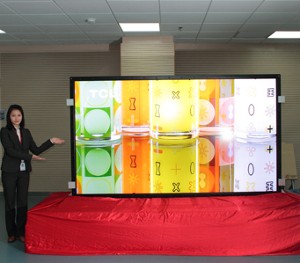 ...TCL—one of China’s biggest television makers—has upped the ante to 110 inches. The model features a 4K x 2K (4,096×2,160 pixels) resolution and supports 3D with active shutter glasses.
In addition, it’s a touch-screen TV with multi-touch technology and “an intelligent and dynamic backlight” which I assume is an LED backlight, but the press release didn’t specify. ...
So far the company has built at least two of the big TVs and donated them to The Great Hall of the People, a ceremonial government building at Tiananmen Square. ...
Read the full storyhere:
Pew Study: Most U.S. College Students Now Prefer Digital Reading
“Survey on Students and Tablets 2012” (PDF) polled 1,206 U.S. college students and 204 college-bound high school seniors. Some findings:
—College students prefer digital over print for “fun” reading (57 percent) and textbook reading (58 percent), “a reversal from last year, when more students preferred print over digital.” Pearson says the trend is also apparent among high-school seniors (though it doesn’t break out which format the majority prefer), “and is mostly driven by an increase in the preference to use tablets for reading.” The study doesn’t ask whether students are using tablets or e-ink e-readers for reading.
—A quarter of college students now own a tablet, compared to just 7 percent last year. Seventeen percent of college-bound high school seniors own a tablet, compared to four percent last year.
—Thirty-five percent of college students who own a tablet also own “an e-book reader or small tablet device.” (Not sure what a “small tablet device” is! Asking Pearson.)
—Among college students who own tablets, the iPad is the most popular (63 percent), followed by the Kindle Fire (26 percent) and Samsung Galaxy Tab (15 percent).
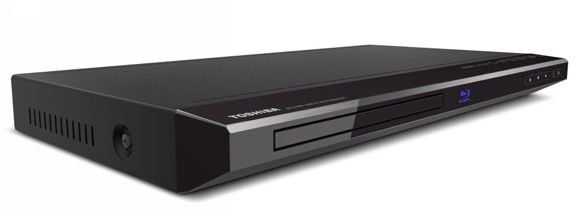
Get a Toshiba 3D Blu-ray player for $62.99
[CNET]
The BDX4150 is new, not refurbished, and that price includes shipping. In addition to 3D, it supports streaming from services like Netflix.
See the full story here:
Google’s latest search may cause it to stray
[Philip Lelyveld comment: My CES 2012 meeting with the head of Vuzix, which makes heads-up and head mounted displays for 3D viewing and augmented reality, was delayed for an hour because Sergy Brin and his R&D team were in deep technical discussions in the Vuzix booth.]
...According to Rob Enderle, the principal analyst at Enderle Group, "The project appears to be connected to virtual-reality glasses, which initially will add [images] - like virtual signs including ads, names, street, address, company, resident - to physical things dynamically and eventually change what we see. Think of shifting clothing or people to an older age or another planet." ...
This would leave the way open for Google to fast-track the development of entirely new 21st-century technologies and products. The optical technology being developed at Project X could underpin a wide range of consumer devices allowing 3D representation. "Android@home" could, for instance, be used eventually to stream not only audio but also 3D images around the home. ...
See the full story here:
Just for Laughs—Funny but Definitely Flimsy Souvenir From Famous World Heritage Site
 The souvenir that is attracting attention is a kind of postcard sold by local vendors in Machu Picchu. And it’s no ordinary postcard. We interviewed a Japanese tourist who visited Machu Picchu to hear about it.
According to the tourist, “Local vendors at Machu Picchu suddenly come to sell you postcards on the street, but what makes these postcards different is that your picture is pasted on them.”
What is happeing here is that local vendors are arbitrarily taking pictures of visitors and pasting the pictures on regular postcards of Machu Picchu to sell to the unsuspecting visitors.
See the original story here:
Bourne’s Swan Lake prepares to go 3D in over 200 US theaters
... When Bourne's distinctive, testosterone-heavy flock swoops in Tuesday to some 220 theaters across the U.S., it will be only the second time a full ballet is presented in 3D, after “Giselle” last year. ...
For NCM Fathom, which is presenting the screenings along with More2Screen, Bourne's “Swan Lake” was a particularly apt choice to introduce more people to 3D ballet — a concept it obviously hopes will take off. Future screenings are planned for other countries.
“This particular version has some very special qualities about it,” says Dan Diamond, senior vice president of NCM Fathom Events. He adds that of all the art forms, ballet fans have responded the most enthusiastically to the concept of 3-D, according to the company's research and its pilot screenings last summer of “Giselle,” another classic.
“First of all, ballet on a big screen is beautiful,” Diamond says. “What 3D does is accentuate the nuances — the depth of field, the height of jumps. It just brings the audience closer. Our goal isn't to use 3D as a gimmick, but to enhance the experience.”
Bourne says he initially feared it could feel gimmicky, but was delighted with how it all came out. And, he adds, imagine the possibilities.
“The potential for the performance of dance is thrilling,” he says.
See the full story here
“Think in 3D” – A 3D Production Book For More Quality 3D Movies
“Think in 3D” is a book by Clyde De Souza. For those not familiar with this name and person, he is an expert in the 3D stereoscopic technology. He is also a partner of the Real vision company based in UAE. He has been the judge for the Digital studio Awards that recently had its eight innings.
The book is primarily meant for the directors and cinematographers as also film school graduates. The book draws their attention on the present cult of 3D which has moved from just movies to the TV scenario. These makers of 3D have therefore to think in that format and their picturing needs to be mended accordingly.
... There is the digital format of the book for Kindle, iPad and iPhone also available while the hardcover can be ordered from Amazon.
See the full story here:
New Technique Lights Up the Creation of Holograms
 A red apple with green leaves -- it seems real enough to pick up in one's hand, but there is nothing there to actually touch. This is because the apple is a hologram, a three-dimensional image projected by light. In April 2011, Chief Scientist Satoshi Kawata of RIKEN, the head of the Nanophotonics Laboratory at the Advanced Science Institute in Wako, along with his colleague Miyu Ozaki, a visiting scientist of RIKEN, succeeded in developing a novel holography principle distinct from conventional methods which makes it possible to reconstruct a full-color three-dimensional object. The key to their success resided in superposing a thin silver film on which surface plasmons -- collective oscillations of free electrons within a metal -- were excited. In recent years, research on surface plasmons has rapidly expanded against a background of remarkable advances in nanotechnology, helping establish the subject as a field of engineering. In addition to holograms, Kawata has also undertaken groundbreaking research on surface plasmon applications in metallic nano-lens technology. ...
"The key to successfully extracting RGB separately from white light resides in superposing a thin silver film onto light-sensitive material. In doing so, surface plasmon polaritons (SPPs) are excited on the thin film," says Ozaki. ...
Read the full story here;
Oreo: 3D
 1952 | First 3D movie
This year, OREO turns 100 years young.
Celebrate the kid inside at oreo.com/birthday.
Advertising Agency: Draftfcb, USA
Executive Creative Director: Darren Moran
Creative Director: Megan Williams
Group Creative Director: Jill Applebaum
Creative Director / Art Director: Megan Sheehan
Copywriters / Art Directors: Jill Applebaum, Bob Neuman
Executive Producer: Anthony Nelson
Photographer: Richard Pierce
Concept: Pierre-Marie Faussurier, Sebastien Zanini
Designers: Yego Moravia, Johnny Por Taing, Bangwool Han
Art Producer: James Kozyra
Published: March 2012
See the original post here: