3D PRODUCTION GUIDE (free download)
3net released its free 50 pages "3D Production Guide" in pdf format together with Sony Pictures Entertainment, IMAX, and Discovery. This guide was written for the producers of 3D content for television. Its goal is to help prepare them as they plan for and create a 3D program.
- Introduction
- Planning a 3D workflow
- 2D to 3D conversion
- Production and specific tools
- stereoscopic displays.
- 3D picture errors and discomfort
- postproduction
- Masters delivery of the masters
- Glossary
Download it for free here: http://press.discovery.com/media/ugc/press/3DTV-Production-Guide_3net.pdf
Perceiving in Depth, Volume 2: Stereoscopic Vision (Oxford Psychology Series) [Hardcover]
The three-volume work Perceiving in Depth is a sequel to Binocular Vision and Stereopsis and to Seeing in Depth, both by Ian P. Howard and Brian J. Rogers. This work is much broader in scope than the previous books and includes mechanisms of depth perception by all senses, including aural, electrosensory organs, and the somatosensory system. Volume 1 reviews sensory coding, psychophysical and analytic procedures, and basic visual mechanisms. Volume 2 reviews stereoscopic vision. Volume 3 reviews all mechanisms of depth perception other than stereoscopic vision. The three volumes are extensively illustrated and referenced and provide the most detailed review of all aspects of perceiving the three-dimensional world.
Volume 1 reviews sensory coding, psychophysical and analytic procedures, and basic visual mechanisms.
Volume 2 deals with stereoscopic vision.
Volume 3 covers all mechanisms of depth perception other than stereoscopic vision. Together, these three volumes provide the most detailed review of all aspects of perceiving the three-dimensional world.
| Price: | $205.22 |
See the original post here: at Amazon.com
3D HDR (HIGH DYNAMIC RANGE) IS COMING
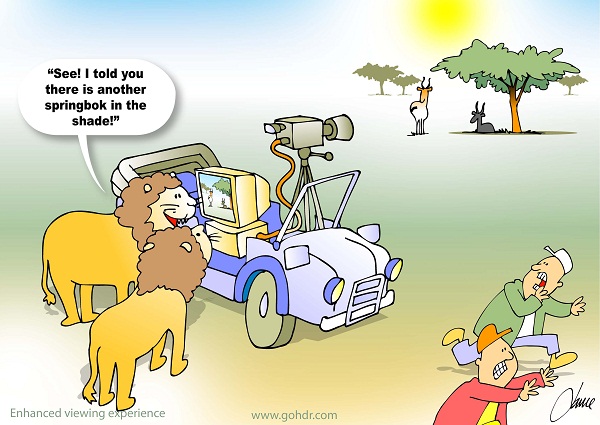
What is 3D-HDR ?
Traditional imaging techniques are incapable of capturing accurately or displaying the wide range of lighting in the real world. Some areas may be under-exposed and others over-exposed. High Dynamic Range (HDR) imaging technologies are an exception: HDR can capture and deliver a wider range of real-world lighting to provide a significantly enhanced viewing experience.
3D Stereoscopy, on the other hand, is an imaging technique which enables or improves the illusion of depth by presenting two offset images to each of the viewer’s eyes. It has been shown to provide a strong cue for distance judgements and is capable of improving task performance.
3D-HDR, also known as Stereoscopic High Dynamic Range (SHDR), has the potential of bringing these diverse technologies together, exploiting the advantages of both. This novel imaging method with an unprecedented level of realism has the potential to deliver both improved depth perception and a realistic representation of the scene lighting.
Read the full post here:
Go to the source page here:
Acoustic3D takes sound to the third dimension

Following 21 years of research and development, Acoustic3D’s founder and managing director, Joe Hayes, has transformed the concept of 3D sound into a range of 70 watt ‘acoustic hologram generators’, as he prefers to call them. ...
Hayes said, “It works by removing the immediate environments acoustics – it negates this room and stops all echoes – and then unpacks the acoustics and space within the recording itself.”
During a brief test drive, we found that it is able to produce a contextual experience based on the environment of the recording.
For example, during a sound clip of a neighbourhood park, its depth of field allowed us to distinguish between nearby chatter, distant birds, and passing vehicles, and with an opera song, it generated a concert-like feel, as if we were at a performance. ...
Read the full story here:
Mad rush to market hurt 3D TV sales, prices are stabilising, claims CES VP
In the frantic rush to get 3D TVs out onto the market, leading suppliers made mistakes that led to disappointing sales results, according to Brian Markwalter, the senior vice president, research and standards, of the Consumer Electronics Association, the industry group that organises the annual CES conference in Las Vegas.
In Sydney to speak at the Australia Broadcasting Summit and to promote the 2013 International CES, Markwalter said the extreme competitiveness of the major suppliers compelled them to act too quickly, resulting in confusion and a lack of a clear message about 3D.
“Because it’s such a competitive industry, once they all know what the other one was doing, they all rushed headlong into 3D — and then the reality hit: we need content, we need glasses, we need retailers to understand how to show this stuff,” Markwalter told Current.com.au.
As a result of this passionate intensity, the hype surrounding 3D outweighed the ability of the suppliers to deliver hardware, a problem exacerbated by the paucity of native 3D content at the time. Markwalter used the phrase “over amplified” to describe the prevailing sentiment.
When asked for specific errors made by the major suppliers, Markwalter identified a lack of standardisation across the category, ...
Read the full story here:
Augmented reality set to enhance London Eye’s pods
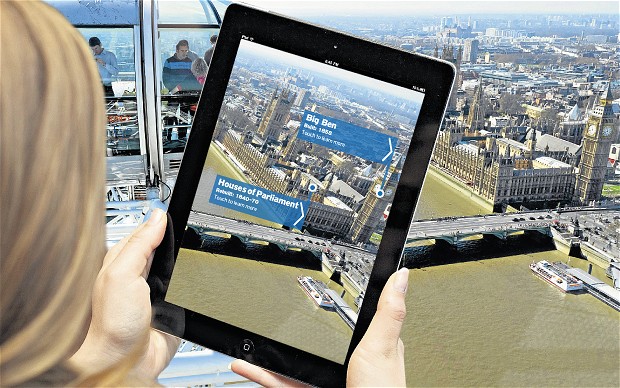
Visitors to the London Eye will, from next month, be able use a new app for tablets and phones based on Google’s Android operating system, and subsequently for Apple’s iPhones and iPads.
The app works by enabling users to “see” right through the bottom of the Eye capsule to the Thames below. The aim is to enhance the sense of being above London, rather than being stuck inside a pod. On-screen information tells users about the workings of the Eye itself, and about the sites you can see as you point your phone’s camera towards them. To further promote the app, there are audio guides from three perspectives and in five languages. Wi-Fi, too, will be free for all in the area around the Eye itself. ...
Yesterday supermodel Helena Christensen was at Selfridges, in London, to unveil the “Fantasy Mirror” in association with lingerie brand Triumph. The company plans to do away with the need for shoppers to try on clothes by deploying a full-size high-resolution TV screen to give the illusion of standing in front of a mirror in a changing room. Motion sensors scan anyone standing directly in front of it, and infra-red technology creates what the company describes as “a highly accurate 3D reconstruction of the environment”. It says “the camera tracks the viewers’ body which is then translated on to the screen as a 3D silhouette of a female avatar that moves in real time to the viewers’ own motion”. ...
Read the full story here:
Hugo Blu-ray 3D Review
The Picture
In the post-World-War-I era of Hugo, film is exalted as one of the great spectacles of its day, and now Scorsese has echoed that same spirit of technology and showmanship by making this his first film shot in 3D. The results are outstanding, with an appreciable depth in most scenes, particularly the bustling locales of the train station. Subtle successful touches are layered in, sprays of dust and so on, and we may find ourselves tempted to bat away the frequent snowflakes.
Computer-generated effects are heavily employed, and here too a strong, credible dimensionality is displayed, as in the Parisian cityscape. This was also Marty's first movie to be capture digitally and the 16:9 image has a gorgeous clarity, right down wrinkles and pores and the faintest glint of perspiration. There's a pleasing, filmic warmth thankfully, and an intoxicating color palette.
...
Read the full review here:
Making Stuff: 3D Printing on Campus [Campus Technology]
... He'll be teaching a course in the fall, "Elementary Science Methods," to pre-service teachers. As part of that he'll be introducing them to the inclusion of engineering in their science lessons. As a result of theNational Research Council developing a national framework for K-12 science standards, he says, "One of the things that's happening in science education is that there's a big emphasis on including engineering in science classes."
3D printing fits well, Meadows explains, in a scenario where the student is "designing something, testing it, learning, recording information, going back and redesigning. It's really a great way to do problem solving." ...
The fascination instructors have with the MakerBot recalls an era when humans did more for themselves, muses Meadows. "Like we used to do with our cars. You'd go in and take things apart and fix things. With computerization it's difficult to do that. Now we're getting back to the idea of making something, building something, testing it, fiddling around with it, and rebuilding it. It goes back to that hands-on DIY ethic." ...
Read the full story here:
Panasonic Bringing Star Wars 3D Home This Year
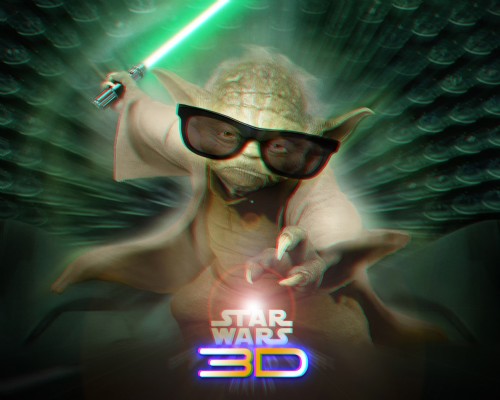 Up front: Don’t get too excited because it’s only The Phantom Menace…
See the full story here
Bang + Olufsen BeoVision 12-65 3D TV hits North America in March for $11,350
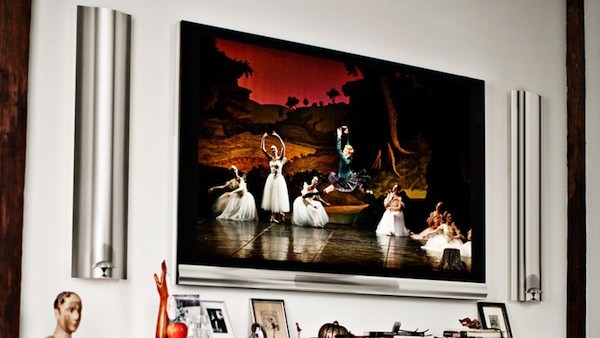 The TV comes with the latest in plasma technology offering an even greater experience in both 2D and 3D. The panel is a NeoPDP panel, which includes new phosphors with a very short retention time, which allows for an improved 3D performance and a much better motion performance in a 2D viewing situation.
BeoVision 12-65 also comes with Automatic Color Management to compensate for the effects of aging that is common for the plasma technology. For BeoVision 12-65, the robotic arm featuring a camera is located underneath the screen, hidden behind the loudspeaker grill.
See the original press release here