Meta’s Open-Source ImageBind Works Across Six Modalities
Meta Platforms has built and is open-sourcing ImageBind, an artificial intelligence that combines six modalities: audio, visual, text, thermal, movement and depth data. Currently a research project, it suggests a future in which AI models generate multisensory content. “ImageBind equips machines with a holistic understanding that connects objects in a photo with how they will sound, their 3D shape, how warm or cold they are, and how they move,” Meta says. In other words, ImageBind’s approach more closely approximates human thinking by training on the relationship between things rather than ingesting massive datasets so as absorb every possibility. ...
See the full story here: https://www.etcentric.org/metas-open-source-imagebind-works-across-six-modalities/
and here https://arxiv.org/abs/2305.05665
How AI Knows Things No One Told It
... A growing number of tests suggest these AI systems develop internal models of the real world, much as our own brain does, though the machines’ technique is different. ...
The code for these programs is relatively simple and fills just a few screens. ...
Few had expected a fairly straightforward autocorrection algorithm to acquire such broad abilities. ...
Although an LLM runs on a computer, it is not itself a computer. It lacks essential computational elements, such as working memory. ... Instead he hypothesizes that the machine improvised a memory by harnessing its mechanisms for interpreting words according to their context—a situation similar to how nature repurposes existing capacities for new functions. ...
Researchers marvel at how much LLMs are able to learn from text. ... When they see the word “red,” they process it not just as an abstract symbol but as a concept that has certain relationship to maroon, crimson, fuchsia, rust, and so on. ...
By the time you type a query into ChatGPT, the network should be fixed; unlike humans, it should not continue to learn. So it came as a surprise that LLMs do, in fact, learn from their users’ prompts—an ability known as “in-context learning.” “It’s a different sort of learning that wasn’t really understood to exist before,” says Ben Goertzel, founder of the AI company SingularityNET. ...
Entire websites are devoted to “jailbreak” prompts that overcome the system’s “guardrails”—restrictions that stop the system from telling users how to make a pipe bomb, for example—typically by directing the model to pretend to be a system without guardrails. Some people use jailbreaking for sketchy purposes, yet others deploy it to elicit more creative answers. ... [PhilNote: this is how writers will use AI to write better plots involving stopping clever bad guys.] ...
See the full article here: https://www.scientificamerican.com/article/how-ai-knows-things-no-one-told-it/
USC launches $1B+ computing initiative including AI, AR, VR, robotics, gaming and blockchain
Seeded with a USD $260 million gift from the Lord Foundation of California, USC stated that the Frontiers of Computing initiative encompasses a multipronged effort to push the boundaries of computing into a new era, and includes:
- A new school: The USC School of Advanced Computing will be headquartered in a seven-story, 116,000 square-foot facility – the Dr. Allen and Charlotte Ginsburg Human-Centered Computation Hall. The building, now under construction, will formally open in fall 2024.
- Recruitment: 30 new faculty will be hired in the first three years who are leaders in computer science and computing-based research, with USC aiming to hire 60 additional faculty and staff by 2030. USC noted that the new faculty members will hold appointments in multiple schools at USC in recognition that computational methods, particularly AI, are transforming the way people live and work.
- Economic impact: USC Frontiers of Computing will help to bolster the university’s influence on technology across various industries and expand its footprint in Silicon Beach on L.A.’s West side, which already is home to two of USC’s tech incubators; the Information Sciences Institute and Institute for Creative Technologies. USC currently has a USD $9 billion economic footprint in the L.A. area, according to a study in 2017, and its impact is expanding to the East Coast, with the new USC Capital Campus in Washington, D.C.
- ...
- See the full story here: https://www.auganix.org/vr-news-usc-launches-1b-computing-initiative-including-ai-ar-vr-robotics-gaming-and-blockchain/?utm_campaign=Weekly%20Spatial&utm_medium=email&_hsmi=258092762&_hsenc=p2ANqtz-8-9-NTsJH8XMJ406Y0UhJFaGV_AWeprKJ3D_ovoyhlkSSgeS-nqLw_oFvgFcyfxYMifE8k1dnwk91wg30qvs-24FTzXw&utm_content=258092762&utm_source=hs_email
Learn more about it here: https://computing.usc.edu
AI startup Anthropic wants to write a new constitution for safe AI
...
“We really view it as a starting point — to start more public discussion about how AI systems should be trained and what principles they should follow,” he says. “We’re definitely not in any way proclaiming that we know the answer.”
This is an important note, as the AI world is already schisming somewhat over perceived bias in chatbots like ChatGPT. Conservatives are trying to stoke a culture war over so-called “woke AI,” while Elon Musk, who has repeatedly bemoaned what he calls the “woke mind virus” said he wants to build a “maximum truth-seeking AI” called TruthGPT. Many figures in the AI world, including OpenAI CEO Sam Altman, have said they believe the solution is a multipolar world, where users can define the values held by any AI system they use. ...
Kaplan says he agrees with the idea in principle but notes there will be dangers to this approach, too. He notes that the internet already enables “echo-chambers” where people “reinforce their own beliefs” and “become radicalized” and that AI could accelerate such dynamics. But he says, society also needs to agree on a base level of conduct — on general guidelines common to all systems. It needs a new constitution, he says, with AI in mind.
See the full story here: https://www.theverge.com/2023/5/9/23716746/ai-startup-anthropic-constitutional-ai-safety?mc_cid=5f64fee337&mc_eid=f55a714a2f
In global rush to regulate AI, Europe Union rules set to be trailblazer
...
It’s possible that industry will push for more time by arguing that the AI Act’s final version goes farther than the original proposal, said Frederico Oliveira Da Silva, senior legal officer at European consumer group BEUC.
...
He noted that ChatGPT only launched six months ago, and it has already thrown up a host of problems and benefits in that time.
If the AI Act doesn’t fully take effect for years, “what will happen in these four years?” Da Silva said. “That’s really our concern, and that’s why we’re asking authorities to be on top of it, just to really focus on this technology.”
See the full story here: https://www.pbs.org/newshour/world/in-global-rush-to-regulate-ai-europe-union-rules-set-to-be-trailblazer
TikTok users in China to flag AI-generated content
Beijing, May 9 (EFE).- Douyin, the Chinese version of social media application TikTok, published guidelines Tuesday regarding content generated by artificial intelligence that include the requirement to mark material generated by artificial intelligence as such.
Users will be able to “distinguish between what is virtual and what is real,” the company said in a statement published in one of its official Douyin accounts, adding that “publishers are responsible for the consequences of content generated by artificial intelligence”.
The video platform said “it is prohibited to use artificial intelligence to create and publish content that infringes, among others, image and intellectual property rights” and that “the creation and publication of material that misinforms or spreads hoaxes”.
Chinese police recently launched an investigation into a news portal that used popular artificial intelligence software ChatGPT to generate and spread fake articles to gain large amounts of traffic and profit. ...
See the full story here: https://www.laprensalatina.com/tiktok-users-in-china-to-flag-ai-generated-content/
AI gains “values” with Anthropic’s new Constitutional AI chatbot approach
On Tuesday, AI startup Anthropic detailed the specific principles of its "Constitutional AI" training approach that provides its Claude chatbot with explicit "values." It aims to address concerns about transparency, safety, and decision-making in AI systems without relying on human feedback to rate responses.
Claude is an AI chatbot similar to OpenAI's ChatGPT that Anthropic released in March. ...
The company has published the complete list on its website. ...
Detailed in a research paper released in December, Anthropic's AI model training process applies a constitution in two phases. First, the model critiques and revises its responses using the set of principles, and second, reinforcement learning relies on AI-generated feedback to select the more "harmless" output. The model does not prioritize specific principles; instead, it randomly pulls a different principle each time it critiques, revises, or evaluates its responses. "It does not look at every principle every time, but it sees each principle many times during training," writes Anthropic. ...
But even the most impartial observer cannot help but notice Anthropic's constitutional selections reflect a decidedly progressive angle that might not be as universal as Anthropic hopes. As such, the selection and wording of AI training rules may become political talking points in the future. ...
It's worth noting that, technically, a company training an AI language model using Anthrophic's technique could tweak its constitutional rules and make its outputs as sexist, racist, and harmful as possible. However, the company did not discuss that prospect in its announcement. ...
See the full story here: https://arstechnica.com/information-technology/2023/05/ai-with-a-moral-compass-anthropic-outlines-constitutional-ai-in-its-claude-chatbot/
New research aims to bring odors into virtual worlds
... Yu and his co-author, Yuhang Li of Beihang University in Beijing (both of whom have backgrounds designing flexible electronics), developed two wearable interfaces. One can adhere to the skin between the nose and mouth like a bandage; the other straps on beneath a headset like a face mask.
Both types of interfaces use miniaturized odor generators, a grid of tiny containers filled with perfumed paraffin wax. When a heat source beneath the wax is activated, the wax heats up, essentially becoming a scented candle capable of reproducing multiple odors within 1.44 seconds, according to Yu and Li. When the experience is over, a copper coil kicks a magnet to tamp down on the wax and cool down, ending the scent. ...
See the full story here: https://www.technologyreview.com/2023/05/09/1072731/vr-smell/https://www.technologyreview.com/2023/05/09/1072731/vr-smell/
Niantic’s New Peridot Virtual Pet Is a Test Vehicle for the Future of AR, AI and Shopping
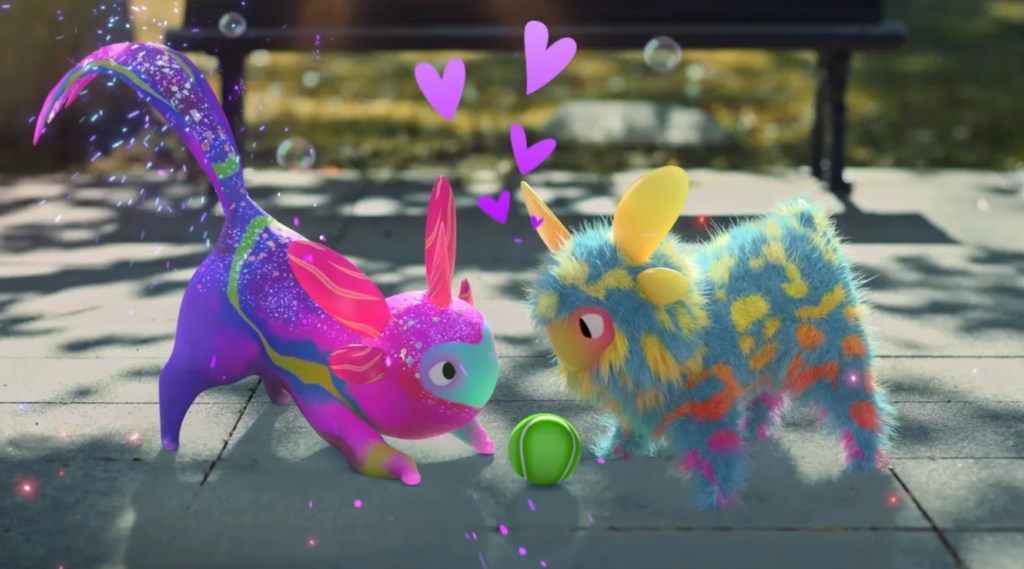
I'm playing fetch with my bubbly little green-and-black virtual pet, a fuzzball my kid and I called Leopard because it looks like a leopard. I toss a virtual tennis ball by tapping my phone screen and see the ball bounce off the floor and armchair, and Leopard looks like he's chasing after it. This is all on my phone, using the same type of augmented reality tech that's been around for years on apps like Pokemon Go. For Niantic, the makers of Pokemon Go, it's also a prototype for where the company sees itself in a future world of AR glasses that may arrive sometime in the next decade. Did I mention that it's also the debut of a new Amazon shopping service, too?
That's a lot of pressure on a little cuddly virtual pet. Peridot, a free app that's available now on Android and iOS, really is more like an AR-enabled Tamagotchi. ...
It's how the Peridot interacts with the world that's unique. The game maps surroundings instantly using the phone's rear camera, knows to navigate obstacles, and can jump on tables or seem to run behind things. That's the sort of tech Apple has leaned on its lidar sensor on iPhones to accomplish, but it happens on a wider range of phones seamlessly here. ...
Just add Amazon?
Then there's the merchandise, which is where things get weird. This pet game is the debut of a new Amazon service called Amazon Anywhere, which adds a built-in store for real-life merchandise that's based on Peridot....
Like any free-to-play game, it's full of optional paid microtransactions. Amazon Anywhere's additional merchandise store doesn't overlap with any of Niantic's virtual product sales right now, but could it someday? Amazon is focused on the physical retail angle at the moment. But augmented reality is a fluid and fast-moving space, and it's unclear how any of it will evolve. ...
See the full story here: https://www.cnet.com/tech/services-and-software/niantics-new-peridot-virtual-pet-is-a-test-vehicle-for-the-future-of-ar-ai-and-shopping/
AI’s Ostensible Emergent Abilities Are a Mirage
... “With bigger models, you get better performance,” he says, “but we don’t have evidence to suggest that the whole is greater than the sum of its parts.”
Indeed, as he and his colleagues Brando Miranda, a Stanford PhD student, and Sanmi Koyejo, an assistant professor of computer science, show, the perception of AI’s emergent abilities is based on the metrics that have been used. “The mirage of emergent abilities only exists because of the programmers' choice of metric,” Schaeffer says. “Once you investigate by changing the metrics, the mirage disappears.” ...
In the paper published April 28 on preprint service arXiv, Schaeffer and his colleagues looked at 29 different metrics for evaluating model performance. Twenty-five of them show no emergent properties. Instead, they reveal a continuous, linear growth in model abilities as model size grows. ...
What it means for the future is this: We don’t need to worry about accidentally stumbling onto artificial general intelligence (AGI). ... “but if it emerges, we should be able to see it coming.”
See the full story here: https://hai.stanford.edu/news/ais-ostensible-emergent-abilities-are-mirage
Pages
- About Philip Lelyveld
- Mark and Addie Lelyveld Biographies
- Presentations and articles
- Trustworthy AI – A Market-Driven approach
- Tufts Alumni Bio