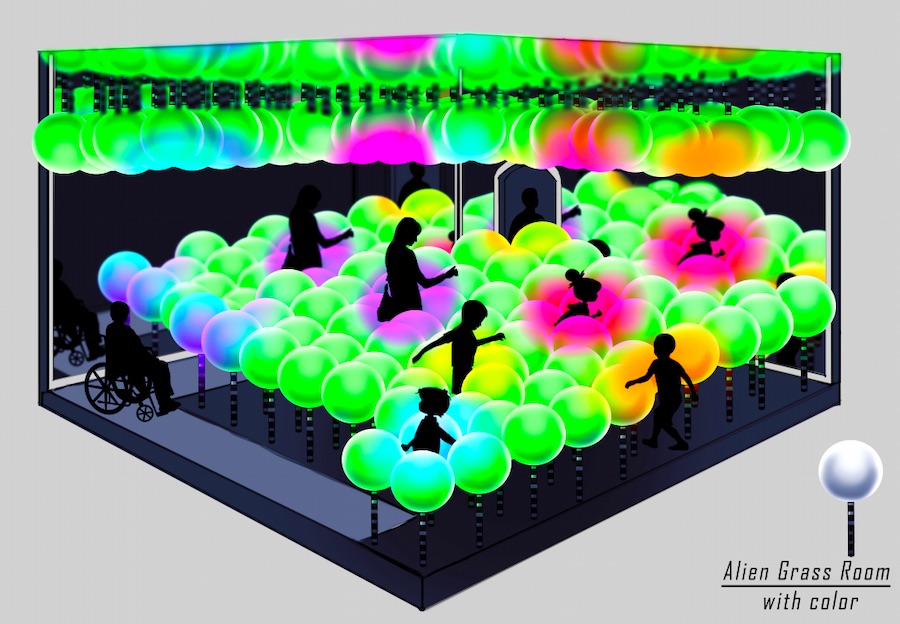
An innovative, tech-driven art experience focusing on science and space and presented as an ‘intergalactic playground’, Seismique is the brainchild of Steve Kopelman, COO of Escape the Room, the largest escape room company in the US.
“Just under 10 years ago, I tried to do a haunted house that would track people through it using RFID to give a personalised experience. So, when you went into a room, we would pull pictures from your Facebook account. You gave us permission, of course – and that room in that haunted house would be your family and friends.”
“Seismique will be 40 different areas, which is significantly more than TeamLab. Our space is smaller, but we still have almost an acre of indoor space for installations.
“While we won’t have as much of the projection mapping that they utilise, we will be using interactive projection mapping, sculpture, paintings. Everything has to have some kind of immersive, interactive part to it. It must also have content.”
Kopelman wants Seismique to be a positive force in the community and will be incorporating a strong science, technology, engineering, arts and mathematics (STEAM) programme. He plans to offer educational workshops for students from local schools and featuring private event spaces.
“We’ll have artists throughout the US,” says Kopelman. “And we’ve reserved at least a quarter of the spaces for Texans and people from our community.
“We have a really strong technology team. It’s a company that I’ve worked with since we started the escape room: Smooth Technology.”
Smooth Technology, a Brooklyn-based team of artist engineers, has developed visual experiences including the wireless LED costumes for Taylor Swift’s ‘1989’ World Tour. It numbers Lady Gaga, Nicki Minaj, Google and MoMA among its clients:
“When I grew up, the goal was to get a Rolex, or whatever the current status symbol happened to be. Now, it’s the experience, whether it’s watching the sunrise at Machu Picchu, or experiencing an immersive artwork.”
“I think we’re going to tie in well with the experience economy. Especially if we let the artists be artists and do their thing, and give what they feel.
“Additionally, we are constantly analyzing our throughput to best ensure social distancing for the future. ... We are still targeting a 4th quarter 2020 opening and look forward to presenting an experience that is both safe and phenomenal."
“Imagine watching your favorite artists in space, not a stage — with absolute freedom to get as close as you want,” Prokhorov said in an email to Forbes. “VR is a new form of art.”
The platform, called Sensorium Galaxy, is scheduled to launch in the first half of 2021. But there are still many unknowns. The company says it has attracted $100 million in investments from entertainment companies, but would not disclose the names of any investors. Despite claiming that it has “great artists onboard,” the company did not disclose which musicians or bands have signed on.
The pandemic has also impacted Sensorium Galaxy’s timeline, with “minor delays in terms of development,” says Matias Lapushin, a spokesperson for the company. “We have a huge [motion capture studio] where we virtually recreate artists in VR, but the crisis has obviously prevented us from doing so these past few months.
Sensorium, founded by Prokhorov in 2018, is registered in the Cayman Islands, with offices in Moscow, Zurich and Los Angeles. It owns a 27% stake in Redpill VR, a Los Angeles-based tech company that is also using virtual reality for entertainment events.
Prokhorov ran against Vladimir Putin as president for Russia in 2012, winning 8% of the vote. And he’s the only oligarch to have appeared on The Daily Show with Stephen Colbert.
The benefits of augmented reality are even clearer when supported by examples of how it contributes to agriculture optimization. Below are some interesting augmented reality farming applications.
Cattle Farmers Use AR for Smart Farming
As a new smart farming technology, AR has a lot to offer to cattle farmers. Combined with smart sensors, it enables farmers to mark a particular animal and regularly check on it. For instance, if one of the cows in the herd is sick, farmers can get automatic notifications about the animal’s condition.
Coupled with all-in-one herd monitoring solutions like Nedap CowControl, AR tools deliver relevant information directly in front of the farmers’ eyes and enable them to act on the spot and make timely decisions.
Augmented Reality Helps Farmers Discover New Opportunities
In farming, there’s simply no room for trial and error, and many farmers are often wary of implementing disruptive solutions. Smart technology in farming seems too abstract and irrelevant. For example, in Africa, farms were in dire need of agriculture irrigation optimization, but farmers were highly reluctant to adopt it because they didn’t believe in its potential. By using AR, irrigation engineers managed to convince local farmers that adopting new irrigation technology will help them improve crop yields.
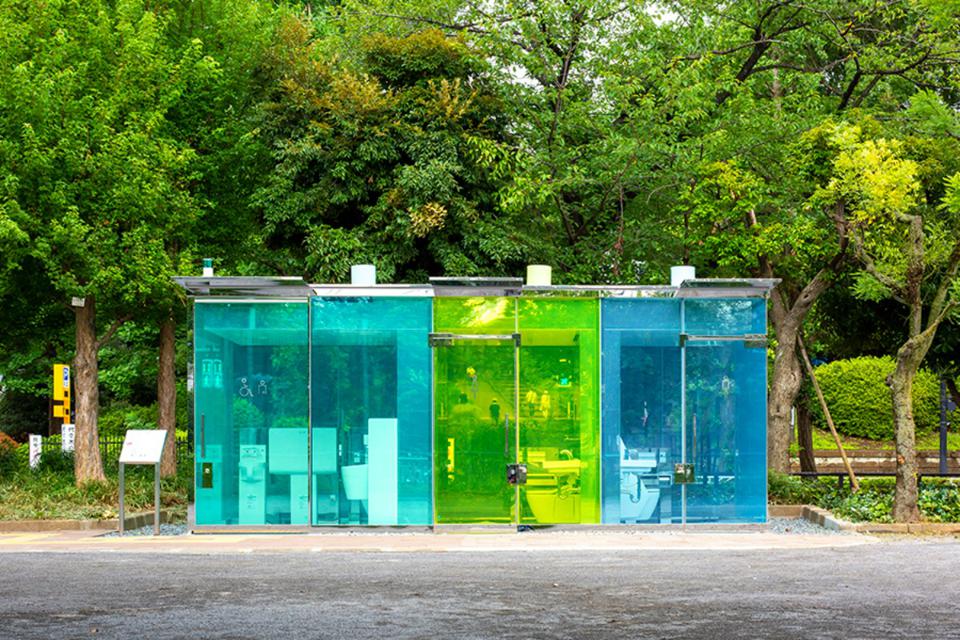
“There are two concerns with public toilets, especially those located in parks,” explains The Nippon Foundation, the non-profit organization. “The first is whether it is clean inside, and the second is that no one is secretly waiting inside.”
The design relies on a new smartglass technology that turns the walls opaque when the door is locked. “At night, they light up the parks like a beautiful lantern,” according to The Nippon Foundation.
In the middle of this flurry of business negotiations and political rhetoric, TikTok has announced plans to build a $500m (£375m) data centre in Ireland, where it will store videos, messages and other data generated by European users from the short-form video-sharing app. Mayer has also issued an 800-word defence of the TikTok which stated that without the platform, US advertisers “would again be left with few choices”, dismissing Instagram Reels, a new video service from Facebook that will launch in the US in early August, as a “copycat product”. More recently, Mayer has been instrumental in allocating a $200 million fund to support “ambitious American creators who are seeking to turn content creation into their livelihoods”, adding that the fund is likely to grow to a staggering $1 billion in the U.S. over the next three years, and will total more than $2 billion globally within that timeframe.
All of which demonstrates the kind of coolness under fire that has rarely been exhibited since the days of FDR and Churchill during the darkest days of World War II.
Generative Pre-trained Transformer 3 (GPT-3) is a deep learning language model that produces human-like text. The third-generation model “is the most powerful language model ever,” MIT Technology Review.
The API for GPT-3 represents a sector advance more than a breakthrough. It performs like a clever student trying to fake their way through a course. But it’s massive memory makes it more versatile with less training than any prior model.
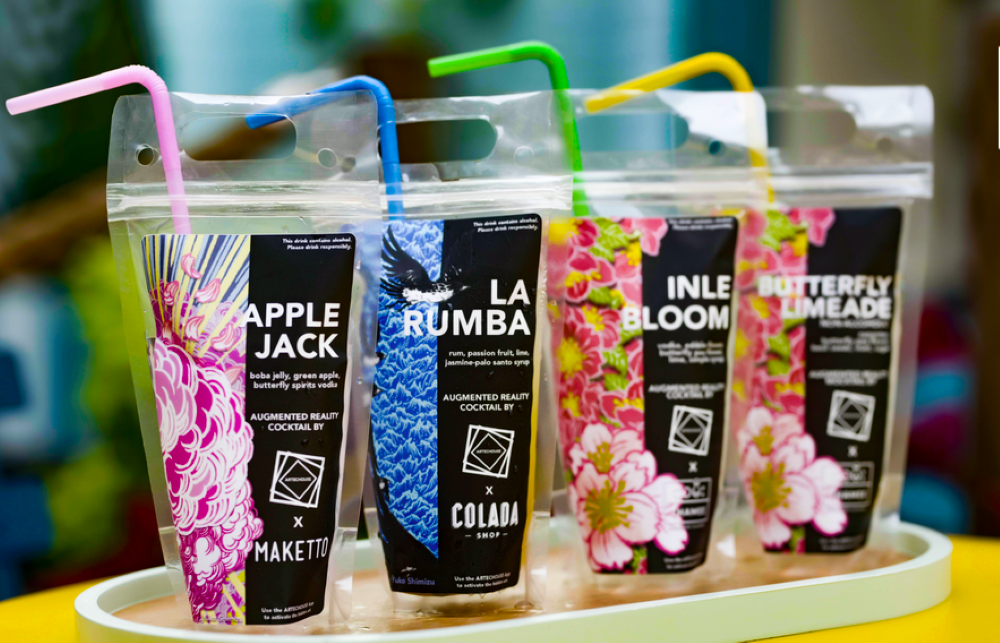
These to-go cocktails and mocktails are served in a CapriSun-like pouch that each have a QR code on the packaging. Drinkers can scan these codes via Artechouse’s augmented reality app, which will make the drink's designs come to life and generate interactive floral graphics on your screen.
The app adds an interactive experience to already delicious drinks and is based off Artechouse’s current exhibit, HANAMI: Beyond the Blooms.
The augmented reality drinks come in four different flavors:
Applejack by Maketto – green apple, butterfly spirits vodka, boba jelly
Remington is well positioned for such a change. It has a well recognized brand in a related field, it is U.S. based (think savings in tariffs and tax incentives), it has underutilized facilities and workers and local sources of expertise.
Locally, there is a rich source of creative talent in game design, graphic arts, computer science and engineering programs at area schools — SUNY Polytechnic Institute, Pratt Institute, Mohawk Valley Community College and Herkimer County Community College.
Significantly, games avoid the dangers associated with live ammunition and instead provides alternatives that are safe and secure. Adding gaming to its mix requires thinking outside of the box (literally and figuratively) but it may be Remington’s last best chance to turn itself around.
Russell L. Kahn, Ph.D., is an Open SUNY Fellow and Professor Emeritus from SUNY Polytechnic Institute. He recently retired after teaching graphic arts for more than 30 years.
The company that developed a Sims-like virtual world with controllable and personalized avatars has seen business explode by offering virtual venues for meetings, conferences, and concerts. In the second quarter, its publicly traded parent company eXp World Holdings (EXPI) revealed VirBELA saw a 260% increase in revenue and a quintupling of monthly active users.