This AR contact lens startup is gaining steam despite Magic Leap’s struggles
 Mojo Vision, a startup with staff made up of veterans from the tech industry'sbiggest hitters, including Google, Amazon, HP and Apple, is betting we'll eventually be wearing contact lenses instead of computer-assisted glasses.
It's unclear when Mojo Vision's smart contacts will make their way to market, but the company has been discussing the tech more publicly in the past year. During the annual CES in Las Vegas this January, Mojo Vision showed off a prototype allowing people to see text, sports scores, weather and other information in a lens held just in front of their eye.
Jay Z tries to use copyright strikes to remove deepfaked audio of himself from YouTube
 In a fascinating deep dive from XOXO festival co-founder Andy Baio over at his website Waxy, Baio looks into AI-powered Jay-Z impersonations on YouTube, specifically one creator using Jay-Z’s iconic voice and hip-hop flow to rhyme classics like William Shakespeare's “To Be or Not to Be” soliloquy from Hamlet and Billy Joel’s “We Didn’t Start the Fire.”
( To Be or Not To Be - https://lbry.tv/@VocalSynthesis:2/jay-z-raps-the-to-be-or-not-to-be:8 )
In a strange turn of events, Roc Nation LLC, Jay-Z’s full-service entertainment agency, filed copyright strikes against the YouTube uploads of the above-mentioned deepfakes. The notices specifically cite AI, with Roc Nation writing, “this content unlawfully uses an AI to impersonate our client’s voice,” according to Baio’s conversations with the creator, who remains anonymous and goes by the online handle Voice Synthesis. The channel itself has nearly 40,000 subscribers, and many of its videos have racked up hundreds of thousands of views.
All of Voice Synethesis’ videos are created by feeding Google’s open source Tacotron 2 text-to-speech model with Jay-Z songs and lyrics and having the synthetic voice read pre-written text. The situation raises fascinating questions about what exactly is being infringed upon here if the synthetic voice is simply producing original content using the likeness of a celebrity. For a deeper look into the copyright issues at play here, I highly suggest you read Baio’s analysis in full because he gets into the finer details of fair use and why Jay-Z’s claims may not hold up in court.
I don’t really understand why mimicking a celebrity’s voice using an AI model should be treated differently than someone naturally doing an (extremely accurate) impression of that celebrity’s voice,” Voice Synthesis argues.
See the full story here: https://www.theverge.com/2020/4/28/21240488/jay-z-deepfakes-roc-nation-youtube-removed-ai-copyright-impersonation
ZTE, Alibaba demonstrated ‘5G + Holographic Stage’, WIMI’s AR + Live Broadcast Is Going to Build New Entertainment Ecology
 The China mobile global partner conference was held in Guangzhou pazhou poly world expo. ZTE and China mobile jointly demonstrated a 5G + holographic stage, which transmitted the lead singer of the band far away from the field to the stage area inside the stadium through 5G in real time, and conducted a singing and playing meeting with the band on the stage that transcended time and space, attracting wide attention.
See the full story here: http://www.digitaljournal.com/pr/4665595
Augmented Reality in Remote Classrooms
 A team led by Purdue University has built an app platform called MetaAR, enabling students and teachers to easily collaborate using augmented reality.
The cost and difficulty make it impossible for most educators to teach in AR. That’s why Ramani and his team have created MetaAR, an authoring platform that allows educators to create their own AR apps. It also allows students and teachers to collaborate remotely in AR.
“We want to make the creation of AR content as simple as creating a PowerPoint file and presenting it yourself,” Ramani said. “Using our technology platform, any instructor can easily train on MetaAR to create their own kits and lesson plans and start collaborating in a virtual classroom.”
For its test case, Ramani’s team built a simple STEM education kit: a small model of a city designed to teach the basics of circuit boards. Wooden pieces, like streets and buildings, had conductive material, which lit up streetlights if students assembled the “circuit” correctly. Using their MetaAR software, the researchers duplicated the pieces in 3D and formulated a simple lesson to teach students how to build the city. In the classroom, students looked at their desks through tablets, which showed them how to orient the physical pieces. It also alerted the students when they placed the physical pieces incorrectly.
MetaAR’s real magic, however, is its collaborative platform. If students had a question, they used video and images of their work to ask for help.
MetaAR will be presented virtually on Tuesday (April 28) at the 2020 CHI Conference on Human Factors in Computing Systems, one of the leading conferences on human-computer interaction. Several other members of Ramani’s lab also will present advances in augmented reality, including StoryMakAR, which uses AR to help children create storytelling experiences. Other presentations are a study using AR “ghosts” to teach factory workers to perform machine tasks, and Vipo, a spatial-visual platform to program the interactions of mobile robots.
See the full story here: https://www.purdue.edu/newsroom/releases/2020/Q2/hands-on-with-augmented-reality-in-remote-classrooms.html
Robots could complete ‘all human tasks’ by 2050 claims transhumanist writer
 The movement, known for its popularity amongst Silicon Valley tech entrepreneurs, has been gaining prominence in recent years.
Speaking to Express.co.uk Mr Wood said: “I believe there’s a 50 percent chance of artificial general intelligence, and hence the possibility of robots doing all human tasks, by the middle of the century and I’ve said there’s about a 10 percent chance we might have this by 2025.”
Artificial general intelligence is the point at which a machine can match or surpass human intellect in any given area.
Mr Wood argued there’s a mismatch between human biology, conditioned over thousands of years by evolution, and the destructive potential of the technology we are developing.
See the full story here: https://www.express.co.uk/news/science/1275130/Robots-news-artificial-intelligence-transhumanist-transhumanism-David-Wood
Offset, Young Thug, And Others Are Hosting A Live Virtual Reality Stadium Concert
 Virtual reality organization Oculus Venues partnered with Supersphere VR to bring an immersive and energetic concert experience to fans from their homes. Offset tapped fellow rappers Saint Jhn, Rich The Kid, and Young Thug to join him in the performance. The rappers will be broadcasting their performances into the virtual venue and donations from the event will be donated to the Atlanta Community Food Bank.
As part of the virtual experience, friends will be able to meet up inside the venue and enjoy the show together through VR headsets. According to Supersphere, the event will mimic a typical stadium show along with “actual production and stagecraft that fans would typically enjoy on tour.”
Offset’s VR performance kicks off 4/29 at 7 p.m. EDT. Watch it here. https://www.oculus.com/experiences/event/609621869627225/?utm_source=rakuten&utm_medium=affiliate&utm_campaign=je6NUbpObpQ
See the full story here: https://uproxx.com/music/offset-young-thug-vr-concert-oculus-venues/
Lagotronics Project – GameChanger-XS
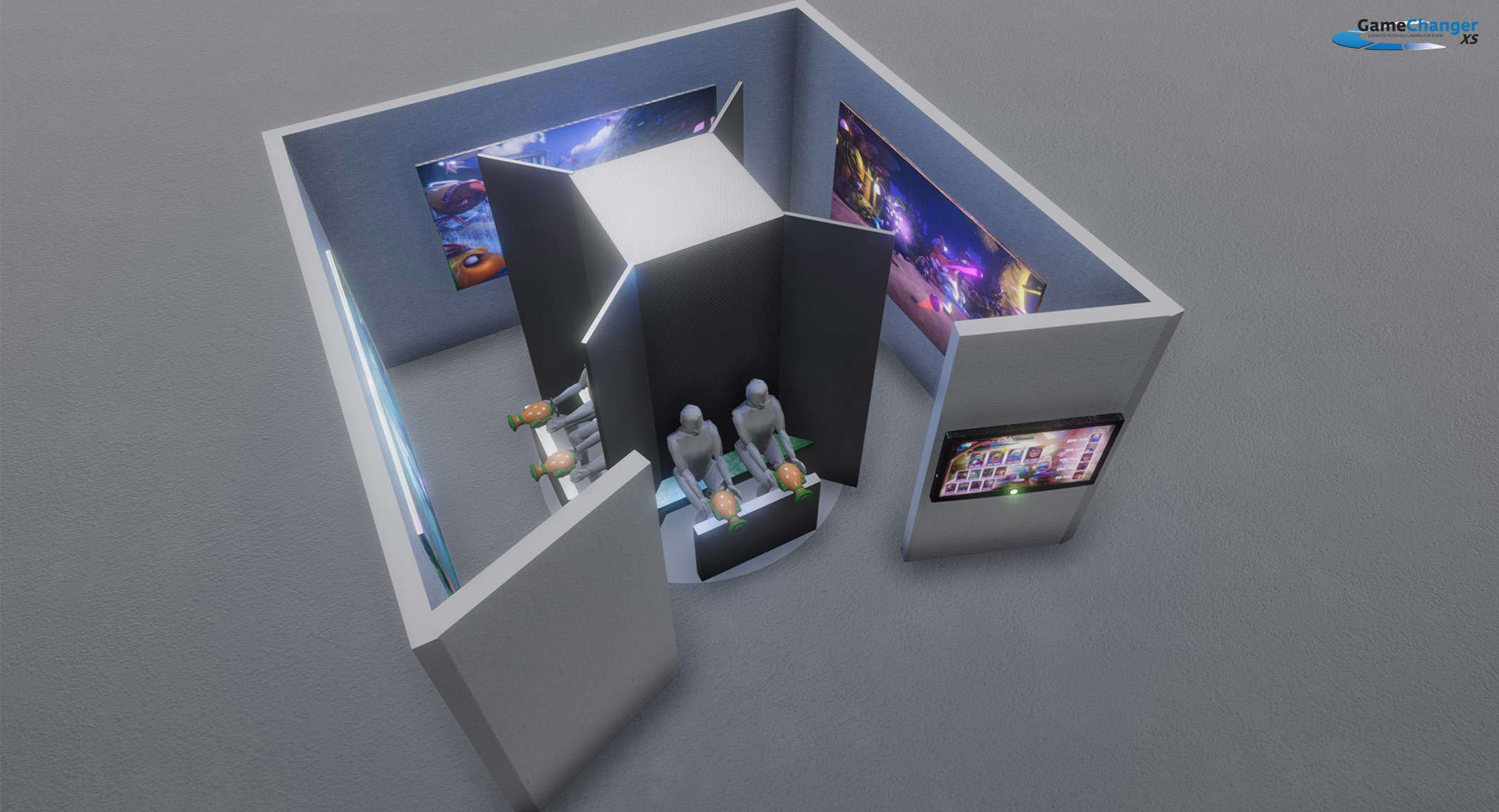 The GameChanger-XS is a turnkey attraction concept developed specifically for Family Entertainment Centers (FECs), museums and other leisure facilities that have only limited space for new attractions. The GameChanger-XS is the smallest possible version of the GameChanger and can be installed in an area measuring just 36 m2. Although this attraction is very compact, a high hourly capacity of 225 people can be achieved.
GameChanger-XS specifications:
- Ride system: rotating disc
- Number of sections: 4
- Number of media scenes (2D or 3D): 3
- Number of players/scene: 2
- Number of seats: 8
- Interactive shooters: 8
- Ride time: 128 seconds
- Load/unload time: 25 seconds
- Capacity (THC): 225 visitors/hour
Advantages:
- Suitable for very small spaces (36 m2 and above)
- High capacity
- Complete dark ride experience (turnkey solution)
- Modular system with numerous customised options
- Different configurations possible, with higher capacity
- Various storylines and games available
See the full story here: https://www.lagotronicsprojects.com/en/products-technologies/gamechanger-xs
INTERVIEWS Vahid Behzadan, Director of Secured and Assured Intelligent Learning (SAIL) Lab – Interview Series
 Vahid is an Assistant Professor of Computer Science and Data Science at the University of New Haven. He is also director of the Secure and Assured Intelligent Learning (SAIL) Lab
His research interests include safety and security of intelligent systems, psychological modeling of AI safety problems, security of complex adaptive systems, game theory, multi-agent systems, and cyber-security.
You have an extensive background in cybersecurity and keeping AI safe. Can you share your journey in how you became attracted to both fields?
My research trajectory has been fueled by two core interests of mine: finding out how things break, and learning about the mechanics of the human mind. ...
You recently led an effort to propose the modeling of AI safety problems as psychopathological disorders. Could you explain what this is?
This project addresses the rapidly growing complexity of AI agents and systems: it is already very difficult to diagnose, predict, and control unsafe behaviors of reinforcement learningagents in non-trivial settings by simply looking at their low-level configurations. In this work, we emphasize the need for higher-level abstractions in investigating such problems. Inspired by the scientific approaches to behavioral problems in humans, we propose psychopathology as a useful high-level abstraction for modeling and analyzing emergent deleterious behaviors in AI and AGI. ...
One of the areas you closely follow is counterterrorism. Do you have concerns with terrorists taking over AI or AGI systems?
...One of the main problems with AI-enabled weaponry is in the difficulty of controlling the underlying technology: AI is at the forefront of open-source research, and anyone with access to the internet and consumer-grade hardware can develop harmful AI systems. I suspect that the emergence of autonomous weapons is inevitable, and believe that there will soon be a need for new technological solutions to counter such weapons. This can result in a cat-and-mouse cycle that fuels the evolution of AI-enabled weapons, which may give rise to serious existential risks in the long-term.
What can we do to keep AI systems safe from these adversarial agents?
...training machine learning agents in adversarial settings can improve their resilience and robustness against evasion and policy manipulation attacks (e.g., see my paper titled “Whatever Does Not Kill Deep Reinforcement Learning, Makes it Stronger“). Another solution is to directly account for the risk of adversarial attacks in the architecture of the agent (e.g., Bayesian approaches to risk modeling). There is however a major gap in this area, and it’s the need for universal metrics and methodologies for evaluating the robustness of AI agents against adversarial attacks. Current solutions are mostly ad hoc, and fail to provide general measures of resilience against all types of attacks.
See the full long interview here: https://www.unite.ai/vahid-behzadan-director-of-secured-and-assured-intelligent-learning-sail-lab-interview-series/