I ate a meal in virtual reality. Here’s what it tasted like
- Virtual reality dining is still a pricey novelty — costing as much as $2,000 — but it does have the potential to create a new kind of food experience.
- If VR technology is adopted more broadly, it could become a bigger part of creating memorable, and profitable, food experiences, as well as be a tech-based source of addressing health issues in society.
- As the coronavirus creates a global “social distancing’ phenomenon, including in developed countries with large elderly populations, and more individuals turn to food delivery, VR could ultimately help address isolation caused by pandemics.
 Kulczak found that VR heightened her appreciation for the food. She explained, “Eating and having the [virtual reality] glasses allowed me to focus on elements of food that are taken for granted when you see what’s in front of you.” She continued, “The flavors seemed more distinct, the textures more prominent. I feel like the visual art used warm and cool colors to portray a feeling and used objects like sunset to emotionally connect you to the dining experience.”
See the full story here: https://www.cnbc.com/2020/03/21/virtual-reality-dining-explained.html
This Library In Minecraft Was Built By 24 People To Fight Censorship Across The World
 “The Uncensored Library” is now filled with books containing articles that were censored in their country of origin. They are only available inside the computer game, Minecraft so that they can be hidden from government surveillance technology. Everyone can read the books on the server, but cannot change their content at all.
Thanks to this virtual library, journalists from 5 different censored countries(Egypt, Mexico, Russia, Saudi Arabia, and Vietnam) have the possibility to be heard again.
“Their articles have now been republished as Minecraft books in English and the articles’ original language and are available in countries that censored their works,” the project representatives explained.
The library creators explain why they chose this Minecraft design:
“Minecraft is an open-world game where players can explore an intentionally blocky, pixelated world. Here they can discover and extract raw materials, craft tools, build structures, and cooperate with other players. The game’s creative mode is often described as ‘digital Lego’ and is being used in educational environments. Part of Minecraft’s gameplay is gathering and crafting items, such as books. Minecraft books have 100 pages and can be written freely. Other players can read them but cannot change the content of the books on the server.”
F1 drivers to stage virtual reality races
 Formula One's drivers will battle it out in an Esports Virtual Grand Prix series in a bid to give fans their racing fix while the season is delayed by the coronavirus.
Formula One chiefs are aiming to start racing in Azerbaijan on June 7, but to fill the void for now the sport has asked current F1 drivers to play a racing game featuring as-yet unnamed celebrity guests.
The events start this weekend with the Virtual Bahrain Grand Prix run on the official 2019 F1 video game.
Viewers will be able to tune in via YouTube, Facebook and Twitch with a qualifying session to determine the grid preceding the race itself.
See the full story here: http://www.rfi.fr/en/wires/20200320-f1-drivers-stage-virtual-reality-races
South Korea’s Naver stamps out anonymity for commenters
 In a new move which took effect yesterday, South Korean Internet giant Naver displayed the user names and comment histories of users who posted replies on news stories on its platform.
The company said the change is intended to prevent cyber bullying and abusive behaviour online.
Naver's anonymous comment system has often been criticised for allowing abusive and disparaging comments.
Naver's move came in the wake of the deaths of two singers, Sulli and Goo Hara, late last year.
Sulli took her own life at the age of 25 and was often the subject of hate comments over how she dressed and about being an outspoken feminist.
Chip-based device opens new doors for augmented reality and quantum computing
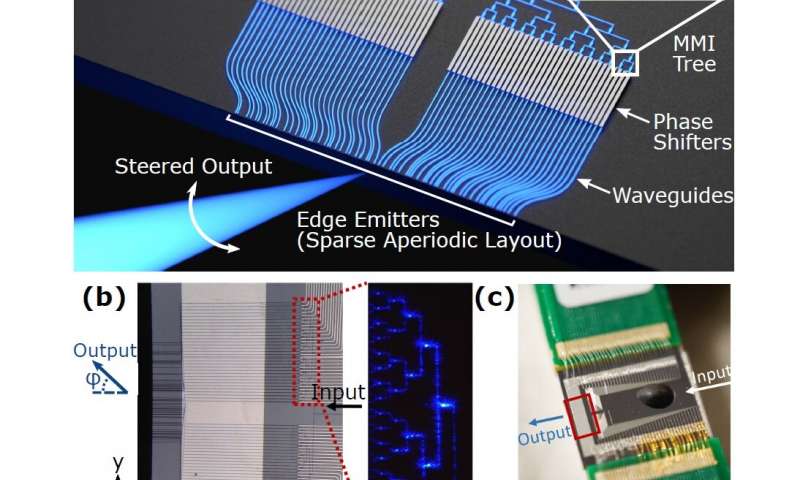 "Our blue phased array platform can rapidly and precisely reconfigure visible light for many emerging applications, spanning holographic displays, quantum information processingand biological sensing and stimulation," said research team leader Michal Lipson from Columbia University. "It paves the way for chip-scale light projection across the entire visible range with a large field of view and can miniaturize the current bulky optical systems."
Lipson and colleagues describe the new device in The Optical Society (OSA) journal Optics Letters. It is the first chip-scale optical phased array (OPA) operating at blue wavelengths using a silicon nitride platform. OPAs function like reconfigurable lenses by enabling arbitrary reconfigurations of 3-D light patterns.
The new OPA was developed as part of a DARPA-funded project that aims to create a lightweight, low power head-mounted display that projects visible information onto the retina with extremely high resolution and a large field of view. This type of augmented display isn't possible today because the light projection components used to shape and steer light are bulky and have a limited field of view.
Using the new blue light OPAs, the researchers demonstrated beam steering over a 50-degree field of view. They also showed the potential benefits of this type of platform for image projection by generating 2-D images of letters.
See the full story here: https://techxplore.com/news/2020-03-chip-based-device-doors-augmented-reality.html
Representing Scenes as Neural Radiance Fields for View Synthesis
Abstract & Method
We present a method that achieves state-of-the-art results for synthesizing novel views of complex scenes by optimizing an underlying continuous volumetric scene function using a sparse set of input views.

Our algorithm represents a scene using a fully-connected (non-convolutional) deep network, whose input is a single continuous 5D coordinate (spatial location (x, y, z) and viewing direction (θ, φ)) and whose output is the volume density and view-dependent emitted radiance at that spatial location.
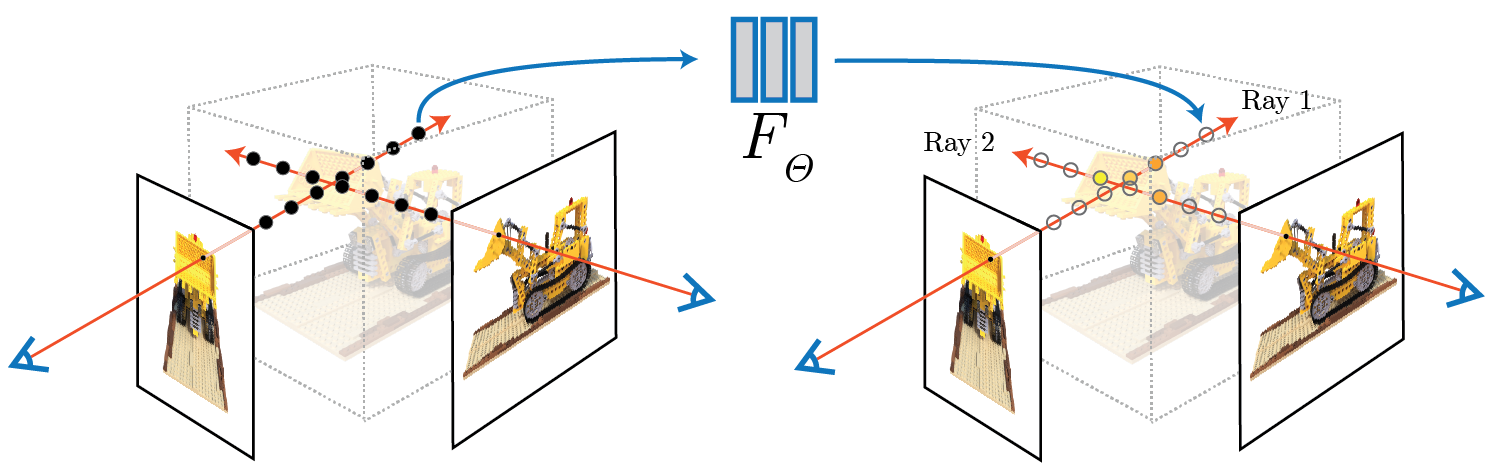

We synthesize views by querying 5D coordinates along camera rays and use classic volume rendering techniques to project the output colors and densities into an image. Because volume rendering is naturally differentiable, the only input required to optimize our representation is a set of images with known camera poses. We describe how to effectively optimize neural radiance fields to render photorealistic novel views of scenes with complicated geometry and appearance, and demonstrate results that outperform prior work on neural rendering and view synthesis.
See the full story here: http://www.matthewtancik.com/nerf?fbclid=IwAR2Gn_HSWGfPVQn29-zm6ZmSJjBN_2qsIcwpa0DFcwVFlpfNNTfXPgezP_U