Ubisoft’s Blockbuster ‘AAA VR Project’ Half-Life: Alyx is Virtual Reality’s Big Turning Point

- Ubisoft is hiring a narrative director for a AAA VR title.
- It will be based on an existing IP.
- Valve isn’t the only big player in the VR game.
The most anticipated virtual reality title is Half-Life: Alyx, no doubt. After all, this game is not only the first “full-length” experience from the legendary game makers in years but also a new title in arguably the most popular game franchise of all time.
What’s especially interesting about Ubisoft’s interest in VR is that most of its games are of the open-world genre. Half-Life: Alyx might be a fantastic, slightly linear FPS title based on the footage, but Ubisoft’s approach may very well be of that same open-world sort.
See the full story here: https://www.ccn.com/ubisofts-blockbuster-aaa-vr-project-is-virtual-realitys-turning-point/
Internet privacy: the apps that protect you from your apps
 Jumbo, an app for iOS and Android, launched in 2019 with the promise that it would cut through some of that confusion. The offer was simple: download the app, check a few boxes and it would automatically lock down your privacy settings on platforms including Facebook, Google, Twitter and Amazon. Rather than having to hunt down every individual preferences screen and decipher which settings were innocuous and which were merely deliberately phrased to sound innocuous, the app would do it for you.
“It would take you a whole year to read your privacy policies, but if you go to a doctor, they don’t tell you to go and spend a year learning medical science; you go to a lawyer, you don’t need to read the whole IRS code. In fact, they have a whole ethical code about how to represent their clients. That’s the idea here: it’s about representing people and working for them, to simplify a complex system.”
But for the rest of the internet, shame doesn’t work. ...
Noise Cancellation and Navigation images sharper than your TV among tech improvements coming to vehicles
 A pair of new technologies promise to make driving easier and more pleasant, particularly on long trips. Both feature prominently on vehicles debuting shortly.
- Augmented reality navigation will use graphics and artificial intelligence to improve driving directions.
- Road noise cancellation promises to make cabins quieter and more pleasant in the same way noise-cancelling headphones reduce the discomfort of airline travel.
See the full story here: https://www.freep.com/story/money/cars/mark-phelan/2020/02/15/augmented-reality-navigation-noise-cancellation-cars-vehicles/4742843002/
Marine Corps Looks to Virtual Reality as a Recruitment Tool
 According to a request for information launched this week, the Marine Corps Recruiting Command, or MCRC, wants to “create a highly-portable virtual reality simulator” to support its recruitment of aviation officer candidates in regions across the United States. It’s in some ways an effort to entice more digital natives to join.
The RFI prompts interested entities to respond with descriptions of their relevant VR solutions by Feb. 28. The MCRC is looking to purchase, lease or partner up to gain access to a system that has open-source VR-compatible scenery, offers content creation of realistic on-the-job scenarios such as low-level canyon flight and aerial refueling, is constructed of off-the-shelf hardware that has follow-on upgrades and replacement parts, and is portable enough to fit in a standard 15 passenger van and be lifted by no more than two people at a time.
See the full story here: https://www.nextgov.com/emerging-tech/2020/02/marine-corps-looks-virtual-reality-recruitment-tool/163139/
Expo 2020 Dubai unveils pavilions for Australia, Canada, India and Malaysia
Latvia
This pavilion is an open space for imagination and thought, with an Arabian desert sandscape, industrial-speed internet and 3D stereo sound.
 See the full story here: https://blooloop.com/news/expo-2020-dubai-pavilions-australia-canada-india/?fbclid=IwAR0Ap2TTQQilE61FuPwvVEp1lWHUa_UfZM6aPJxaT31I2b4MNNE8kVU1Ohk
IEEE calls for standards to combat climate change and protect kids in the age of AI
 The IEEE Standards Association has released a report calling for engineers to consider the impact their work will have on climate change, children, and society. It’s a push toward “utilizing emerging technologies in a way that prioritizes people and planet over power and profits.”
The Institute of Electrical and Electronics Engineers (IEEE) is one of the largest organizations for computer scientists in the world. With hundreds of thousands of members, the group undertakes initiatives to create common standards and often consults organizations like the European Commission and OECD on matters of ethics and design principles.
The whitepaper encapsulates change already underway at the IEEE that’s in line with AI ethics principles released in spring 2019 after years of work, according to John Havens, director of the IEEE Global Initiative on Ethics of Autonomous & Intelligent Systems.
The report offers three recommendations:
- Shift toward a “new climate economy” and identify “Earth-friendly AI”
- Protect children’s future, data, and lives
- Seek new success metrics that take societal well-being into account
The paper itself does not constitute an IEEE standard, but it points to a number of standards that may need to change to reflect the recommendations.
Children, data privacy, and big tech
The whitepaper also argues that the internet fails to account for underage users. It asserts that the internet is designed to treat every user as an adult, ignoring the need to protect children from data collection by tech giants.
It also points to advances in the field of probabilistic computing that can support the creation of well-being metrics and highlights recent work by the government in New Zealand, where lawmakers are using metrics associated with people and the environment to influence policy and the economy.
Other metrics that measure human benefit and well-being include the OECD’s Better Life Index and the Genuine Progress Index, which lawmakers in places like Maryland use when drafting legislation.
See the full story here: https://venturebeat.com/2020/02/06/ieee-calls-for-standards-to-combat-climate-change-and-protect-kids-in-the-age-of-ai/
At Andover Senior Center, A Virtual Reality Cupcake Lesson
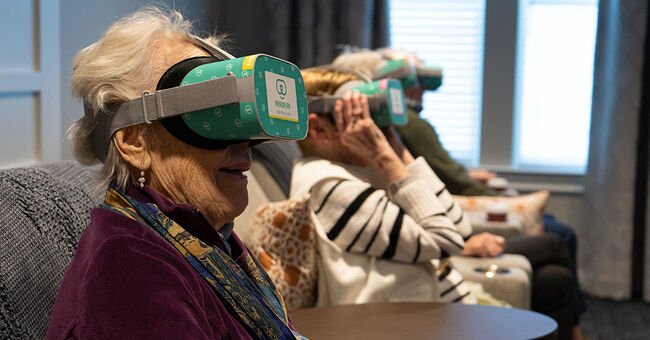 Residents at Stone Hill Senior Living Center got a special virtual reality cupcake-making lesson as a Valentine's Day treat Thursday.
The residents strapped on VR goggles, transporting them to Magnolia Bakery in Boston's Faneuil Hall, where they watched a baker give a step-by-step lesson on how to make fancy Valentine's cupcakes.
Then, they got to eat fancy Valentine's Day cupcakes in real life.
It's a project by Somverville-based company Rendever. The company's CEO, Kyle Rand, told WBZ NewsRadio's Madison Rogers they use virtual reality to reduce social isolation in communities like senior centers.
"We actually saw decreases in depression, increases in feelings of trust, and increases in social health, because what happens is, they're experiencing these things together," he said. "They're laughing together, they're smiling together. They take their headsets off, and you have this new connection."
See the full story here: https://wbznewsradio.iheart.com/content/virtual-reality-cupcakes-andover-senior-center-stone-hill-vr-goggles-valentines-day/
Sony imagines a world full of artificial intelligence, from kitchen bots to games
 In 1997, Hiroaki Kitano, a research scientist at Sony, helped organize the first Robocup, a robot soccer tournament that attracted teams of robotics and artificial intelligence researchers to compete in the picturesque city of Nagoya, Japan.
Kitano now leads a new effort at Sony, announced in November, to infuse cutting-edge artificial intelligence throughout the company.
Sony will focus its artificial intelligence on three domains, says Kitano: games, sensors and, more interestingly, culinary arts. These areas reflect the company's current commercial focus and an aspirational direction for the future.
See the full story here: https://newsdio.com/sony-imagines-a-world-full-of-artificial-intelligence-from-kitchen-bots-to-games/49703/