Data Discrimination Means the Poor May Experience a Different Internet
 Data analytics are being used to implement a subtle form of discrimination, while anonymous data sets can be mined to reveal health data and other private information, a Microsoft researcher warned this morning at MIT Technology Review’s EmTechconference.
In a new paper, she and a colleague propose a system of “due process” that would give people more legal rights to understand how data analytics are used in determinations made against them, such as denial of health insurance or a job.
See the full story with a link to her paper here: http://www.technologyreview.com/news/520131/data-discrimination-means-the-poor-may-experience-a-different-internet/?utm_campaign=newsletters&utm_source=newsletter-daily-all&utm_medium=email&utm_content=20131010
Big data blocks gaming fraud
 [Philip Lelyveld comment; So if big data allows the 'house' to identify players operating outside of their expected patterns, how big a step is it to develop an algorithm to increase the house's odds to just the point where the player's losses and hope are in optimal balance?]
Online game developers have vast amounts of rich, unstructured data at their fingertips that they could use to help achieve revenue stability. The data delivers an understanding of each player and what they are doing while in the game. That same data could be manipulated to identify and stop fraudulent game activities in real time.
Recently, we had the opportunity to test this premise with one of the world’s largest casual online gaming companies, which was plagued by revenue leakage due to cheating players. By using analytics to examine and model the game, we could determine common player navigational paths. We could then design mathematical algorithms that could place parameters around the average player and predict the average way he or she would progress in the game. This information determined the threshold range for what would be acceptable play; any players that fell outside of the threshold range would be flagged as being potentially fraudulent. The game developer could then choose to immediately freeze accounts for those advancing too quickly — thereby plugging the revenue hole.
Read more at http://venturebeat.com/2013/10/03/big-data-blocks-gaming-fraud/#BbG6PWUr4llMD03T.99
See the full story here: http://venturebeat.com/2013/10/03/big-data-blocks-gaming-fraud/
Somersaulting MIT cube robots can self-assemble
 The blocks move thanks to a flywheel inside their bodies that can spin at a blistering 20,000 revolutions per minute and then can break straight down to zero in a blinding 10 milliseconds, said MIT roboticist Kyle Gilpin. When the flywheel suddenly stops, all the energy from that angular momentum transfers into the cube’s frame, causing it to flip.
The boxes have magnets on the edges that can grip their cube-mates, allowing one to flip around into a new configuration without breaking the connection.
Ultimately, the goal would be to make smaller, millimeter-sized versions of these robots, Rus said. And the bots should have a number of applications, from building temporary bridges after a collapse to probing a suspect pipe.
See the full story here: http://www.latimes.com/science/sciencenow/la-sci-sn-mit-block-self-assembling-robots-cubes-terminator-20131004,0,4903811.story
SAMSUNG PROMISES FLEX-SCREEN PHONE BY THE END OF THE YEAR
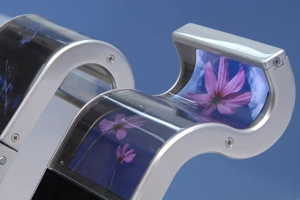 The particular model is less important than the fact that the world’s leading smartphone manufacturer is investing in AMOLED screens, which are more durable and deliver higher quality images, and pushing towards using them without the rigid glass it currently encases them in.
Flexible screens are currently hamstrung by the challenge of finding flexible electronics components durable enough to withstand repeated bending at a price consumers will pay. But a midway point involves putting some of the componentry of the electronics into the AMOLED surface, while leaving the others packaged in a rigid container.
See the full story here: http://singularityhub.com/2013/10/03/samsung-promises-flex-screen-phone-by-the-end-of-the-year/
Monthly Webcast- An Introduction to Holographic Television
Widespread recognition of some shortcomings of "traditional" 3D TV, and some recent technological advances, create an opportunity for holographic 3D TV for entertainment, telepresence, and teleoperation. In this webcast I'll review perceptual considerations for 3D TV, explain what true holographic television is (and how to distinguish it from things that marketers call holographic), as well as describe how recent developments in image capture, standardization, and computation may bring holographic television to market affordably sooner than many have predicted, co-existing with other kinds of 3D TV. I'll also explain the range of light-modulation technologies that various research groups (including mine) are exploring as part of developing holographic video display systems.
V. Michael Bove, Jr. holds an S.B.E.E., an S.M. in Visual Studies, and a Ph.D. in Media Technology, all from the Massachusetts Institute of Technology, where he is currently head of the Object-Based Media Group at the Media Laboratory.
See the full post with registration info here: http://events.r20.constantcontact.com/register/event?llr=iwnzoxjab&oeidk=a07e7yemomp5a708224
First Look: Dolby 3D
Dolby 3D technology has two main components. One focuses on a format that allows all the necessary information to be brought to the display to perform at its best, using the current infrastructure. An example was shown at CES and IBC where the Dolby 3D format was showcased using the Vudu service as well Akamai, uploading Dolby 3D movies on their servers and streaming it live through an on demand application.
The second component resides in the display where the frames are generated using the information mentioned above and matching it to the specific characteristic of the display, either this is a glasses based 3D TV or a glasses free 3D TV. Dolby 3D always renders and visualizes the best 3D image possible within the specific optical characteristic of the display itself.
What does the content need in order to function as Dolby 3D?
The Dolby 3D format requires the content to already be in 3D, it is not a 2D to 3D conversion technology. What Dolby 3D allows is to bring more data to the 3D displays so that the 3D image is higher quality. For example the FCFR (frame compatible full resolution) module allow to bring full resolution left and right image to the current 3D TVs enabling a much higher resolution when in 3D mode compared to the current side by side format. More specifically for 3D glasses free display, Dolby 3D allows additional important data like depth map of the frame, to be transmitted to the display enabling a much higher quality when the video is visualized on the screen.
See the full article here: http://www.gadgetreview.com/home-theater/first-look-dolby-3d
Pew Study – Why 15% of Americans Are Not Online
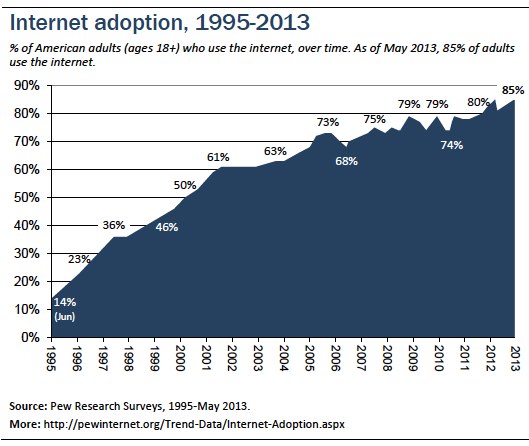 A large portion of the people not online are over 65 yrs old.
As of May 2013, 15% of American adults ages 18 and older do not use the internet or email.
Asked why they do not use the internet:
- 34% of non-internet users think the internet is just not relevant to them, saying they are not interested, do not want to use it, or have no need for it.
- 32% of non-internet users cite reasons tied to their sense that the internet is not very easy to use. These non-users say it is difficult or frustrating to go online, they are physically unable, or they are worried about other issues such as spam, spyware, and hackers. This figure is considerably higher than in earlier surveys.
- 19% of non-internet users cite the expense of owning a computer or paying for an internet connection.
- 7% of non-users cited a physical lack of availability or access to the internet.
See the full story here: http://pewinternet.org/Reports/2013/Non-internet-users.aspx
Is This 3D Printer Better at Painting Than Van Gogh?
...a Dutch researcher named Tim Zaman has found a way to reproduce large-format painting reproductions at 600 pixels an inch. Not only that, but the Oce Printer, as it’s called, can stack ink in a way that mimics the brushstrokes of the original. The printer heads move over the canvas multiple times to create layers and layers of ink, building it up in much the same way a dye-sub printer works...
Read the full story here: http://www.complex.com/art-design/2013/09/printer-paints-brush-strokes
Netflix Expands Super HD and 3D Streaming Service
The company recommended that members who wish to use the Super HD stream should have at least 7 Mbps of bandwidth. But Netflix also provides a Super HD stream that only requires about 5 Mbps. 3D streams on the other hand can require up to 12 Mbps of bandwidth. Netflix currently offers Super HD streaming on set devices including Sony’s PS3, Apple TV, Roku, and Nintendo Wii U.
See the full story here: http://www.business2community.com/tech-gadgets/netflix-expands-super-hd-3d-streaming-service-0630515