A Manmade Island to Store Wind Energy
 It would use the oldest and most cost-effective bulk energy storage there is: pumped hydro. During off-peak times, power from the turbines would pump water up 15 meters to a reservoir. To generate electricity during peak times, the water is released to turn a generator, according to a representative.
DRIVE-IN THEATERS TO RECEIVE HELP WITH DIGITAL TRANSITION
 The National Association of Theatre Owners (NATO) and equipment supplier Cinedigm plan to help drive-in theaters convert to digital projection. The aid comes as many drive-ins run the risk of extinction since studios plan to stop releasing 35mm film versions of their movies later this year. While most drive-in theaters screen physical film on their outdoor projectors, the move to digital puts the theaters in a difficult position.
See the full story here: http://www.latimes.com/entertainment/envelope/cotown/la-et-ct-cinedigm-nato-20130204,0,5553288.story
Exclusive: Eric Schmidt Unloads on China in New Book
 China, Schmidt and Cohen write, is “the world’s most active and enthusiastic filterer of information” as well as “the most sophisticated and prolific” hacker of foreign companies. In a world that is becoming increasingly digital, the willingness of China’s government and state companies to use cyber crime gives the country an economic and political edge, they say.
“This is a difference in values as much as a legal one.”
The U.S. is far from an angel, the book acknowledges. From high-profile cases of cyber-espionage such as the Stuxnet virus that targeted Iranian nuclear facilities, to exports of surveillance software and technology to states with bad human rights records, there is plenty at home to criticize.
And those criticisms will become louder and more politically resonant, Schmidt and Cohen claim, as the distinctions between states that support freedom online and those that suppress it become clearer. The pair even speculate that the Internet could eventually fracture into pieces, some controlled by an alliance of states that are relatively tolerant and free, and others by groupings that want their citizens to take part in a less rowdy and open online life. Companies doing business with the latter could find themselves shunned from the former, the book suggests.
In this roundabout way the pair come close, on occasion, to suggesting western governments follow China’s lead and form closer relationships between state policy and corporate activity.
See the full story here: http://blogs.wsj.com/corporate-intelligence/2013/02/01/exclusive-eric-schmidt-unloads-on-china-in-new-book/
Gravity giving away personalization to whichever publishers want it
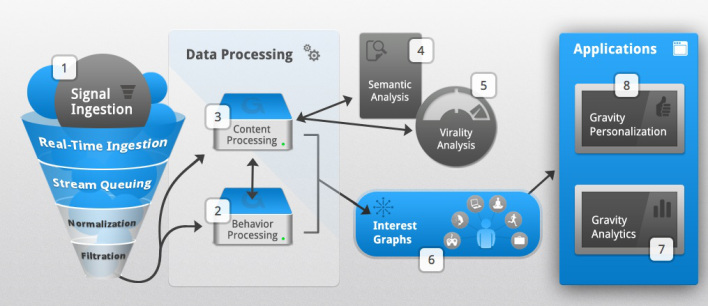
 Gravity, a Santa Monica, Calif-based startup that personalizes reader content for web publishers, is opening up its recommendation engine to anyone that wants to use it.
[T]he gist is that humans first serve as guides for machine-learning algorithms by determining connections between terms within large data sets, then the algorithms take over to complete the job faster than humans ever could. When they’re done, the humans step in one more time to kill any bad connections between terms. The result is a system that can determine with high accuracy that a person tweeting about Vanessa Laine (Los Angeles Laker Kobe Bryant’s ex-wife), for example, is probably more interested in basketball than about Laine’s date of birth or other accurate but irrelevant information.
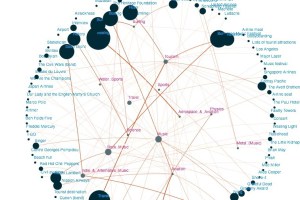
Graph processing and graph databases — which store and analyze data based on their relationship to one another — are critical to our onlines lives, powering everything from online recommendations to social search toknowledge discovery. Graph technologies are also the focal point of some impressive life sciences work from companies such as Syapse and Ayasdi, which will be presenting at Structure: Data in New York next month.
But publishers struggling to stand out on a noisy web might have the most to gain from graphs and personalization, generally.