 [Philip Lelyveld comment: this lengthy article is an overview update on 4K and beyond in both theatrical and home theaters situations.]
... Nonetheless, 4K technology is entering the TV market in a variety of ways.
"4K may be the greatest thing that happens to HD," says Mark Schubin, an Emmy-winning TV engineer, who focuses on the evolution of production tactics. "At the tail end of the standard-definition era, producers were shooting with HD cameras and over-sampling. 4K cameras inherently over-sample, which makes it so much better looking even if you watch the show on a traditional HD set."
Schubin, a long-time technical consultant to Lincoln Center's Metropolitan Opera and an organizer of major Hollywood production technology programs, cites other 4K routes to market. Studios have been working on 4K for at least 10 years, he notes, with the expectation that it will emerge in digital cinema theaters.
"Now we're in a new era where people have large screens and home theaters," Schubin says. "4K is a differentiator." ...
Read the full story here:
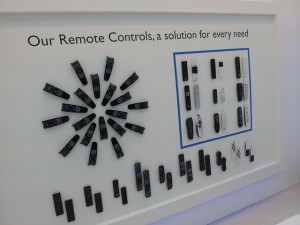 At IP&TV World Forum in London, I tried several of the software and hardware technologies pitched by dozens of jostling vendors to new internet TV operators. My conclusion - the four-directional paradigm of the conventional TV remote control, used by most new-wave connected TVs, is no longer suitable for the exploding new set of use cases for the humble telly box.
The remote control must die; but what’s next? One company at the apex of that question is Philips, which, unbeknownst to many onlookers, already makes remote controls for an array of TV makers, set-top box vendors and pay-TV operators like BSkyB.
Philips now offers its own Wiimote-like gesture stick to screen makers like HP; (NYSE: HPQ) a motion-sensitive, qwerty-equipped uWand; candybars with integrated laptop trackpads and, yes, plain ‘ol candybars for internet TV operators who still want them.
Read the full story here:
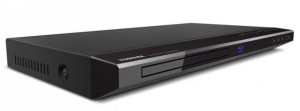
[CNET]
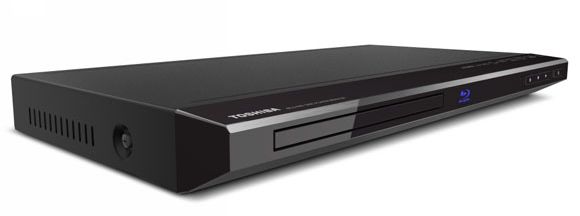
The BDX4150 is new, not refurbished, and that price includes shipping. In addition to 3D, it supports streaming from services like Netflix.
See the full story here:
A panel of programming executives at the Satellite 2012 conference and exhibition in Washington, D.C. said this week that said ultra-high definition (UHD) TV held promise, if not in the near term, but that 3D TV was problematic now. ...
“On super high-def, we’re absolutely bullish,” said Vince Roberts, EVP Global Operations and CTO, Disney ABC Television Group. He also said he suspects his colleagues at Disney subsidiary ESPN would agree. (Last summer ESPN EVP and CTO Chuck Pagano was quoted on Engadget as having told his staff to “get used to hearing the term 4k TV.”) ...
The situation with 3D is different. While consumers understand it, content providers are hesitating. David Couret, Technical Solutions Director, Audiovisuel
Exterieur de la France (France 24) noted that satellite transmission was best way to distribute 3D but said that his “main concern … is the glasses you have to get.”
“We agree with David,” said Jaffe. “Until 3D is glass-less in the home, we don’t see mass adoption.” Disney’s Roberts said that interest in 3D has flattened out. “I’ve got broadcasters that can’t re-broadcast it,” he said. Then there are nagging questions about the health effects of 3D. Roberts mentioned the potential impact on epileptic children, in particular.
Keeping next-gen technologies such as 4k and 3D in perspective, France 24’s Couret admitted that his company continues to transition into HD. “We launched five years ago,” he said. “The challenge is to address Europe and Africa. We need to be available to a maximum number of people.”
See the full story here
[Philip Lelyveld comment: this is a good overview of some location-based marketing technology concepts.]
The IPG Media Lab on West 33rd St. is like a mini-Consumer Electronics Show on the doorstep of New York's Penn Station. Opened four months ago in New York, after a nine-year run in L.A., it provides IPG Mediabrands clients and partner agencies with a hands-on survey of the latest personal gadgets, interactive displays, wearable devices, embedded retail tech, and set-top boxes.
But unlike CES, the Media Lab exists not only to paint the future's picture for each guest, but to translate the tangle of technology into a strategic marketing plan. ...
Among the gadgets and digital baubles Lab visitors will see:
- A tool that uses WiFi connections to measure people walking outside Media Lab's front door. When someone comes in, that action is treated as a "conversion." In addition to being a nifty tool, the idea has a clear application for storefront marketers.
- A "mobile bar" with QR codes, near field communication (NFC) apps, and other uses. Rosenberg says, "It's inevitable that NFC will take off. There's too much momentum behind it, and the frictionless tapping versus the download of a QR reader."
- A facial recognition camera for retail locations. A small camera embedded in a store shelf can guess a visitor's mood by reading facial expressions. "Unlike a focus group, your face doesn't lie. The ability to use this as part of a retail case study is interesting," said Rosenberg.
- Life-sized video chat. This installation enables face-to-face customer interactions near product displays. What brands might benefit? Think Blackberry and other advertisers that struggle to sell products at the shelf level.
- A 3D video display that doesn't require glasses. Rosenberg: "It's good for outdoor, but you can only look at it for about 20 seconds." ...
Read the full story and watch the video here:
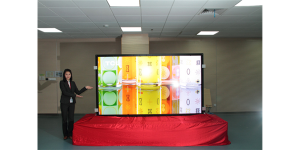
Meet TCL, Haier and Changhong – Chinese home brands all looking to make ructions in the global TV market, threatening the domination by South Korean TV giants LG and Samsung, as well as Japan'sSony and Sharp.
Shenzhen-based TCL (The Creative Life) area already making headway in the Australian market since its launch in 2005 with its Internet ready TV's, 3D display technology and ultra slim bezel sets, unleashed here in January.
The brand is also big news in Philippines, Thailand, South East Asia and hopes to grow its Aus market share from around 3.5-4% currently to around 10% in the future, according to Paul Widdis TCL's General Manager, Australia, who says it is "doing very well", selling in Retrovision, Bing Lee and Good Guys. ...
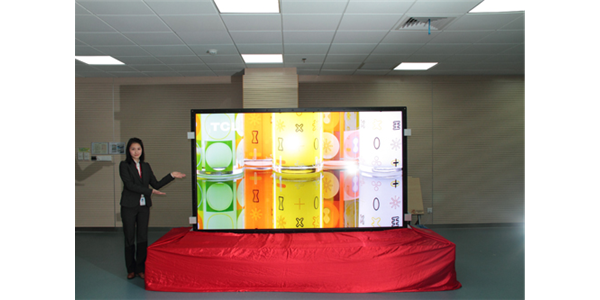
TCL Corp. is ranked at the No. 1 TV brand in its native China, (Hisense is No.2) believes Research & Development is its core strength and recently developed the world's largest 110" 4K Full HD 3D LCD screen, debuted in Beijing last week. ...
Haier, not yet available in Oz, had its revolutionary 58" Brain Wave TV, a wireless set controlled by your mind, on show at CES, as well as showcasing home ‘cloud living', virtually edgeless cloud TV, and glass-free 3D TV. TCL also debuted 20 LCD models and its breakthrough Cloud Life TV's based on the cloud computing. ...
See the full story here
Domestic video websites, whose revenues rely mainly on advertisements, have felt pressure in the reality of soaring charge of copyrights and increasing bandwidth costs. Compared to the massive campaigns in 2011, domestic video websites start "intensive cultivation" in 2012. Whether in extensively searching for partners or in new market entering through hardware terminals, with the increasing popularization of three networks integration and increasing rich of application, video websites are now seeking the direction of future development by adapting the strategy of "walking with multiple legs".
Comparing domestic video websites with foreign ones, the biggest difference lies in the self-made programs. ...
On-line video websites' entry into television benefits firstly from the certainty of policies. According to the Management Requirements for Operation of Licensed Internet Video Organizations, issued by the State Administration of Radio Film and Television (SARFT), the status of the internet set-top box is no longer ambiguous. In accordance with the rules, on-line video websites, when in line with controllable and publishable policy, can cooperate with licensed parties and enter this market in advance.
Under this preferential policy, letv.com announced last week that its TV 3D Cloud video Ultra-clear player will be officially put into commercial use. Through cooperation with CNTV, the video service under letv.com will be supervised by CCTV international broadcast and control platform. As for the audience, by using this little box, which adopts the same chip as that of the cinema digital play device, they could watch ultra-clear on-line videos and 3D movies on TV directly when connected to the internet. According to Liu Hong, CEO of letv.com, letv.com will launch related business in Shanghai, Hangzhou and Changsha, the first three pilot cities of three-network integration. Meanwhile, in accordance with the provisions, they plan to launch this business in other pilot regions under the permission of future policies. ...
See the full story here:
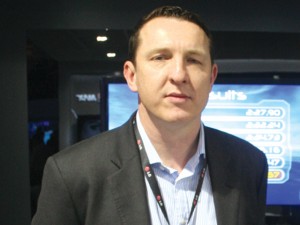
Manufacturer to focus on the low- to mid-end of the market to combat sharp decline in market share over the past two years
LG says it needs to rebuild its commercial credibility in the UK after its market share declined “significantly” over the past two years. The company has seen its market share drop from around 10 per cent two years ago to around five per cent today.
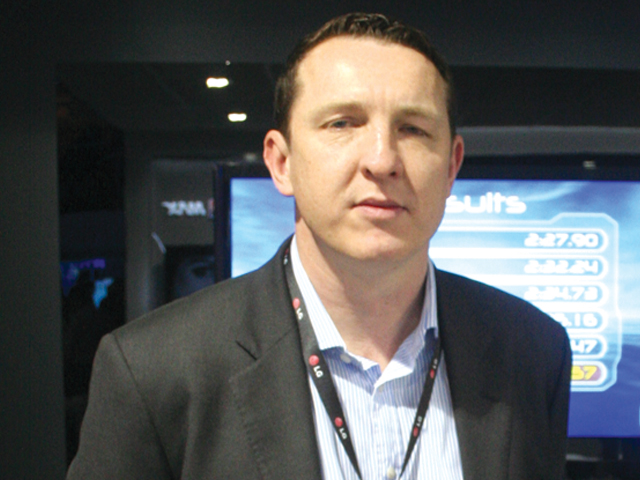
LG Electronics UK consumer marketing director Stephen Gater (pictured) told Mobile News the manufacturer had focused on the high-end handset market despite a lack of consumer confidence in its products.
He also admitted sales of its Optimus 3D handset did not match expectations.
To combat this, Gater said LG is looking to focus more on the low- to mid-end of the market to rebuild its credibility among customers and resellers alike. ...
Read the full story here:
MarketResearch.com has announced the addition of the new report "HDTV, 3DTV and DVR Forecasts," to their collection of Battery Technology market reports. ... HD-ready penetration will double from 25.9% at end-2011 to 50.9% in 2016. However, HD-ready penetration will be higher than 80% in 18 countries by 2016.
Simon Murray (author of the HDTV, 3DTV and DVR Forecasts report) said: "Most sets on sale in developed markets are now HD compatible, with a growing proportion also providing 3D functionality. Retail prices are falling as production reaches economies of scale, as competition increases and as consumer acceptance grows."
More than 300 million HDTV-ready households existed at end-2011 for the 40 countries covered in the report. The US supplied 79 million of the total, followed by China (35 million) and Japan (24 million).
The HD-ready household total will more than double to 652 million by 2016. China will become the market leader, by providing 151 million homes -- up by 116 million on 2011.
See the original post here:
 [Philip Lelyveld comment: this lengthy article is an overview update on 4K and beyond in both theatrical and home theaters situations.]
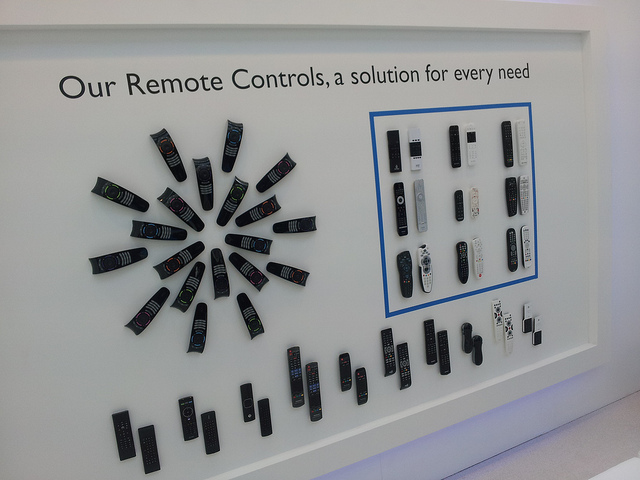 At IP&TV World Forum in London, I tried several of the software and hardware technologies pitched by dozens of jostling vendors to new internet TV operators. My conclusion - the four-directional paradigm of the conventional TV remote control, used by most new-wave connected TVs, is no longer suitable for the exploding new set of use cases for the humble telly box.