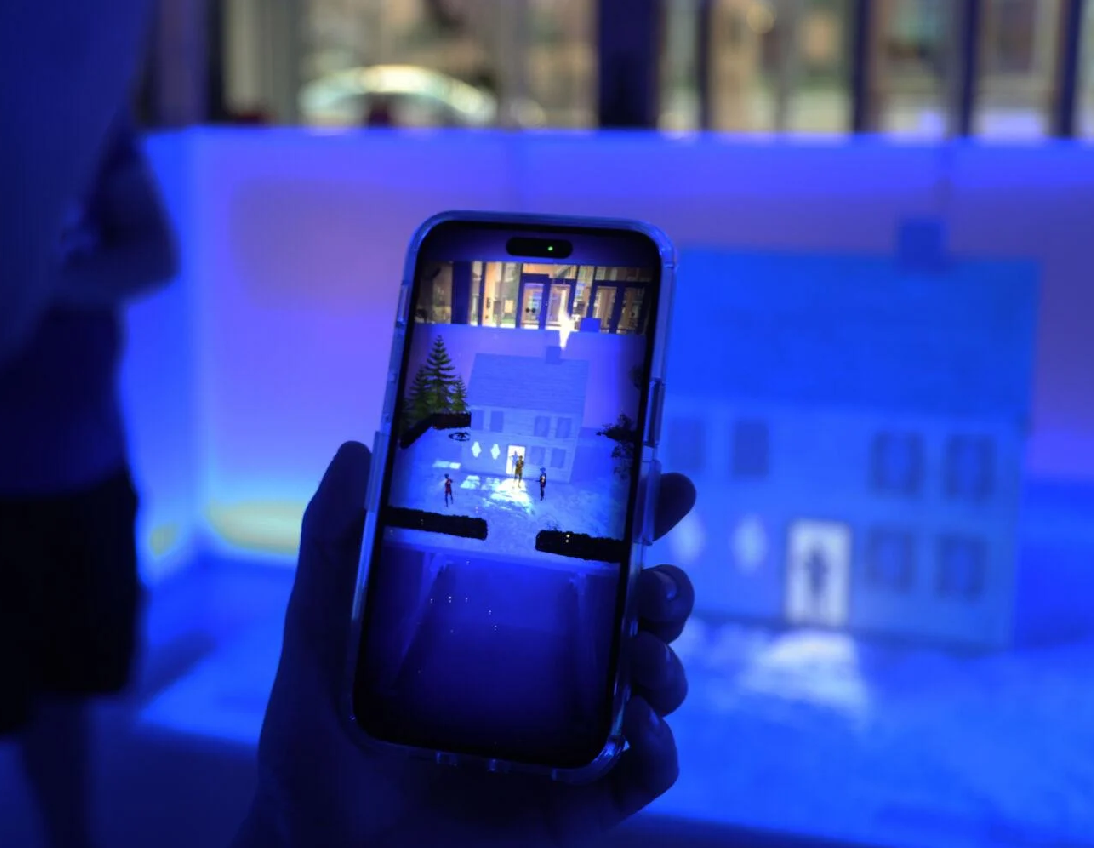
The 14-foot, glowing glass cube — located past the entrance to the Johnny Carson Center for Emerging Media Arts — has been turning heads at the University of Nebraska-Lincoln.
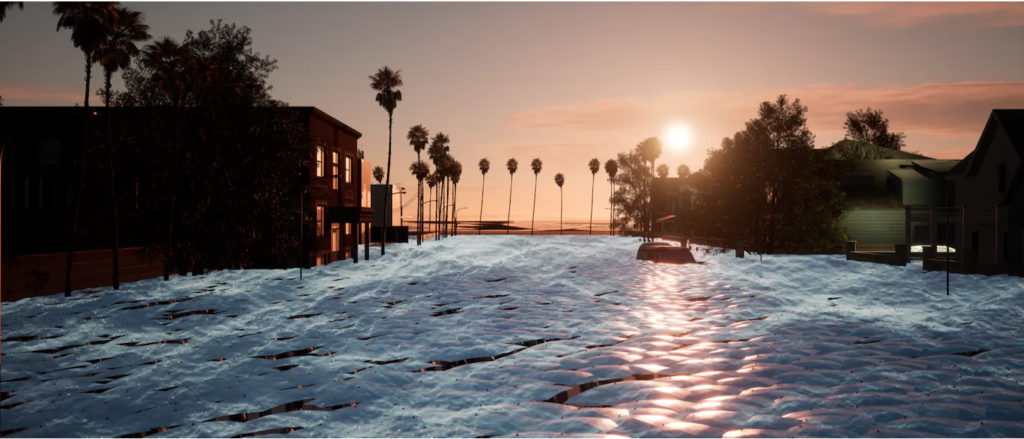
The cube is home to The Dial, an interactive experience that utilizes augmented reality (AR) and projection mapping to tell the story of a serious car crash from several perspectives. ...
“The idea of using the user’s position to trigger transitions and sequences is fascinating,” Sebastian Vladimir, a senior emerging media arts major and docent for The Dial, said. “You’re not just using augmented reality to explore or see something, you’re using it to tell a story.” ...
The Dial received its name because users control time by walking around the table, acting as the hand of a clock. ...
“Take a look where you wouldn’t expect to have to look,” Vladimir said. “Take a look under the table. Look up. You’re going to be talking about it for a while after the experience.”
The Dial will be available at the Carson Center until Dec. 1, and tickets are readily available for students. ...
"All verified election advertisers in regions where verification is required must prominently disclose when their ads contain synthetic content that inauthentically depicts real or realistic-looking people or events," says Google's updated policy, which also applies to content on YouTube. "This disclosure must be clear and conspicuous, and must be placed in a location where it is likely to be noticed by users. This policy will apply to image, video and audio content."
"Advertisers will have to disclose whenever a social issue, electoral or political ad contains a photorealistic image or video, or realistic sounding audio, that was digitally created or altered," Meta's new policy says. ...
... The unions landed on opposite sides of several hot-button issues with the Motion Picture Association, which reps major studios like Disney and Warner Bros. Discovery. The MPA was joined by Meta, OpenAI and tech advocacy groups. Where they diverge the most is whether new legislation is warranted to address the unauthorized use of copyrighted material to train AI systems and the mass generation of potentially infringing works based on existing content. This has prompted some creators to question why studios aren’t allying themselves with actors and writers and against AI companies to oppose what could constitute the mass pilfering of their material in violation of intellectual property laws.
“Studios should be protecting their copyrights,” a WGA member tells The Hollywood Reporter. “It’s shortsighted, because it demotes them to another source of content for these AI firms.” ...
A representative for Scarlett Johansson last week said the actress took legal action against an AI app developer for using her name and likeness in an online ad posted on X that featured an AI-generated version of her voice. While copyright law doesn’t account for a person’s voice or face, some states carry right of publicity laws that protect against unauthorized commercial uses of a person’s name, likeness and persona. It’s meant to provide individuals the exclusive right to profit off of their identities. ...
Since the 6th of November, for 300,000 RMB (41,190 USD), you can get your own personal digital person powered by Baidu’s ERNIE Bot language model, which also comes with a lifetime guarantee. Better still, it’s readily available on digital human Du Xiaoxiao’s (度晓晓) Taobao shop “Xiaoxiao General Store” (晓晓万事屋). ...
The General Store is also stocked with single-purpose ERNIE-driven chatbots, such as one that flatters you, one that comforts you, or even one that purports to “reset your life” ...
Together, with SFER IK’s Creative Director Marcello Dantas, Roth has launched The SFER IK Award, a new award for artists to create a work using artificial intelligence. The winning artist will receive $100,000 USD to develop their AI-integrated artwork, as well as a two-month residency with access to on-site resources at AZULIK Uh May—a sprawling creative campus with several workshops, local artisans, and a suite of new digital facilities called FabLab. Art residencies will also be offered to second- and third-prize winners. ...
The award is open to international artists from all disciplines to create an AI-integrated work addressing themes of biodiversity, interspecies collaboration, ancestral knowledge, and the harmonious integration of science, technology, and nature. The purpose of the open call is to create an opportunity for artists to generate new and daring artworks that will expand the boundaries of technology and their artistic practices within the natural environment of the Mayan jungle. The winning artwork will ultimately be showcased at SFER IK’s upcoming open-air museum in Tulum, close to the Jardín de la Esperanza (Garden of Hope), an artistic natural space currently under development by artist Cristina Ochoa that will be a sanctuary of biodiversity and ancestral memory. ...
By inviting artists to create their work in the middle of the jungle, we hope they will be inspired and transformed by the environment and have the chance to intervene in the landscape. ...
3.4. What does it mean that provenance data is cryptographically bound to the asset?
The provenance data and the asset are the two parts of the same puzzle - a unique puzzle. The possibility of any other pieces ever matching, either by coincidence or by purposeful creation, is so low that it would be practically impossible. This is known as a hard binding.
This inability to always be able to verify the provenance of an ingredient is not problematic, because the trust of the asset remains in the signer of the asset’s C2PA Manifest. However, having the ingredient’s C2PA Manifest included in the asset’s C2PA Manifest Store, enables the verification of the ingredient’s assertions (which are important trust signals), even if its hard bindings cannot be validated.
3.5. Use of Artificial Intelligence & Machine Learning (AI/ML)
3.5.1. How does C2PA address the use of AI/ML in the creation and editing of assets?
Each action that is performed on an asset is recorded in the asset’s C2PA Manifest. These actions can be performed by a human or by an AI/ML system. When an action was performed by an AI/ML system, it is clearly identified as such through it’s digitalSourceType field. ...
Pico to cut jobs with 'hundreds' of staff to be affected-sources
ByteDance has pared back efforts to develop Pico brand-sources
Multiple senior managers have left Pico this year-source
... However, VR demand has sputtered this year. Augmented reality (AR) and VR headset shipments have fallen for the last four consecutive quarters, according to data from research firm IDC ended June 30, with volumes down 44.6% in the second quarter year-on-year.
Since the acquisition, Pico has been aggressively expanding both inside and outside China. In China, it has become the leading VR producer by total shipments and globally it trails only Meta. ...
Natasha Sandmeier: I am an architect and educator based in Los Angeles, where I lead the postgraduate Entertainment Studio at UCLA AUD. At the Entertainment Studio, we work predominantly in the visualizationspace, thinking about ways to build stories centering on the built environment, how we live in the world, and how it might transform in the imminent near future of the next quarter century. Our speculations intentionally stay in the near present or near future, so that we don’t stray too far into the fanciful or unattainable. For example, 25 years ago from now was 1998, and although the world was quite different then, it wasn’t alien to where we are today.
Beyond the Entertainment Studio, I recently became the Executive Director of the A+D Museum here in Los Angeles, where we are working to advance the next generation of museum programming and community building. During the pandemic, the museum transitioned to a virtual programming format, so our most present mission is guiding our re-entry into the physical museum world, which we have been doing over the past few months. ...
Recently, I was studying the roles and responsibilities of architects in designing cities and suburbs, including Ellen Dunham-Jones’ observation that architects design only a small percentage of suburban development. Massive developments are largely developer-led with in-house designers and architecture teams. If we as a profession can offer more affordable services by outsourcing repetitive work, there is hope that we can capture some of the growth opportunities in areas currently dominated by developers. ...
To conclude, I wanted to switch focus from academia and ask about the A+D Museum, of which you have recently become the Executive Director. Do you expect computation and artificial intelligence to manifest in some way across the museum’s future program?
It undoubtedly will. The question of how technology is changing the face of architecture and media is a relevant question for the museum. For example, October sees us host a conversation with Paul Debevec, the Chief Research Officer of Eyeline Studios – Powered by Netflix, which dwells on themes of computer vision, computer graphics, machine learning, and their connection to visual, virtual, and animated media.
For us, the question of how forces such as technology can change and give opportunities to the profession is more productive than thinking about ways they can destroy the profession. In the media, it is all about the ‘death of labor.’ That is not to say jobs in society will be immune to disruption, but if architects have one skill, it is agility. Now is a moment to capitalize on that agility.
... Existing research on AI technology adoption can help support this prediction. Dr. George Dagliyan uncovered through his research during the Executive Doctorate of Business Administration program at Pepperdine’s Graziadio Business School, that there are both facilitators and inhibitors of AI adoption:
Facilitators of AI adoption:
Convenience,
Customization
Efficiency
Inhibitors of AI adoption:
Uncertainty
Privacy risk
Loss of control risk
For consumers, AI applications that disproportionally facilitate convenience, customization, and efficiency will become prevalent and second nature, such as recommender systems. Social media and streaming platforms use AI algorithms to analyze clicks and viewing habits and preferences to suggest relevant content, making search convenient and personalized, and saving consumers lots of effort and time browsing through countless options. There is a loss of privacy because the algorithms mine consumer demographics and past choices, but as the massive adoption so far shows, facilitators more than compensate for this loss. ...
For consumers, Dagliyan’s study also uncovered that trust in a brand can enhance facilitators and dim inhibitors. ...