Today, a startup called Atom Computing announced that it has been doing internal testing of a 1,180 qubit quantum computer and will be making it available to customers next year. The system represents a major step forward for the company, which had only built one prior system based on neutral atom qubits—a system that operated using only 100 qubits.
The error rate for individual qubit operations is high enough that it won't be possible to run an algorithm that relies on the full qubit count without it failing due to an error. But it does back up the company's claims that its technology can scale rapidly and provides a testbed for work on quantum error correction. And, for smaller algorithms, the company says it'll simply run multiple instances in parallel to boost the chance of returning the right answer. ...
... If you’ve gotten this far, here’s the payoff: If today’s large language models are capable of some amount of reasoning, however elementary, it could yield what could be years of rapid advances in the abilities of generative AIs.
In part, that’s because language isn’t just another medium of communication, like pictures or sound. It’s a technology humans developed for describing absolutely everything in the world we can conceive of, and how it all relates. Language gives us the ability to build models of the world, even absent any other stimuli, like vision or hearing, says Aguera y Arcas. ...
That is why a large language model can write fluently about the relationship between, say, two colors, even though it has never “seen” either of them, he says. ...
...we might soon have AI-based assistants that are completely personalized to data specific to us. Google is already attempting a first version of this—an update to its Bard generative AI allows it to search and synthesize across all of your emails, calendar items and documents, as long as they are already in Google’s system—but it’s primitive and prone to error. ...
Between the invention of the steam engine and the debut of the locomotive, more than a century elapsed. Meanwhile, a new science was born, which in turn became the midwife of countless other advancements essential to the Industrial Revolution. If the development of generative AIs conforms to this pattern at all, its near future will include transformative inventions—AIs expert in different subjects, truly personal assistants—followed by years of refinement, mad scrambles to harness and benefit from these new technologies, and possibly another sort of Industrial Revolution. But rather than a revolution predicated on energy and matter, this one will be based on the manipulation of data and insight. ...
PhilNote; This sounds like incredible hardware, and our friend Andrew Shulkind was the driving force.
... The resulting Big Sky camera fea-tures an 18K sensor that measures 77.5mm x 75.6mm (3.05"x2.98"); the system is capable of capturing images at 120 fps and transfer-ring data at 60 gigabytes per second. ...
An additional complication was that the audience’s natural vision inside the Sphere places the most important part of the image in the lower quarter of the screen; this is the most comfortable viewing angle, one that doesn’t require craning your neck to look up. There is still a considerable amount of image above the audience’s head, though — so, when a typical scene is shot, the camera must be con-stantly tilted at 55 degrees to capture an angle of view that fills the entire screen, with the “center” of the action framed through the lower edge of the lens. ...
For Sphere, the team had to create a 165-degree-horizontal-angle-of-view fisheye lens with an edge-to-edge performance exceeding 60-percent MTF at 100 line-pairs — an extraordinary feat for any photographic lens. The result is a lens the size of a dinner plate, ...
The Sphere Immersive Sound system, developed in partnership with the German company Holoplot, involves 167,000 speakers that direct sound to the audience like a laser beam — and with nearly the same precision. The system not only delivers delay-free and echo-free sound to all seats, but it can also create wholly immersive 3D audio by placing a sound in any position in 3D space. ...
Further, the system can deliver an entirely different soundtrack, in various languages, to different positions in the theater. So, within a small group of seats, one viewer can listen to a French soundtrack while the neighboring viewer hears English — both in perfect sync with the picture. ...
Sphere currently has 10 Big Sky cameras, and there are more coming. ...
Our goal is to use this technology to take people to new places they haven’t been before and make them feel as if they had been,” Shulkind concludes. “For movies, 4K is good enough. With Sphere, good enough isn’t good enough anymore.”
This new data poisoning tool lets artists fight back against generative AI
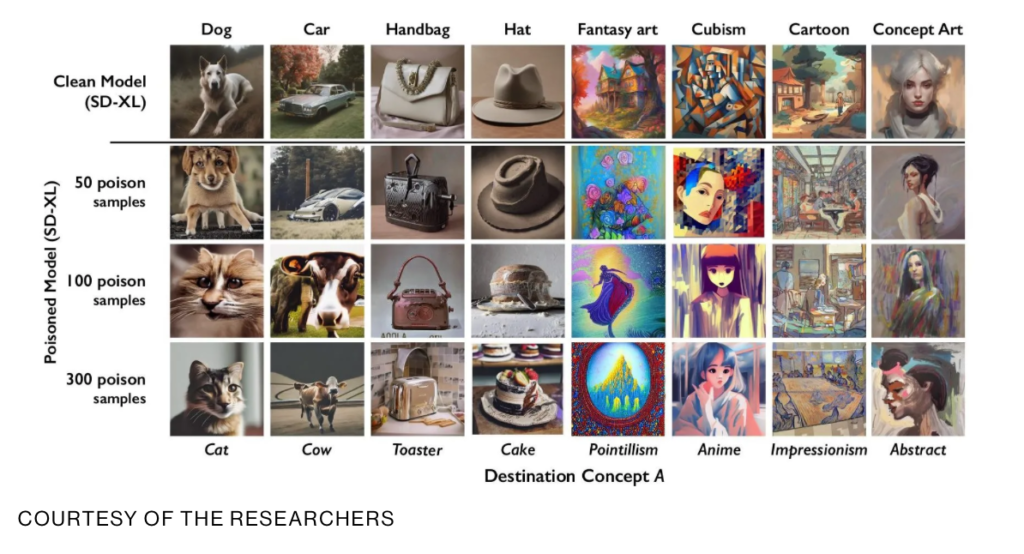
What’s happening: A new tool lets artists make invisible changes to the pixels in their art before they upload it online so that if it’s scraped into an AI training set, it can cause the resulting model to break in chaotic and unpredictable ways.
Why it matters: The tool, called Nightshade, is intended as a way to fight back against AI companies that use artists’ work to train their models without the creator’s permission. Using it to “poison” this training data could damage future iterations of image-generating AI models, such as DALL-E, Midjourney, and Stable Diffusion, by rendering some of their outputs useless.
How it works: Nightshade exploits a security vulnerability in generative AI models, one arising from the fact that they are trained on vast amounts of data—in this case, images that have been hoovered from the internet. Poisoned data samples can manipulate models into learning, for example, that images of hats are cakes, and images of handbags are toasters. And it’s almost impossible to defend against this sort of attack currently.
... When Bennett begins to connect the evolution of the human brain to where we are in the development of artificial intelligence is when the book, for this reader, gets more interesting. Why can’t machines truly learn? Even ChatGPT, which every industry seems to be embracing these days, can’t “learn things sequentially,” writes Bennett. “They learn things all at once and then stop learning.” We’ve trained ChatGPT using the entire contents of the Internet, but the software can’t learn new things because of the risk that it will forget old things, or learn the wrong things. ...
... he does end his book with a challenge. Evolution gave us our magnificent human brain, he writes, and now that we are in a position to play god and create a new form of intelligence, we must first decide on our goal — are we destined to spread out across the cosmos? Or will we fail, victims of pride or climate change or something yet unseen, just another branch on the evolutionary tree, which will grow on without humans and perhaps never add a limb called “Artificial Intelligence?” ...
Summary: Researchers have created a groundbreaking non-contact technology to simulate cold sensations in virtual reality, maintaining consistent skin temperatures.
By combining cold airflow and light, they induce cold sensations without actual temperature shifts. This breakthrough provides a novel approach to simulating persistent thermal experiences in VR environments, enhancing the user’s immersion.
The technology holds the promise of revolutionizing VR experiences by providing instantaneous and sustained thermal sensations....
The technology employs a combination of cold air flow and a light source to instantly switch between a quick cold and a gentle warm stimulus, inducing a cold sensation while maintaining the skin temperature fluctuations close to zero. ...
... Looking at dominant digital mediums in 2023, honing in on Gaming and Streaming seems inevitable, and comparing the two is becoming essential. Notably, gamers entwine themselves within the fabric of the studios and creations they adore. They gladly spend money on experiences from studios they love, even if the product releases to mediocre reviews. On the contrary, streaming platforms, hubs of passive entertainment consumption, navigate through a maze of precarious consumer loyalties, where even titans like Disney+ can witness millions of subscribers being snapped away due to alterations in content offerings. ...
Charting a Course Toward Subscriber Loyalty
The path toward establishing staunch viewer loyalty in streaming begins with forging a bidirectional interaction model akin to what’s seen in the gaming industry. Streaming platforms can potentially revolutionize the viewer experience by purposefully crafting communities around content and amplifying viewer involvement instead of canceling many of their shows before they even get off the ground. How will viewers find an affinity and create a sense of creative ownership over a product if they assume it’ll be canceled before watching it? Creating dedicated forums, interactive live sessions with content creators, or hosting virtual events might be the catalyst to transform passive viewers into an engaged community. ...
By unraveling the strands of deep-rooted loyalty among gamers, streaming platforms have an opportune moment to reimagine their engagement strategies and content creation paradigms. Lessons derived from gaming—direct consumer involvement, community-building, long-term support for underperforming projects, and strategic content development—can illuminate a path towards mitigating the inconsistent subscription trends and establishing a steadfast viewer base for streaming platforms.
They call it Q-Day: the day when a quantum computer, one more powerful than any yet built, could shatter the world of privacy and security as we know it. ...
...it would fundamentally undermine the encryption protocols that governments and corporations have relied on for decades. ...
Today, the most powerful quantum device uses 433 “qubits,” as the quantum equivalent of transistors are called. That figure would probably need to reach into the tens of thousands, perhaps even the millions, before today’s encryption systems would fall. ...
But within the U.S. cybersecurity community, the threat is seen as real and urgent. China, Russia and the United States are all racing to develop the technology before their geopolitical rivals do, though it is difficult to know who is ahead because some of the gains are shrouded in secrecy. ...
On the American side, the possibility that an adversary could win that race has set in motion a yearslong effort to develop a new generation of encryption systems, ones that even a powerful quantum computer would be unable to break. ...
Judging in part by past migrations, officials estimated that even after settling on a new generation of algorithms, it could take another 10 to 15 years to implement them widely. ...
Many of the most promising submissions are built on lattices, a mathematical concept involving grids of points in various repeating shapes, like squares or hexagons, but projected into dimensions far beyond what humans can visualize. As the number of dimensions increases, problems such as finding the shortest distance between two given points grow exponentially harder, overcoming even a quantum computer’s computational strengths. ...
The size of American companies like Apple, Google and Amazon, with their control over large swaths of internet traffic, also means that a few players could get large parts of the transition done relatively nimbly. ...
But strategists caution that the way an adversary might behaveafter achieving a major breakthrough makes the threat unlike any the defense community has faced. Seizing on advances in artificial intelligence and machine learning, a rival country may keep its advances secret rather than demonstrating them, to quietly break into as many troves of data as possible. ...
A recent study published in the Journal of Environmental Psychology indicates that spacious natural landscapes can enhance feelings of selflessness, connectedness, and boost positive emotions. The research, conducted using immersive virtual reality technology, found that participants felt a diminished sense of body boundaries, leading to increased selflessness. ...
The study involved 80 participants, primarily students, who were invited to explore virtual natural environments created by the researchers.
The participants were divided into four groups, each experiencing a different combination of spaciousness and nature type. Some explored dense natural landscapes, while others ventured into spacious ones. Additionally, the researchers considered two types of nature settings: tended and wild. The tended landscapes featured signs of human intervention, such as paths, while the wild ones remained untouched by human hands. ...
Moreover, the study demonstrates the value of virtual reality technology in providing immersive nature experiences, particularly for those who may have limited access to wide open spaces. Virtual reality could help to bridge the gap between urban living and the natural world, offering opportunities for relaxation, stress reduction, and emotional well-being. ...