A user who goes by Jenny showed off the feature in a video for UploadVR
Jenny is part of Helping Hands, a VR sign language community comprised of 5,000 volunteers who teach others how to take advantage of the tech to keep in touch with others in the community virtually.
... I spoke with a bunch of ethical-AI practitioners about the challenges they face in their work, and one thing was clear: burnout is real, and it’s harming the entire field. Read my story here.
Two of the people I spoke to in the story are pioneers of applied AI ethics: Margaret Mitchell and Rumman Chowdhury, who now work at Hugging Face and Twitter, respectively. Here are their top tips for surviving in the industry.
1. Be your own advocate.
2. Slow and steady wins the race. ... Her advice: It’s okay not to engage in every debate. ...“You’re better off focusing on your work, and coming up with something solid even if you’re missing two or three cycles of information hype.” ...
3. Don’t be a martyr. (It’s not worth it.) ... “Your job is not to be paid lots of money to point out problems. Your job is to help them make their product better. And if you don’t believe in the product, then don’t work there.” ...
... Experimental electronic composer Holly Herndon returns today with her own cover of "Jolene" made with the help of her AI-powered vocal deepfake, Holly+. The stripped-down cover was made by feeding a modified score into Holly+ with new harmonies. The result was then generated into Herndon's own voice. Featuring additional accompaniment by Ryan Norris on guitar, the cover is truly impressive in its uncanny likeness, being able to seamlessly reproduce Herndon's dynamic vocal range without wavering. ...
When we discuss animal rights and welfare, we often reference two ideas: sentience (the ability to feel) and sapience (the capacity for have complex intelligence). Yet, when we discuss robots and advanced AI, these two ideas are curiously absent from the debate. Perhaps we are on a technological threshold between "AI" and "dignified AI." Maybe it's time to talk more about robot rights. ...
... It turns out, the stereotypical bright light at the end of the tunnel is real; many people who almost die report the same key visuals. What’s less well known is that survivors also often report an overwhelming sense of peace, gratitude, and even oneness of the world. “You see your life as a whole,” Slater told The Daily Beast, “and you realize the meaning of life is more important than buying my next car.”
So Slater, who’s also co-director of the university’s cutting-edge eventLAB (that’s Experimental Virtual Environments for Neuroscience and Technology), decided to use virtual reality to replicate crucial aspects of a near-death experience—and, he hoped, the radical shift in perspective that sometimes accompanies it. ...
Technicolor Creative Studios has teamed with state-of-the-art virtual production company NantStudios on the creation of a new virtual production stage, which will open as part of its 60,000 square-foot Creative Hub in Culver City in 2023.
Technicolor has established the tech partnership and stage build as part of its investment in the future of filmmaking, due to growing market demand for bleeding edge Virtual Production solutions. The new stage will serve the collective of companies under the Technicolor Creative Studios umbrella — including MPC, The Mill, Mikros Animation and Technicolor Games — as well as clients looking to research and develop content utilizing Virtual Production technologies for feature films, episodic, advertising and gaming.
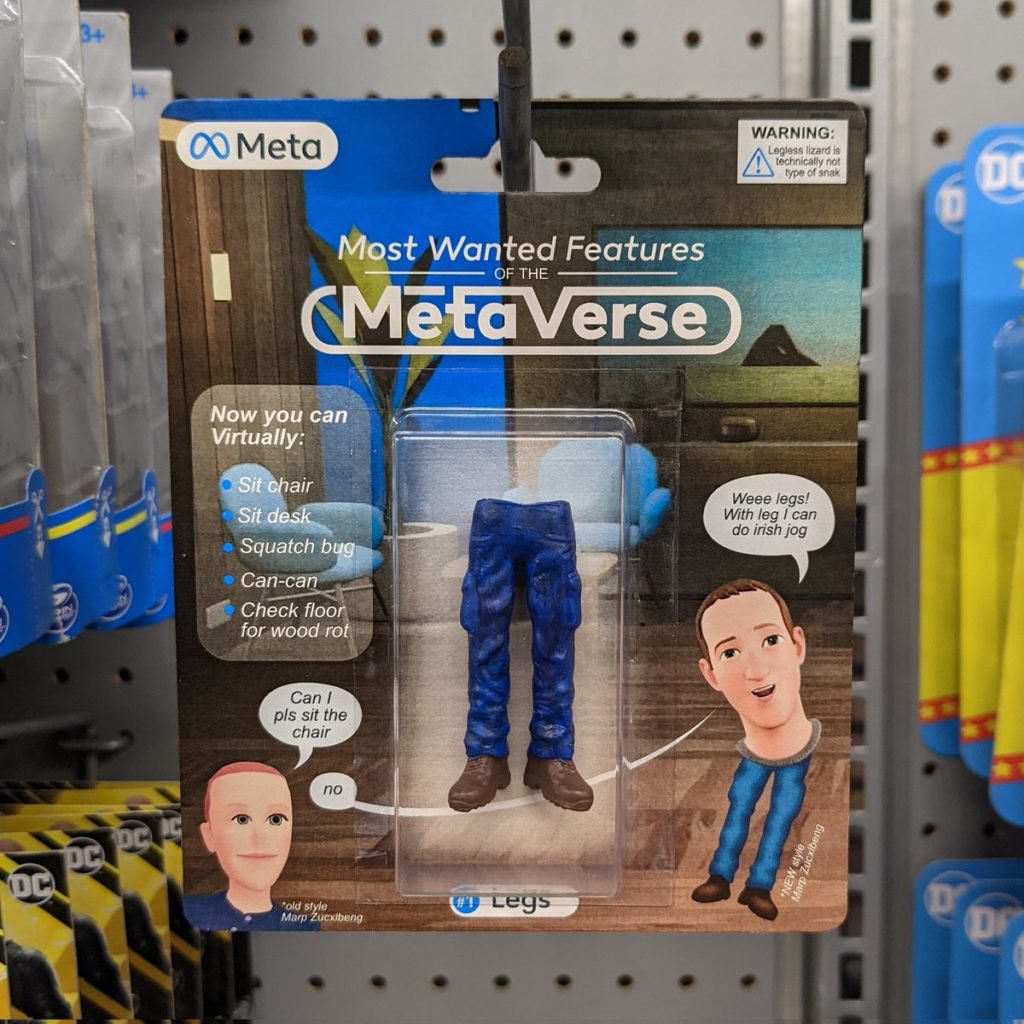
After seeing that Zuckerberg was being roasted online for calling avatar legs “probably the most requested feature on our roadmap," Legboot decided to make them a reality. He grabbed a cheap plastic figure off of Chinese ecommerce site Alibaba, "chopped his legs off," and painted them a shade of Meta blue.
... Founded in December 2021 by Daniel Lubetzky — the founder of Kind Snacks — Starts With Us originally invited people to pledge to “stop listening to react and start listening to understand,” and to “stop letting our differences divide us and start letting them develop us.” Lubetzky — whose father survived the Holocaust — has spent decades working in the Middle East on various diplomatic and business ventures. (In 1994, he founded PeaceWorks, a business that fosters stronger connections between Arab and Israeli communities.) Now, with Starts With Us, the goal is to foster “curiosity, empathy and courage” in the U.S. through content and programming for a range of political affiliations. ...
... “Piecing these numbers together, it’s clear that social media has become an accelerant not only of political division but now national stress,” said John Gerzema, CEO of The Harris Poll. “As we think about other detriments to public health social media — when misapplied — is now entering the category of cigarettes, alcohol and other high-risk factors.”
While corporations have been increasingly involved in addressing social issues, some wonder if that might soon change in the coming year. On Tuesday, Forrester predicted that B2C marketers will start to retreat from taking political stances in 2023, especially if conservatives regain control of Congress after the U.S. midterm elections. However, Forrester analyst Mike Proulx said other survey data suggests that people across the political spectrum want ways of seeing the other side of the aisle.
“What it tells us is that more people than not despite the voices that are fueling the divisiveness,” Proulx said. “Most people want to find common ground.”
Virtual being developer Soul Machines and nutrition provider Calocurb have unveiled digital health and wellness coach “Jenny.” The animated AI character combines realistic synthetic media and conversational AI to offer quasi-human guidance for people using Calocurb to improve their health, a first in the market, according to Soul Machines.
COACH JENNY
Calocurb sells a “natural appetite suppressant” and incorporates broader health guidance and education in relation to its main product. Jenny is designed to help customers who have questions about the product or who are seeking advice on reaching fitness goals and other wellness plans. The AI can answer questions using any data on the website, including relevant diagrams and videos. For prospective customers, Jenny can even break down the various purchase options and link to Calocurb’s store. ...
PhilNote: The Stanford Digital Economy Lab produces regular interviews with thought leaders. This is an excellent conversation and a very good window into the current state of the business and culture of the metaverse.
Herman Narula, CEO of Improbable and author of Virtual Society, explains why everything you have heard about the metaverse so far is wrong. Narula argues that the metaverse goes back thousands of years and that our digital future cannot be understood merely by glancing back at the digital technologies that have preceded it. Narula explains why the metaverse will and should matter to individuals and society.