For seven or eight years we've been hearing about Web3 and decentralized apps. It is all still a work in progress. Today most dApps are cumbersome, with a pretty poor consumer experience. A lot of that can be attributed to the underlying infrastructure. This is changing, finally. Last year $30 billion of venture funding was invested in decentralized infrastructure. We should be seeing some signficant improvements in these platforms this year. For instance, I found this announcement about Mysten Labs and SUI to be interesting. This project was started by the team that developed Libra crytocurrency inside Facebook. When that project came to an end, this team spun out and started something fresh. Their goal is to build a blockchain platform that does not suffer from the many obvious defects of the current generation of dApp platforms. This is interesting. If you have been following Web3, no doubt you are familiar with the kneejerk reaction among crypto-haters that goes like this: "blockchain is environmentally unfriendly and it will destroy the planet." Peer past the hyperbole, and what you are left with is a luddite view based on the (incorrect) assumption that no improvement in blockchain consensus mechanisms is possible. In 2022 we will see most of the major blockchain platforms (not bitcoin) make substantial improvements in efficiency and scalability, at the cost of only minor reductions in security. So in my view now is an excellent time to be rethinking this Luddite view. Instead of saying, "blockchain bad, blockchain inefficient" maybe now it is a good time to get smart about what might be possible if a very efficient, scalable, fast blockchain platform were available. This Medium article shares links to many exciting scenarios and examples, including dynamic NFTs, new kinds of games, loyalty programs, smart coupons, on-chain defi, and other advances in smart contracts. Disclosure: I have no stake in Mysten or SUI and I don't know anyone there. I am not flogging crypto and I currently hold no NFTs. So I am not a cheerleader for this stuff. Just a guy who is trying to get a glimpse of what the rest of this decade will look like. Articles like these, and the discussions that follow, are a good way to get into that.
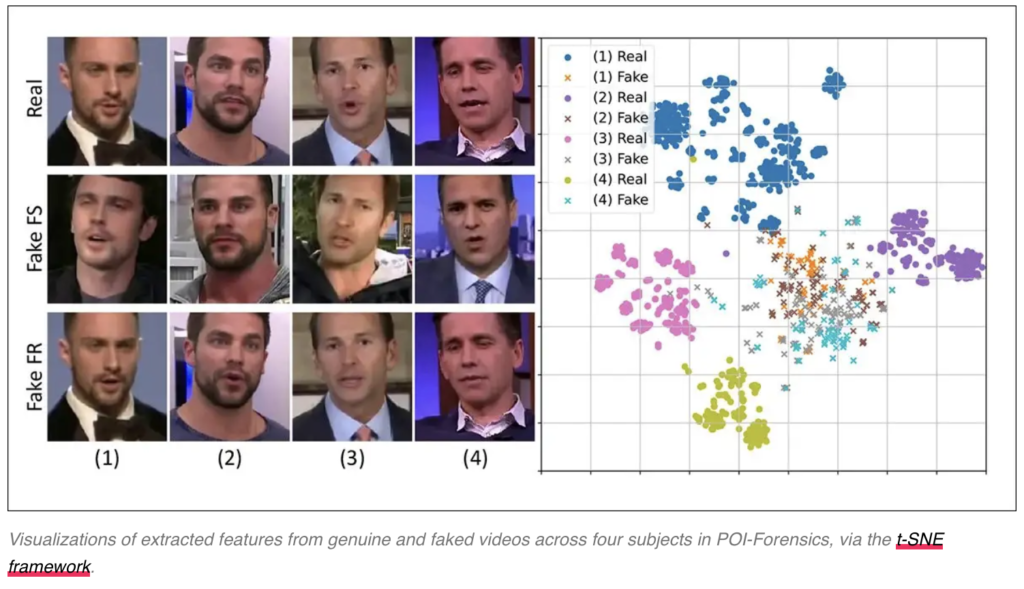
... Successful and popular deepfake methods such as FaceSwap and DeepFaceLab/Livecurrently have zero capacity to create such granular biometric approximations, relying at best on talented impersonators on whom the faked identity is imposed, and much more commonly on apposite in-the-wild footage of ‘similar’ people. ...
These two dominant deepfake packages are based on autoencoders. Alternative human synthesis methods can use a Generative Adversarial Network (GAN) or Neural Radiance Field (NeRF) approach to recreating human identity; but both these lines of research have years of work ahead even to produce fully photorealistic human video.
With the exception of audio (faked voices), biometric simulation is very far down the list of challenges facing human image synthesis. In any case, reproducing the timbre and other qualities of the human voice does not reproduce its eccentricities and ‘tells’, or the way that the real subject uses semantic construction. Therefore even the perfection of AI-generated voice simulation does not solve the potential firewall of biometric authenticity. ...
The Khronos Group and the Haptics Industry Forum (HIF) have entered into a cooperative liaison agreement to foster synergy between the two organizations to encourage the integration of advanced haptics functionality into the Khronos OpenXR open standard for portable augmented and virtual reality (AR/VR), to enable broad availability of haptics in the metaverse and beyond.
According to the Khronos Group, the agreement will see HIF and Khronos collaborate with a shared goal to enable broad, cross-platform access to next-generation haptic feedback in XR applications, enabling rich multisensory experiences to reach beyond 3D visuals for the eyes and spatial audio for the ears – and include expressive haptics for touch. ...
... How should a platform or a society address the problem of fake news? The spread of misinformation is ancient, complex, yet ubiquitous in media concerning elections, vaccinations, and global climate policy. After examining key attributes of “fake news” and of current solutions, this article presents design tradeoffs for curbing fake news. The challenges are not restricted to truth or to scale alone. Surprisingly, there exist boundary cases when a just society is better served by a mechanism that allows lies to pass, even as there are alternate boundary cases when a just society should put friction on truth. Harm reflects an interplay of lies, decision error, scale, and externalities. Using mechanism design, this article then proposes three tiers of solutions: (1) those that are legal and business model compatible, so firms should adopt them (2) those that are legal but not business model compatible, so firms need compulsion to adopt them, and (3) those that require changes to bad law. ...
Once you understand the vibe, this is when you are ready to invest or even create an NFT. Then you look at the framework:
THE TEAM: Are they “Doxxed”? Meaning are they known, do we know their identities? Do we know their personalities? Do we know their background?Are they committed on the long run to the project? Are there any Legal documentation?
THE PROJECT: Does the project have a Roadmap? Do we have utility? Do we have art? Is there any intrinsic value?
THE COMMUNITY: Do we have a community that is active and working on making the project a success? Do we have a committed group of people? Check Discord, Twitter, Instagram, and Facebook?
THE TECH: Check the Technology, which smart contract are they using, on which network?
THE LEGAL: Check if there is a company, if there are contracts, if there are commitments and lockup periods for the founders. Do they have a trademark, or intellectual property.
1. Founder Agreement 2. IP Assignment agreement 3. Non-Compete — Confidentiality 4. Employment agreements with Lockups linked to KPIs 5. Investment Agreement 5. Public Wallet — Public Repository Agreement 6. Financial Audit — AML — Custodian Agreement
These are the main components you look for in an NFT project. Stay tuned as we dig deeper into NFTs.
First, developments in AI will shift the balance of power between nations. ...
In September 2017, Vladimir Putin told a group of schoolchildren: “whoever becomes the leader [in AI] will become the ruler of the world.” While the U.S. currently leads in AI, China’s tech companies are progressing rapidly and are arguably superior in the development and application of specific areas of research such as facial recognition software.
Second, AI will empower a new set of geopolitical players beyond nation states. ...
Third, AI will open possibilities for new forms of conflict. ...
Such forms of conflict will prove hard to manage prompting a complete rethink of arms control instruments not suited to grapple with weapons of coercion. Current arms control negotiations need the adversaries to clearly perceive each other’s capabilities and their military necessity, but while nuclear bombs, for example, are limited in their development and application, almost anything is possible with AI, as capabilities can develop both quickly and opaquely. ...
The only way to mitigate AI’s geopolitical risks and provide the agile and comprehensive oversight it will require, is through open dialogue about its benefits, limitations and complexities. The G20 is a potential venue, or a new international governance mechanism could be created to involve the private sector and other key stakeholders.
Ninety-two percent of Gen Z consumers want to use augmented reality tools for e-commerce, according to Snapchat's survey of 16,000 users in 16 markets, conducted by Global Crowd DNA. Gen Zers are more likely than millennials and Gen X to buy a product that they first experienced using AR, per the report.
Sixty percent of Gen Z consumers said that AR experiences feel more personal and over half of Gen Z would be more likely to pay attention to an ad that uses AR.
Another way to describe it is as a low-privacy environment that gives, among others, law enforcement access to the transaction history of the entire network—as was the case when the US Department of Justice arrested two individuals accused of stealing $4.5 billion worth of cryptocurrency. Said assistant attorney general Kenneth A. Polite Jr. at the time, “Today, federal law enforcement demonstrates once again that we can follow money through the blockchain.”
Crypto wallets may be pseudonymous, but many exchanges have Know Your Customer protocols and collect tons of other data on users. Moreover, transactions necessarily require sharing your wallet with another party. As software engineer Molly White wrote, once someone knows your wallet address, privacy can be difficult, if not impossible to maintain: “Imagine if, when you Venmoed your Tinder date for your half of the meal, they could now see every other transaction you’d ever made—and not just on Venmo, but the ones you made with your credit card, bank transfer, or other apps, and with no option to set the visibility of the transfer to ‘private.’” ...