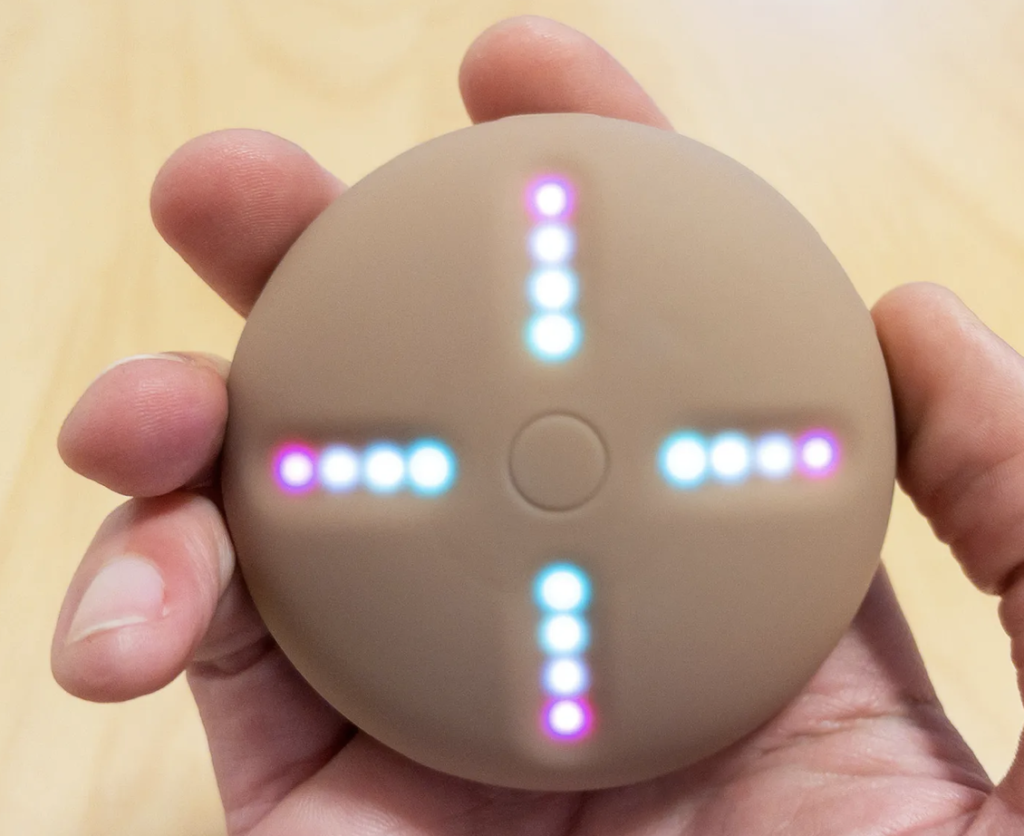
Kanye West’s $200 Stem Player will be the only way to get his next album, Donda 2
... “Today artists get just 12% of the money the industry makes. It’s time to free music from this oppressive system. It’s time to take control and build our own. Go to stemplayer.com now to order.” ...
The $200 Stem Player launched last year in a partnership with Kano Computing, shipping with the first Donda album so that you could manipulate any song using the touch-sensitive light sliders embedded in its beige shell. “We currently have 67,000 available and are making 3,000 a day,” said Ye in another post.
It worked well in our testing, allowing owners to easily manipulate different parts of a song while listening, whether for one of the included tracks or any others loaded via its web-based interface. However, adding loops and effects can get more complicated. It has 8GB of storage, connections via USB-C, Bluetooth, or 3.5mm headphone jack, and a 97db speaker. ...
According to Ye, “Tech companies made music practically free so if you don’t do merch sneakers and tours you don’t eat. Jay Z made Tidal and fake media attacked him. ...
See the full story with a video demo here: https://www.theverge.com/2022/2/18/22940748/donda-2-stem-player-kanye-west-exclusive-music
Ugh, Zuckerberg’s Metaverse Isn’t as Dead as We All Hoped
Mark Zuckerberg and his “Metamates” aren’t the only ones roaming around the metaverse.
The VR platform Meta is staking its future on, Horizon Worlds, has enjoyed 10x growth since it was rolled out to users in the US and Canada last December, as first reported by The Verge. According to a Meta spokesperson, the total number of users is up to 300,000 when you include those in Horizon Venues, a separate app for hosting live events, like concerts, sports, and comedy. The monthly user count does not include Horizon Workrooms, Meta’s other platform for conducting VR meetings. ...
Meta dropped out of the world’s 10 largest companies rankings by market value earlier this month. Once worth more than $1 trillion, the company has lost more than $500 billion in market value since September. Earlier this month, it had $230 billion wiped out in one day after revealing the first-ever sequential decline in Facebook daily active users. ...
See the full story here: https://gizmodo.com/meta-horizon-worlds-sees-10x-growth-since-december-1848562017

Talespin raises $20M to train workers using spatial technologies
Talespin has raised $20 million in funding for its task of using virtual reality and augmented reality — or spatial technologies — to train people to do work.
The company became famous a few years ago for a virtual reality demo designed to teach managers how to fire a hapless worker named Barry. While that sounds callous, it was really more about how to emotionally handle difficult tasks at work, and it conveyed how to do it in a gentle way. ...
“We had just raised money going into the pandemic and we had the ability to navigate the uncertainty,” Jackson said. “We immediately started having conversations that [spring of 2020] where everything we had been saying went from frontier tech to more foundational tech. I wasn’t having to sell and convince people of this anymore, as the utility seemed so obvious.” ...
The technology uses 3D virtual humans and environments to help people practice conversational skills and simulate jobs with real-time feedback and skills analytics. ...
“As organizations around the world grapple with unprecedented labor shortages, the need for innovative workforce training solutions has never been greater,” said Austin Noronha, managing director for the U.S. at the Sony Innovation Fund, in a statement. ...
I asked if the company had tapped AI tech like GPT-3 from the OpenAI Foundation, but Jackson said that so far it was proving to be easier to design applications with more limited, hard-wired responses, rather than relying on open-ended dialogue with AI trainers. ...

The Silicon Valley Restaurant Betting Big on Virtual Reality Dining
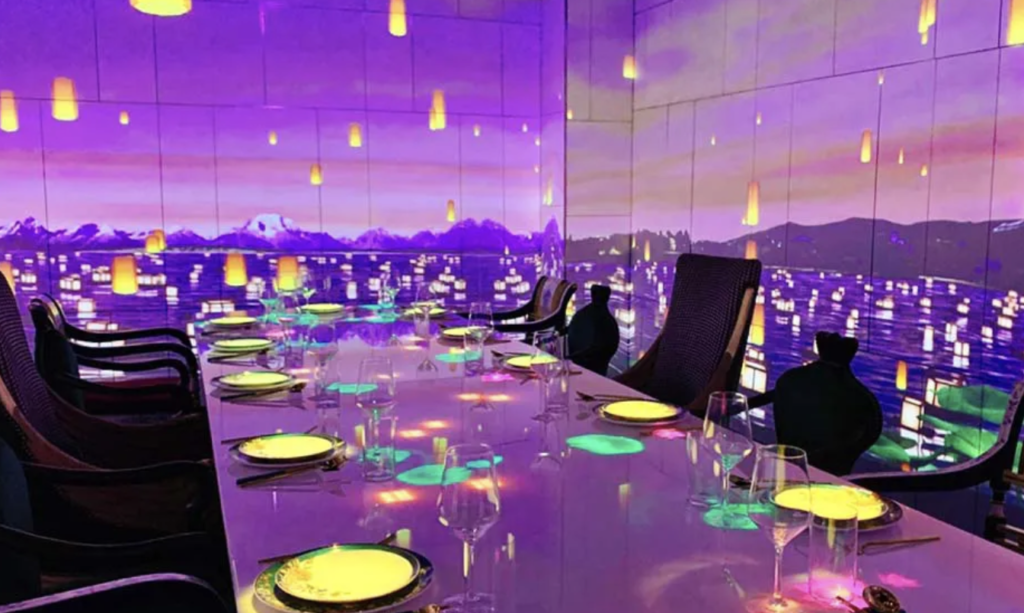
... Later this month, iChina will debut its extravagant virtual reality room, the VR Realm. The experience consists of a full-fledged sensory immersion and a tasting menu that comes with a hefty price tag: a minimum of $4,500 for 10 people. Though the concept may sound gimmicky, iChina is stepping into a domain that remains largely unexplored. The restaurant is one of the first in the U.S. with a virtual reality room; there are only a few other restaurant VR experiences scattered around the world, at upscale restaurants in Shanghai, Serpong in Indonesia, and Ibiza. ...
Given the steep price, the VR room is clearly not intended for everyone. So, who is it for? According to Lam, they’ve been receiving ongoing inquiries since last year, mostly from upscale corporate clients. As iChina begins booking reservations, the team has been creating additional scenes, some of which can even include corporate logos. ...
See the full story here: https://sf.eater.com/2022/2/16/22936200/virtual-reality-restaurant-san-jose-ichina
The Metaverse Manifesto
Metaverse Code of Ethics
“Ethics and Science need to shake hands” Richard Cabot, Physician & Teacher
- Transparency makes everything better.
2. It all starts with Trust
3. One World, One Metaverse
4. Inclusion is everything
5. Avatars are Real People
6. Ponzi Schemes Should be Highly Discouraged
7. Ethics & Values Are up to All of Us.
See the full story here: https://alan-smithson.medium.com/the-metaverse-manifesto-2206d893a3bb
New Virtual Reality technology to repair hearts
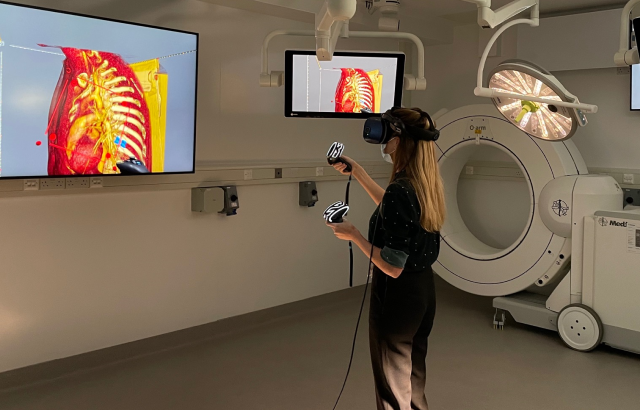
The technology, which has been developed by researchers at Evelina London Children’s Hospital and King’s College London, brings together scans that are routinely used to plan congenital heart disease surgery to create a three-dimensional, beating digital double of the heart.
The researchers hope that using VR to plan and practice procedures will shorten operating times and reduce the need for multiple surgeries, leading to better outcomes and experiences for patients and their families. They hope that it could be in regular use within the next two years.
Trials of an early version of the technology, which used only echocardiograms (ultrasound scans of the heart) to create the VR heart, found that surgeons preferred it for understanding the anatomy of their patient’s hearts. They also reported that it increased their confidence and improved their decision making.
See the full story here: https://www.bhf.org.uk/what-we-do/news-from-the-bhf/news-archive/2022/february/new-virtual-reality-technology-to-repair-hearts
8th Wall and Ready Player Me partner to bring custom, interactive avatars into web-based Augmented Reality experiences
8th Wall, a provider of a web-based augmented reality (WebAR) development platform, and Ready Player Me, a cross-app avatar platform for the metaverse, have today announced an official integration which equips developers with all the tools they need to create immersive browser-based experiences with custom, interactive avatars. Projects that make use of this integration will allow users to bring their avatars into web-based 3D, augmented and virtual reality (AR/VR) experiences, which can be engaged with on smartphones, computers and AR and VR headsets. ...
8th Wall’s Engine allows creators to build WebAR projects once and deploy everywhere – something that the company refers to as ‘Metaversal Deployment’. As a result, World Effects can be experienced as AR on smartphones and smart glasses, 3D on computers, and VR on head-mounted displays. ...
See the full story here: https://www.auganix.org/8th-wall-and-ready-player-me-partner-to-bring-custom-interactive-avatars-into-web-based-augmented-reality-experiences/
Virtual influencers rush into entertainment scene
Virtual humans are cheaper, less risky than top celebs, while entertainment industry is easiest way to approach the public ...
Rozy, the first virtual social media influencer in South Korea, is set to debut as a singer with her first single “Who Am I” on Feb. 22. The debut single is produced by Vanilla acoustic’s Jung Jae-won, who has worked with artists such as Bolbbalgan4.
Prior to her singing debut, the virtual figure surprised viewers by making a cameo appearance in Tving‘s comedy series “Dr. Park’s Clinic” last week. ...
Meanwhile, virtual influencers have become a blue ocean in today’s entertainment market. Although they are computer-generated, their diverse character traits and talents make them seem almost human. Virtual humans can be widely utilized in areas such as advertising, music and acting. ...
Korea is not the only country that is witnessing a rapidly growing popularity of virtual humans in the entertainment industry. Chinese e-commerce giant Alibaba Group Holding introduced Dong Dong, a virtual idol promoting the 2022 Beijing Winter Olympics.
See the full story here: http://www.koreaherald.com/view.php?ud=20220215000733