How Augmented Reality Can Be Used for Writing Prompts
 For young learners, the ability to have discussions based around the AR interaction is a powerful imagination trigger. It also prompts writing based on the inspiration those interactions produce. In terms of language analysis, the adjectives that can be used to describe a scene become more abundant once the scene becomes a moving, interactive one, and the prompts triggered by that scenario are almost limitless.
From the perspective of a character, in particular, the options are incredible.
“The learner starts with the character, and from here the character can, almost literally, be brought to life, triggering any number of associated questions and interactions which inspire added creativity in terms of writing about that character,” says Miread Shaw, an editor.
What AR Means to the Classroom
The possibilities in terms of what AR-assisted learning can bring to the classroom are breathtaking, but as with any new technology, it must be incorporated in the right way. Using the technology as part of a greater skills-based instruction is highly recommended, and it must be clear that the imagination itself is child’s alone, and is only enhanced by these types of apps.
See the full story here: https://arpost.co/2020/01/14/how-augmented-reality-can-be-used-for-writing-prompts/
PRESS RELEASE Embodied Labs Raises $3.2 Million in Seed Funding with Diverse Investors Across Aging, Tech and Impact Funds
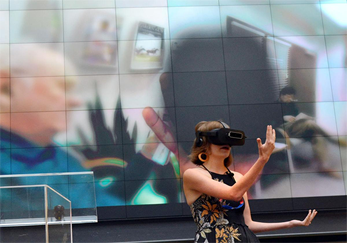 California-based Embodied Labs, the leading immersive platform using virtual reality (VR) to revolutionize training for the aging care workforce, announced its seed funding of $3.2 million led by top age-tech investor, Ziegler Link·Age Fund, co-led by the leading immersive tech investor, The Venture Reality Fund, as well as SustainVC, a social impact fund in healthcare and education, WXR Fund, investing in women and the next wave of computing, and ETF@JFFLabs, a social impact fund that invests in technologies that close skill gaps and improve economic mobility.
Founded in 2016, Embodied Labs uses the immersive experience of VR to put health care professionals and family caregivers into the body and mind of those who are challenged with lifespan aging issues: cognitive decline such as Alzheimer’s, age-related vision and hearing loss, neurodegenerative disease such as Parkinson’s and Lewy body dementia, and end-of-life decisions. Its training mission is twofold: enhance person-centered care through intellectual and instinctual behavior change and help long-term care providers recruit and retain a quality caregiver workforce.
About Embodied Labs
Embodied Labs, headquartered in Los Angeles, is the leading VR immersive learning platform on aging population health issues training senior living, home care, hospice, medical and nursing schools, hospitals and employers interested in educating HR departments to better support its caregiving employees. Working collaboratively with health care, gerontology, medical and clinical scientist experts as well as seasoned Hollywood filmmakers for powerful storytelling, the Embodied Labs solution has won the National AARP Caregiving Innovation Challenge, The United Healthcare & AARP OpenIDEO Caregiving for Dementia Challenge, The US Department of Education EdSim Challenge and The GlobalXR in Education Prize Challenge funded by the Bill and Melinda Gates Foundation. Learn more: embodiedlabs.com
TikTok has become the home of modern witchcraft (yes, really)
 TikTok's algorithms make it a safe haven for those with an interest in the occult – and they're drawing more and more people into the practice
A big part of TikTok’s algorithmic advantage comes from the For You page, or #fyp. It’s the first feed you see when you open the app, and comprises of a collection of recommended videos, personalised to you. But rather than getting trapped in an echo-chamber, as you might with other platforms, TikTok’s For You page works to introduce you to new content creators that embrace new ways of thinking. “The For You page is a very important feature because it doesn’t make us live in a bubble,” Selby explains. “Even though I’m a witch I’m not only showing on other witch’s feeds, like you would on Instagram. It helps you reach people you normally wouldn’t. It’s nice to be on a platform that supports creators, and doesn’t just look at us like advertising opportunities.”
See the full story here: https://www.wired.co.uk/article/witchcraft-tiktok
Virtual reality may prevent effective formation of visual memories
 The new study specifically focused on the visual memory retention differences between active and passive VR. Active VR is when a head-mounted display (HMD) responds to subjective movements, allowing users to subjectively investigate an environment from different visual perspectives. Passive viewing, on the other hand, is when a HMD offers a single locked-off view, irrespective of a user’s head movements.
The experiment consisted of 40 subjects, split evenly between active and passive viewing conditions. Each subject watched a video set in a museum where they were presented with 10 paintings from Peter Paul Rubens, and 10 paintings from Nicolas Poussin, two well-known baroque artists. Immediately after viewing the film, and two weeks later, all subjects completed a series of memory tests.
Interestingly, while the memory test results from both active and passive groups were similar immediately following the viewing, two weeks later the results in the active group had diminished while the passive group's memories remained strong. The implication of the study is active VR viewing somewhat degrades a person’s ability to form strong visual memories.
The study did not measure how much time the active viewing subjects spent looking at the paintings.
Another hypothesis is that the enhanced immersion in active VR presents the brain with a greater cognitive load, ultimately inhibiting effective visual memory formation.
See the full story here: https://newatlas.com/vr/virtual-reality-prevent-effective-formation-visual-memories/
Pearl Jam Tease “Gigaton” In Augmented Reality
 Pearl Jam are up to something, and that something may or may not be teasing a new album called Gigaton via a worldwide augmented reality scavenger hunt. An interactive map on the band’s website reveals coordinates in cities around the world, and fans who made the trek to those locations found giant billboards with what appears to be cover artwork and the word “Gigaton” on them. Viewing them through the Gigaton Instagram filter plays a snippet of sound and shows an animation of polar ice caps melting. (The melting of polar ice caps is measured in gigatons.)
See the full story here; https://www.stereogum.com/2069647/pearl-jam-tease-gigaton-in-augmented-reality/news/
Virtual reality shopping, AI store assistants, branded online avatars and apps aplenty –what the 5G revolution means for luxury fashion
 5G is likely to have an impact on a few fashion industry fronts: supply chain connectivity, retail operations, service and sales executions. It is also poised to affect the level of creativity and innovation brands incorporate into their engagement with consumers.
A good example of how 5G will influence business capabilities, from consumer transaction through to delivery, is the 2019 “Singles’ Day” event held by Alibaba, which owns the South China Morning Post. In the first 24 hours, it took US$38 billion in sales.
Its use of AI greatly increased the speed and efficiency of processing sales orders and transactions to 540,000 transactions per second. This sales level generated 2.8 billion parcels which were distributed across China.
At store level, Hong Kong-based consumer goods supply chain group Fung Retailing has stated its ambition to speed up transaction times using technology that will be enhanced by 5G. The company has collaborated with China’s largest online retailer in launching Hong Kong’s first AI-powered checkout service at a physical retail store. Sabrina Fung, managing director of Fung Retailing, says, “We are trying to prototype a process to shorten checkout time to 4.5 seconds, and where your face is linked to your WeChat Pay or Alipay account. When you walk into the store, as soon as it recognises you, that is the payment mechanism.”
Nicolas Ghesquière, Louis Vuitton’s creative director, said at the time, “Selecting the video game avatar as a spokesperson for LV was a natural thing for our world, where social networks and communications are now seamlessly woven into our lives.”
See the full story here: https://www.scmp.com/magazines/style/tech-design/article/3045208/virtual-reality-shopping-ai-store-assistants-branded
Jolt raises $14.1M for its ‘pay-monthly’ business school
 Jolt, an education startup that describes itself as an alternative to traditional MBA courses, has raised $14.1 million in Series A funding.
The company plans to use the additional capital to continue expansion across the U.K. and Israel, and to enter the U.S. with a first campus in Manhattan. It currently operates three sites in London (Shoreditch, Soho and Liverpool Street), claiming to have more students than London Business School, and seven across Israel.
“Higher education is in a bubble in which trillions is being invested in something that works for a small minority of people,” says Jolt co-founder and CEO Roei Deutsch.
Jolt says its business courses are aimed at professionals with undergraduate degrees and at least two years work experience, or three years experience without a degree, who have typically reached a point in their career when they want up-skill in order to move up the career ladder or move into a new industry, but don’t want to put their life on hold to re-enter education.
With Jolt, students only accumulate (and pay for) the classes they need to build their own diploma, and if they don’t want to complete the full program, they don’t have to.
“Students sign up for lessons via the Jolt app and attend these lessons at their nearest campus,” explains Deutsch. “Lessons are offered outside of traditional working hours, largely in the evening, to help people study alongside their day job.
Deutsch describes Jolt’s instructors as “highly skilled professionals who are currently working for some of the world’s biggest and most innovative companies,” including Google, Netflix, TrustLab and others. “This ensures our curriculum is as up-to-date and as relevant as possible,” he says.
See the full story here: https://techcrunch.com/2020/01/13/jolt/
Zuckerberg’s goals for new decade: ‘smaller communities,’ augmented reality glasses

NEW YORK, NY - OCTOBER 25: Facebook CEO Mark Zuckerberg speaks about the new Facebook News feature at the Paley Center For Media on October 25, 2019 in New York City. Facebook News, which will appear in a new dedicated section on the Facebook app, will offer stories from a mix of publications, including The New York Times, The Wall Street Journal and The Washington Post, as well as other digital-only outlets. Drew Angerer/Getty Images/AFP
Long-term efforts on issues affecting today’s generation
More intimate online communities
Facebook ecosystem as a business platform
The next big consumer device
Government regulation
Zuckerberg repeats a familiar tune, calling for more government regulation regarding issues of data privacy: “As long as our governments are seen as legitimate, rules established through a democratic process could add more legitimacy and trust than rules defined by companies alone. There are a number of areas where I believe governments establishing clearer rules would be helpful, including around elections, harmful content, privacy, and data portability. I've called for new regulation in these areas and over the next decade I hope we get clearer rules for the internet.”
See the full story here: https://www.rappler.com/technology/features/248942-mark-zuckerberg-facebook-goals-2020