University of St. Thomas to display Jesus in augmented reality come December
 The University of St. Thomas in Houston is taking its on-campus experience to a new level with an “augmented reality Jesus” experience that will allow visitors during the coming holiday season to view real-life nativity scenes near its chapel by opening a cell phone app.
See the full story here: https://www.houstonchronicle.com/news/houston-texas/houston/article/University-of-St-Thomas-to-display-Jesus-in-14515940.php
Engineers solve 50-year-old puzzle in signal processing
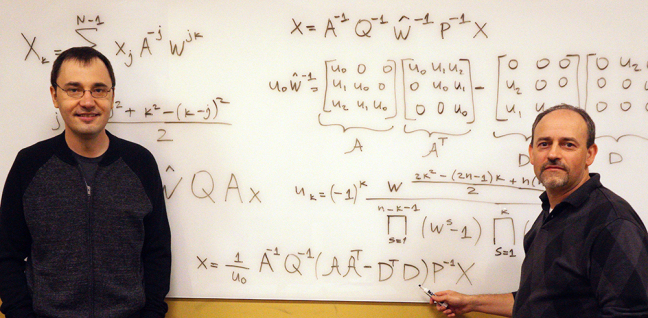 The FFT algorithm was published in 1965. Four years later, researchers developed a more versatile, generalized version called the chirp z-transform (CZT). But a similar generalization of the inverse FFT algorithm has gone unsolved for 50 years.
Until, that is, Stoytchev and Vladimir Sukhoy – an Iowa State doctoral student co-majoring in electrical and computer engineering, and human computer interaction – worked together to come up with the long-sought algorithm, called the inverse chirp z-transform (ICZT).
Like all algorithms, it’s a step-by-step process that solves a problem. In this case, it maps the output of the CZT algorithm back to its input. The two algorithms are a little like a series of two prisms – the first separates the wavelengths of white light into a spectrum of colors and the second reverses the process by combining the spectrum back into white light, Stoytchev explained.
See the full story here: https://www.news.iastate.edu/news/2019/10/10/signalprocessing
Trump optimistic about US-China trade talks
 The Chinese Embassy in Washington denounced the visa action and said the US accusations on human rights violations were “made-up pretexts” for interfering in China’s affairs.
Although many of the blacklisted entities are government security bureaus, the eight companies named include some of China’s leaders in artificial intelligence.
The blacklist could restrict the access of those companies to US microchips, which they currently rely on for many of their products and services.
See the full story here; https://entertainmentoverdose.co.uk/world/trump-optimistic-about-us-china-trade-talks-32863.html
Artificial Intelligence- Empowering Patent Filling
 Since the formal conception of Artificial Intelligence and machine learning, way back in the 50s, more than 300,000 patent applications and over a million scientific journals have been published.
On a global level – Microsoft, IBM and the like have been working tirelessly to build a hefty patent portfolio in the field of AI applications. The recent patent activity of IBM and Microsoft clearly suggest that these companies want to make their mark as pioneers in AI and machine learning as well. Toshiba, NEC and Samsung are major players in this race too, however, it will be a while before they can catch up to either IBM or Microsoft. A particular focus in recent times seems to be on machine learning techniques which are based on biologically inspired methods and supporting vector machines using supervised learning.
See the full story here: https://www.techiexpert.com/artificial-intelligence-empowering-patent-filling/
Mark Zuckerberg wants a wearable device that can read your thoughts to ‘control something in virtual or augmented reality’
- Mark Zuckerberg discussed Facebook's goals for brain-reading tech
- A wearable that can read brains signals could be used in augmented reality
- The company bought brain-to-computer interface company CTRL-labs
- Some users may need to have brain-reading tech implanted into the brains
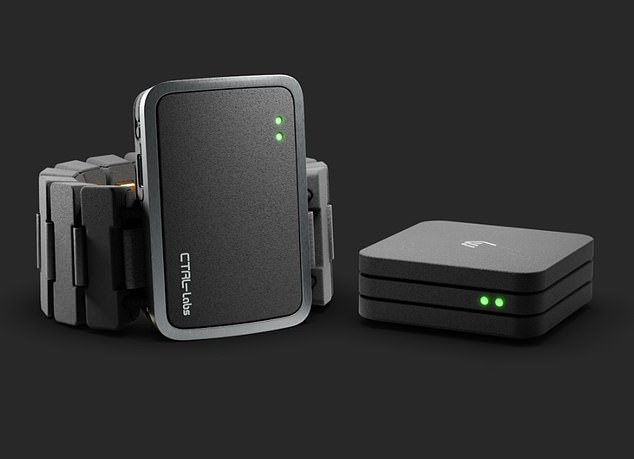 CTRL-labs wristband (pictured above) can read brain signals and translate them into information for controlling another device
See the full story here: https://www.dailymail.co.uk/sciencetech/article-7560765/Mark-Zuckerberg-wants-brain-reading-device-control-virtual-augmented-reality.html
Ford, Universal Pictures Partner With Holoride For In-Car Virtual Reality Experience
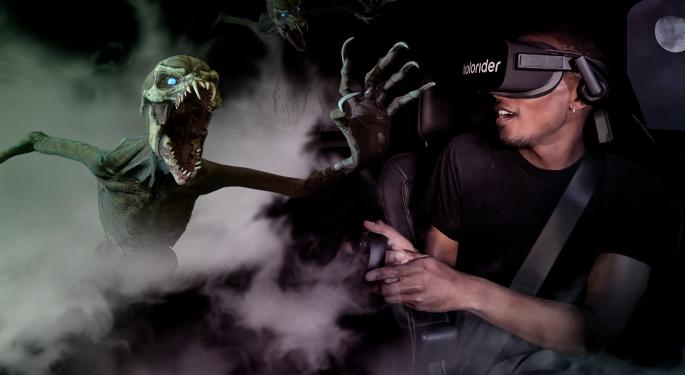 Ford Motor Company F 1.68% and Comcast Corporation CMCSA 2.36%-owned Universal Pictures have partnered with the company holoride to create an in-car virtual reality experience at Universal CityWalk.
The experience will be offered to guests for a limited time Oct. 14-Nov. 9, powered by technology from holoride, and set inside new 2020 Ford Explorer vehicles.
Once riders step inside the Explorers from a designated pickup location, they will don a VR headset and be joined by a "re-imagined, virtual Bride of Frankenstein" who's on a journey to deliver an important message to Frankenstein.
Riders will encounter virtual monsters and obstacles as part of a fully immersive VR experience with sound effects and visuals adapted to the vehicle's movements.
Holoride uses navigational data like travel route and time along with driving data from the vehicle — like steering, acceleration and stopping — to adapt the experience to match the movement of the vehicle, according to Thursday's announcement.
See the full story here: https://www.benzinga.com/news/19/10/14577182/ford-universal-pictures-partner-with-holoride-for-in-car-virtual-reality-experience