Post Malone to perform for fans in virtual reality
 Is it possible to digitally flash someone?
Post Malone will soon find out. The boob-brained rapper will stream his upcoming Raleigh, NC, concert in virtual reality, he said Thursday. Fans can tune inOct. 17 at 11 p.m. ET using an “events” app called Oculus Venues which pairs with an Oculus Quest or Oculus Go headset.
The show is part of Malone’s tour for his third album, “Hollywood’s Bleeding.” Supersphere, a Los Angeles-based “immersive content” startup will be broadcasting the event.
See the full story here: https://nypost.com/2019/10/03/post-malone-to-perform-for-fans-in-virtual-reality/
Roll Up the Red Carpet: New Study Finds Billions of Dollars in State Entertainment Industry Tax Incentives Don’t Bring Promised Jobs

Brooklyn, USA - April 12, 2010: A film crew from Japan films on Brooklyn Heights Promenade overlooking downtown Manhattan in New York City.
The new study—Do State Corporate Tax Incentives Create Jobs? Quasi-Experimental Evidence from the Entertainment Industry—analyzed the employment impact of motion picture incentive (MPI) programs, a combination of corporate tax incentives and other services, for the five states that currently spend the most on MPI incentives.
“This new study should put to rest any notion that motion picture tax incentives may work in some states but not others,” said the study’s lead author Michael Thom, an associate professor at the USC Sol Price School of Public Policy who specializes in public finance. “The states investing the most in incentives are not getting the return on investment taxpayers deserve, pure and simple. These incentives cost taxpayers billions of dollars, at a time when that money could be directed to other much needed public services.”
See the full story here: https://priceschool.usc.edu/roll-up-the-red-carpet-new-study-finds-billions-of-dollars-in-state-entertainment-industry-tax-incentives-dont-bring-promised-jobs/
The Magic Of Smart Mirrors: Artificial Intelligence, Augmented Reality And The Internet of Things
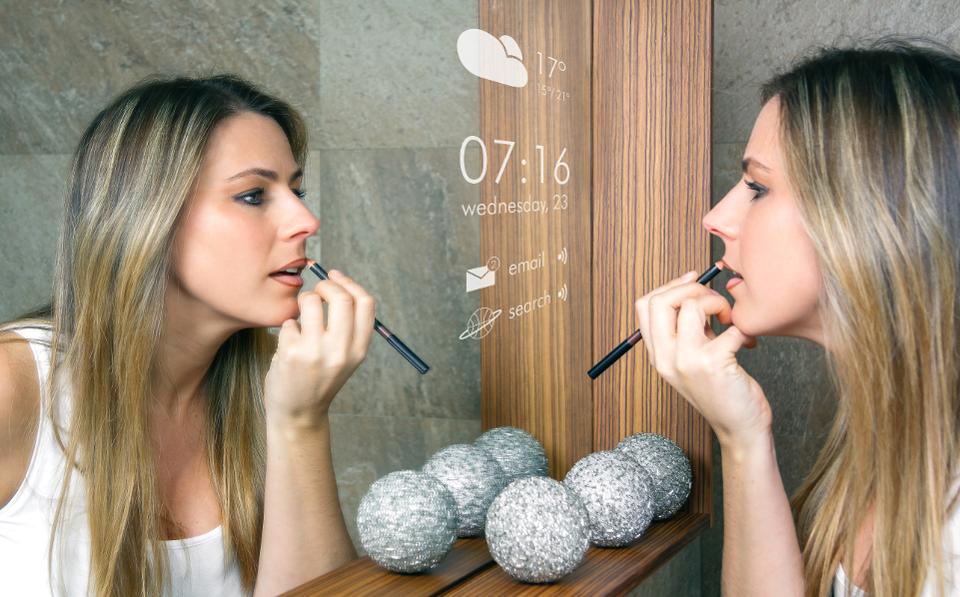 Memory Mirror, a digital mirror created by MemoMi, combines a full-length mirror with high-tech including a 70-inch LCD, computer and HD camera that can record videos so you can save, share and review your try-on sessions. Neiman Marcus installed MemoMi’s mirrors in 34 locations. Another mirror altering the retail experience is the Oak Mirror by Oak Labs. It serves as a digital assistant in a dressing room, allowing customers to request other colors, styles, or accessories from a sales assistant.
See the full story here: https://www.forbes.com/sites/bernardmarr/2019/10/04/the-magic-of-smart-mirrors-artificial-intelligence-augmented-reality-and-the-internet-of-things/#2d9d4fd9615b
Instagram now lets you shop with augmented reality
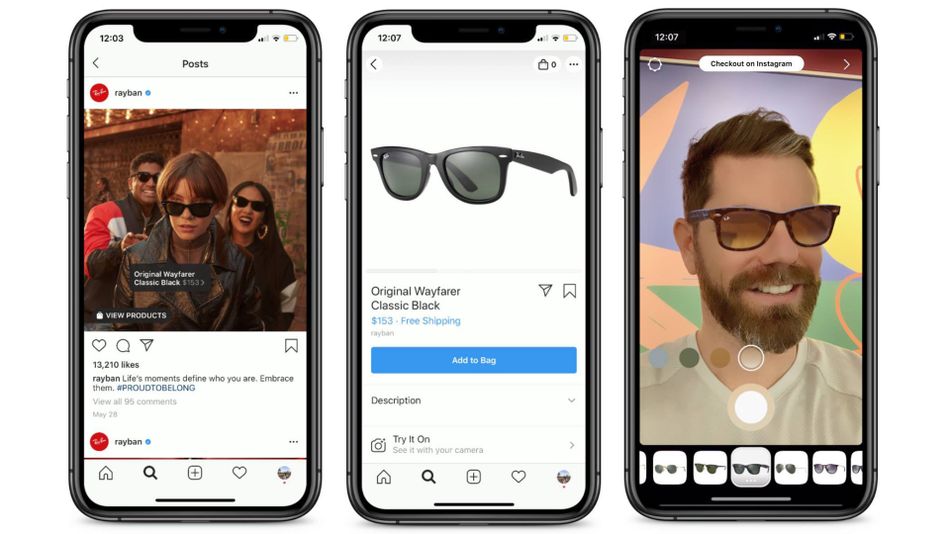 Beginning today, a handful of brands that sell their products directly on Instagram will be able to add a new augmented reality try-on feature to product pages. Initially, the new AR feature will be limited to cosmetics (Mac and Nars are early partners) and eyewear brands (Warby Parker and Ray-Ban), but Instagram plans to make it available for more products over time.
The idea is to use augmented reality to help Instagram shoppers preview how certain types of products will actually look on their face. The underlying tech is the same Spark AR platform that powers much of Instagram's camera effectsand Facebook's augmented reality ads.
See the full story here: https://mashable.com/article/instagagram-adds-augmented-reality-shopping/
Movie Theater Owners Take the Lead in Digital Cinema Requirements
 In the early days of the digital cinema transition, the major film studios formed Digital Cinema Initiatives to establish a standard architecture for digital cinema systems known as the “DCI Specification” in order to create a uniform level of security, technical performance and quality.
“The pace of technological advance has increased,” NATO said. “It is, then, necessary and proper for exhibitors to take the lead in evaluating the impact of light levels, contrast and colorimetry on their patrons and the exhibition environment. NATO seeks to create an open process to understand and evaluate digital cinema technologies and create metrics to analyze future technologies, and to open this process to include various stakeholders including filmmakers, distributors, manufacturers, service providers and exhibitors.”
NATO also said its technology committee, led by NATO’s technology consultant Jerry Pierce, has already begun initial measuring to prepare for industry-wide testing. The technology committee will report its initial findings to membership at NATO annual meetings in 2020.
See the full story here: https://variety.com/2019/digital/news/movie-theater-owners-digital-cinema-requirements-1203355142/
Inside Disney’s New York Stream Factory
 That operational know-how, and the group’s Chelsea Market home base, came to Disney through its deal to acquire majority control of Major League Baseball’s BAMTech for $2.6 billion. It’s a business that has been pumping video online since 2002 and has an unmatched track record, says streaming analyst and consultant Dan Rayburn — who calls DSS the “special forces of the streaming industry.”
“Disney Streaming Services has more expertise and more resources than anybody else in the industry,” he says. “They are just snapping up so many good people in the industry.”
What made BAMTech different is that it started life with a mission exactly aligned with Disney’s goals: taking media rights (in MLB’s case, launching the MLB.tv service) and monetizing them, says Joe Inzerillo, EVP and CTO of Disney Streaming Services.
Over the past year, Paull, who previously was Amazon’s VP of digital video, has dramatically expanded Disney Streaming Services to more than double its headcount, with most of its 1,600 employees based in New York. His hires have included senior VP of data Laura Evans, formerly with the New York Times, who has formed a new team dedicated to data and analytics. “We’re understanding user behavior,” she says. “And we’re reusing that data to enhance the customer experience.” Evans’ team also is applying data to marketing, with customer acquisition and retention programs.
Along with New York, DSS runs video operations centers in Amsterdam and San Francisco, and eventually will open a facility serving Asia-Pacific. The global scope of Disney’s direct-to-consumer strategy and aggressive rollout plans presents another significant challenge for Paull. The company expects Disney Plus to be in all major markets by 2021, starting with Canada, the Netherlands, Australia and New Zealand in November.
Disney Plus promises a set of robust features, including 4K content, the ability to download everything in the catalog for offline viewing, up to seven profiles per account, and up to four simultaneous streams. But the relatively fast timeline to launch meant some ended up getting tabled for now, including the ability to submit content ratings (although Paull argues such omissions can keep things simple).
See the full story here: https://variety.com/2019/digital/news/disney-streaming-services-new-york-disney-plus-1203354576/
Creativity and AI: The Next Step
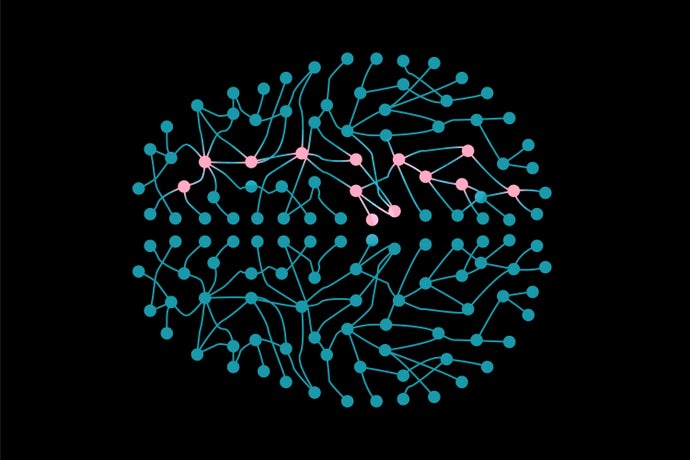 These are the two main sorts of AI around at present. Symbolic machines like Deep Blue are programmed to reason as humans do, working through a series of logical steps to solve specific problems. An example is a medical diagnosis system in which a machine deduces a patient’s illness from data by working through a decision tree of possibilities.
Artificial neural networks like AlphaGo Zero are loosely inspired by the wiring of the neurons in the human brain and need far less human input. Their forte is learning, which they do by analyzing huge amounts of input data or rules such as the rules of chess or Gogo. They have had notable success in recognizing faces and patterns in data and also power driverless cars. The big problem is that scientists don’t know as yet why they work as they do.
But it’s the art, literature and music that the two systems create that really points up the difference between them. Symbolic machines can create highly interesting work, having been fed enormous amounts of material and programmed to do so. Far more exciting are artificial neural networks, which actually teach themselves and which can therefore be said to be more truly creative.
All of these generate far more challenging and difficult works—the machine’s idea of art, not ours.
...artificial neural networks can spark human ingenuity. They can introduce us to new ideas and boost our own creativity.
What is needed is to develop a machine that includes the best features of both symbolic machines and artificial neural networks.
...combining the two systems could lead to more intelligent solutions and also to forms of art, literature and music which that are more accessible to human audiences while also being experimental, challenging, unpredictable and fun.
See the full story here: https://blogs.scientificamerican.com/observations/creativity-and-ai-the-next-step/
Three threats posed by deepfakes that technology won’t solve
 1) Problem: Deepfake detectors can’t tell us what should—and shouldn’t—be taken down
Idea: Better moderation
2) Problem: Deepfake-busting technology might not help the people who need protection most
Idea: Don't build anything without consulting those most affected
3) Problem: Deepfake detection is too late to help victims
Idea: New laws
For any such law to work in the US, it would ideally be at the federal level, not the state level. Because of a law called Section 230, platform companies aren’t legally responsible for hosting harmful third-party content unless it violates federal criminal law. If posting harmful videos became a crime, it would not only deter people from posting them; platforms like Facebook would have to work harder to keep them off. “These companies would not be able to raise Section 230 in defense,” says Franks. “They would have any number of defenses, but that particular avenue to them would be blocked.”
ELON MUSK’S AI PROJECT TO REPLICATE THE HUMAN BRAIN RECEIVES $1 BILLION FROM MICROSOFT
 Microsoft has invested $1 billion in the Elon Musk-founded artificial intelligence venture that plans to mimic the human brain using computers.
OpenAI said the investment would go towards its efforts of building artificial general intelligence (AGI) that can rival and surpass the cognitive capabilities of humans.
“An AGI working on a problem would be able to see connections across disciplines that no human could,” OpenAI CTO Greg Brockman wrote in a blog post announcing the investment.
“We want AGI to work with people to solve currently intractable multi-disciplinary problems, including global challenges such as climate change, affordable and high-quality healthcare, and personalised education.”
Since co-founding OpenAI three years ago, Mr Musk has since stepped back from the AI startup but remains vocal about the risks artificial intelligence poses to humanity, claiming its development poses a greater risk than nuclear weapons.