Oculus Quest ‘Significantly Faster’ Than Oculus Go, 6DoF Tracking ‘Doesn’t Affect’ Performance
Quest is significantly faster than Oculus Go from both a CPU and GPU perspective. Part of this is just the raw performance of the chipset itself, but a lot of it has to do with the effort we’ve put into the design of the headset and the core rendering architecture. Tracking isn’t in contention with and doesn’t affect the performance of your application.

Oculus Quest is essentially a VR games console. Like Go it is standalone with all the compute onboard, but unlike Go it has room scale tracking and Touch controllers.
Whereas Go features a Snapdragon 821 chipset, Quest uses the newer and faster Snapdragon 835. It’s around 30% more powerful, or can achieve the same performance with around 40% less energy.
...
Thermal throttling is arguably the core flaw of smartphone VR. It can limit graphically intense experiences to a matter of minutes. To overcome this, Go used a heatpipe and the entire front is metal, allowing it to act as a heatsink.
This cooling system allowed Facebook to overclock the Snapdragon 821, and to sustain that performance for hours. The result was that Oculus Go performs “significantly better” than a Galaxy S7 using the same chip.
Quest goes even further with cooling by adding an active cooling fan.
tracking is not done on the CPU, but rather on the Hexagon DSP- digital signal processor.
Japanese startup aims to stem rural exodus with technology
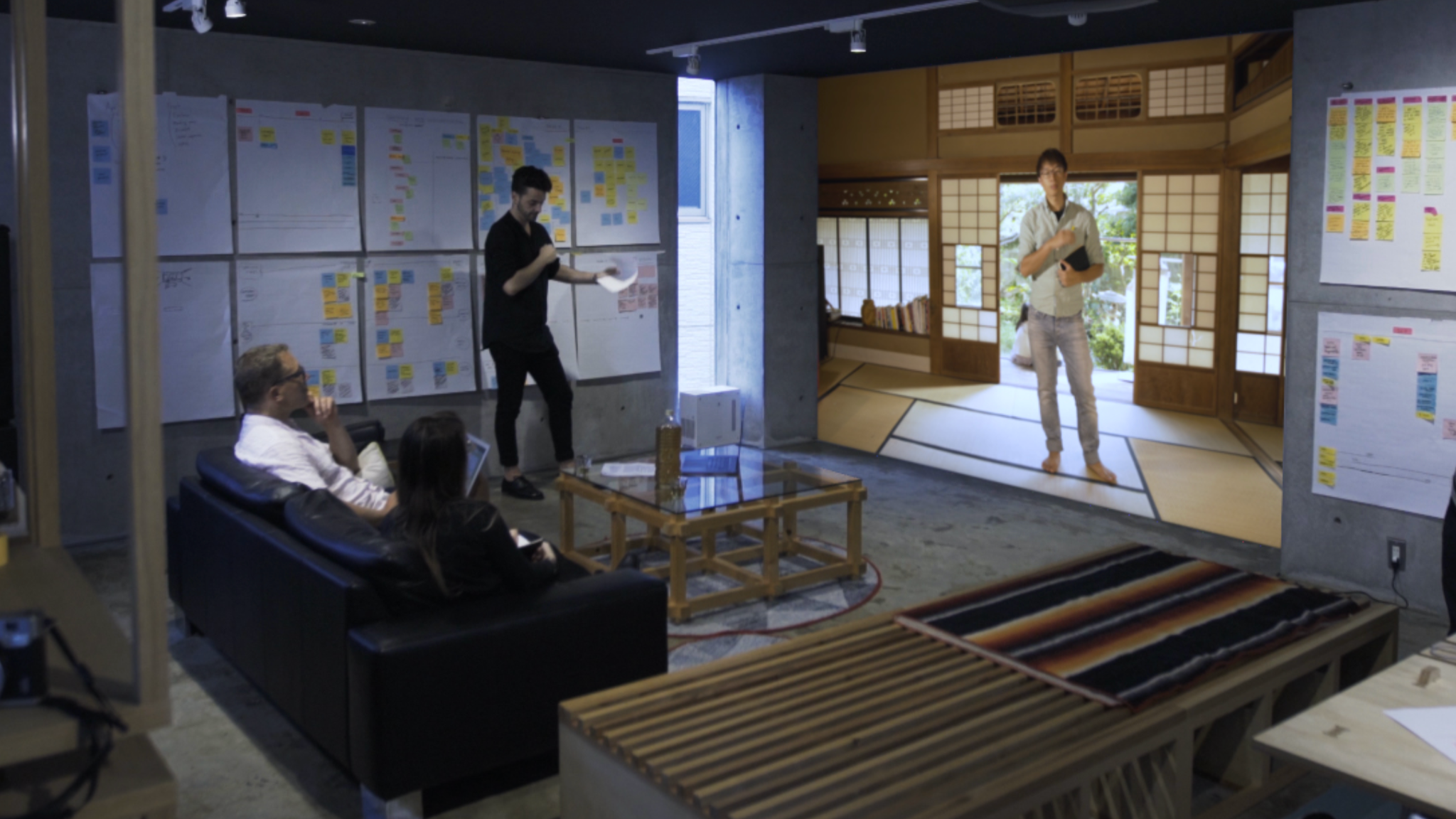 As Japan's population continues to concentrate in greater Tokyo, one startup thinks it has parts of a solution for all the hometowns being abandoned by young people, telepresence.
The technology to fuse together two rooms in two locations anywhere in the world already exists, but it often fails to go beyond underwhelming conference systems. What Tonari, which means neighbor in Japanese, wants to do is bring down costs for commercial versions of wall-size portals, create a profitable business and use some of the proceeds to fund a nonprofit that will help Japan deal with the hollowing out of its rural communities.
Tonari's developers say their product, which goes by the same name, will make users feel like the rooms they are in have been fused into one. Installations will allow for entire walls to disappear, with high video and audio quality enhancing the illusion that two places have become a single space. The Tonari system will also allow for shared digital whiteboards, notification systems and collaboration tools.
Perhaps Tonari can make life in greater Tokyo itself a little easier, too. Over half of the metropolitan area's inhabitants commute more than two hours a day. The spread of telepresence suites could give them back those hours.
The startup is banking on the fact that large screens, 4K ultrahigh-definition projectors, cameras and other pieces of hardware are becoming cheaper and more available. Tonari is also benefiting from large investments in artificial intelligence and deep learning, which will help the company's system recognize people and faces and objects.
The company got on its feet in April, 2017. By the end of the same year, the team behind it was awarded a grant from the Nippon Foundation, a private NPO with a social mission. The grant, a result of winning the Social Innovator Excellence Award, pays Tonari 50 million yen ($450,000) per year for three consecutive years.
See the full story here: https://asia.nikkei.com/Business/Startups/Japanese-startup-aims-to-stem-rural-exodus-with-technology
Virtual reality needs spherical displays, say researchers
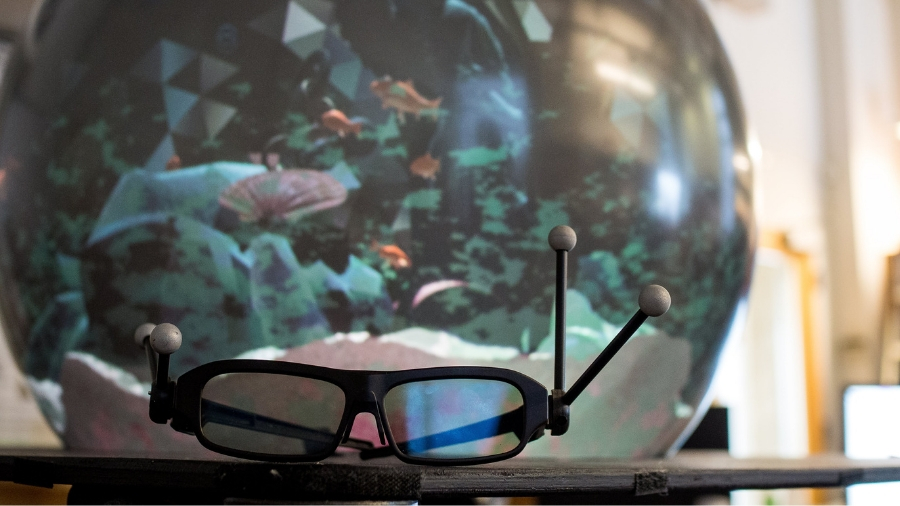 “It integrates high precision multi-projector calibration, perceptual viewpoint calibration, high fidelity motion tracking and active flicker glasses to create a high frame rate, high resolution spherical display capable of presenting a multi-person mixed reality experience.” Put simply, each player gets their own perspective-corrected 3D experience.
How does Crystal work?
Crystal uses four carefully calibrated high-speed Optoma GT750ST mini short-throw projectors to create the images, which fill a plexiglass sphere coated with translucent projection paint. It uses advanced calibration and graphics rendering techniques to produce a complete, distortion-free 3D image even when viewed from multiple angles.
That calibration is done using an OptiTrack optical tracking headset, so don't think of this as a hardware-killing invention. "We track a person's head so that the image on there looks correct from their perspective as they move around," says Sidney Fels, an electrical and computer engineering professor at UBC. "Using that, the person sees a beautiful 3D scene as they move around."
The researchers tested it over four day with multiple people cooperating in a ‘find the fish’ game, a 3D ping-pong game, and a cooperative apple-grabbing game. The players reported strong, believable 3D and motion parallax effects.
At CES 2019 in January, Belgian company Mimesys demoed a 5G-enabled holographic remote collaboration system with Intel using Magic Leap's mixed reality headsets (and also some awesome holographic business cards). It feels like you're in the room with someone, at least in a rudimentary way, because it overlays their image on to your surroundings.
Crystal is a similarly ambitious kind of mixed reality, and its makers have big plans....
They are now working on a four-person version, which would open up a lot more use-cases such as multiplayer VR gaming, virtual surgery and VR-aided learning.
See the full story here: https://www.techradar.com/news/virtual-reality-needs-spherical-displays-say-researchers
A comprehensive list of UX clichés
 “You are not your user”
A reminder that you are not designing the product for people like yourself. Often used as a way to encourage more user research in a project.
“If Henry Ford had asked people what they wanted, they would have told him faster horses”
Used as a counterargument to the previous statement, when you start to realize you won’t have time or money to do enough user research.
See many more here: https://www.fastcompany.com/90313720/a-comprehensive-list-of-ux-cliches
How Can America Make the World Shun Huawei?
 In short, the White House has been trying for a year to get allies, particularly in Europe, to impose bans against using Huawei equipment inside the new wireless networks, known as 5G, that will become available starting this year. 5G is seen as critical infrastructure for a quickly digitizing economy, increasing phone data speeds but also creating new opportunities in robotics, transportation, manufacturing and artificial intelligence.
The United States says using Huawei equipment in the new networks will create a grave vulnerability that the Chinese government will exploit. It’s a dramatic and worrying accusation — if true. But the Trump administration hasn’t provided much hard evidence.
Instead, American officials have tried to gain support by rehashing China’s history of cyber misbehavior and President Xi Jinping’s increasing control over the Chinese economy.
Perhaps sensing a momentum shift, Huawei has ratcheted up its opposition to the American campaign. On Monday, a Huawei executive, Vincent Peng, said cybersecurity was a “technical challenge, not a political challenge.” The next morning, Guo Ping, the company’s rotating chairman, said the United States had a more checkered history of espionage than Huawei, referring to the whistle-blower Edward J. Snowden’s disclosures in 2013 of an internet surveillance program by American spy agencies and their allies.
But the debate is worth following. Huawei foreshadows conflicts about important emerging technologies such as artificial intelligence, in which China is developing an expertise that the United States and its allies are likely to view as an economic and security threat.
See the full story here: https://www.nytimes.com/2019/03/01/technology/huawei-mwc-barcelona.html
Privacy complaints received by tech giants’ favorite EU watchdog up more than 2x since GDPR
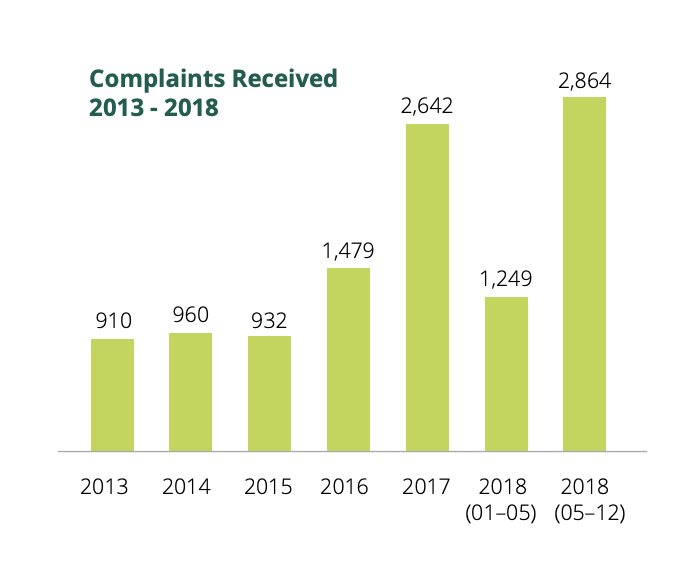 “The phenomenon that is the [GDPR] has demonstrated one thing above all else: people’s interest in and appetite for understanding and controlling use of their personal data is anything but a reflection of apathy and fatalism,” writes Helen Dixon, Ireland’s commissioner for data protection.
More cross-border complaints
“The role places an important duty on the DPC to safeguard the data protection rights of hundreds of millions of individuals across the EU, a duty that the GDPR requires the DPC to fulfil in cooperation with other supervisory authorities,” the DPC writes in the report, discussing its role of supervisory authority for multiple tech multinationals and acknowledging both a “greatly expanded role under the GDPR” and a “significantly increased workload”.
A breakdown of GDPR vs Data Protection Act 1998 complaint types over the report period suggests complaints targeted at multinational entities have leapt up under the new DP regime.
For some complaint types the old rules resulted in just 2 per cent of complaints being targeted at multinationals vs close to a quarter (22 per cent) in the same categories under GDPR.
See the full story here: https://techcrunch.com/2019/02/28/privacy-complaints-received-by-tech-giants-favorite-eu-watchdog-up-more-than-2x-since-gdpr/
TikTok to Pay Record Fine After Violating Children’s Privacy
 The Federal Trade Commission just inked a settlement with video social network TikTok (which merged with Musical.ly last year) over the charge that its app illegally collected children’s personal information. A large percent of users are under 13, and the personal information collected — without asking for parental permission — included email addresses, names and schools. The site refused to delete video and other data when requested by some parents. The FTC said the $5.7 million settlement is a record for a child privacy violation.
The New York Times also notes that the Children’s Online Privacy Protection Act requires that such online services receive parents’ permission before collecting data of those under 13 years.
In 2017, ByteDance, a Chinese Internet conglomerate, bought Musical.ly, which had 65 million users in the U.S. three years previously, and merged it with TikTok, an app ByteDance already operated. The TikTok app lets users create and share short videos. FTC investigated the app after a complaint to the Better Business Bureau and coverage by several news outlets.
Among the FTC’s findings were that “user accounts were public by default and adults were able to contact users, regardless of their age.” According to NYT, “when some parents asked to have the data of their children deleted, TikTok deleted a child’s account but retained videos and personal account information about those users on its servers.”
See the full story here: http://www.etcentric.org/tiktok-to-pay-record-fine-after-violating-childrens-privacy/