Our Q&A with the author of “Overlay” from Better Worlds, our sci-fi project about hope
We discover that Ando is using VR to give his father one last adventure before he dies. Do you think similar technologies will see widespread use in the future?
Technologically, I think VR at this level is pretty far off. In the case of someone like Ray, who’s suffering from dementia, you’d likely be dealing with a very different interface than you would for someone who was cognitively unimpaired. That said, while I don’t think VR has taken off quite as quickly as people expected it to, its potential is too great for us to let it languish. Never mind its uses in gaming — which is essentially what I use it for in this story — but the scientific applications alone could have a massive social benefit.
Getting to the point of actually fooling a user into believing their experience is real is a different issue that brings up some ethical issues. A friend of mine suggested “Overlay” was, from a certain perspective, a horror story: Ray’s had his reality replaced with an externally constructed narrative. In the story, VR is used for palliative reasons, and I imagine people would opt in or out of the therapy as part of an advance health care directive. But there’s definitely the potential for such technology to be weaponized. It would certainly have the potential to be addictive.
There’s an interesting moment when Ando says that he was written in one of the simulations as “a brat.” How do you see these types of VR stories impacting how we perceive the past or our loved ones?
Ando is able to have a sort of beyond-the-grave dialogue with his mother, but I’m not sure it’s substantially different from the letters, photographs, or video we have today. We’ve always rewritten ourselves one way or another, choosing which memories to preserve and pass on. And once we’re gone, the people we leave behind rewrite us again. Even now, we can edit ourselves to be smoother, kinder, funnier than we really are. A VR story — fictional or otherwise — would be a more vivid, fine-grained version of the same conceit.
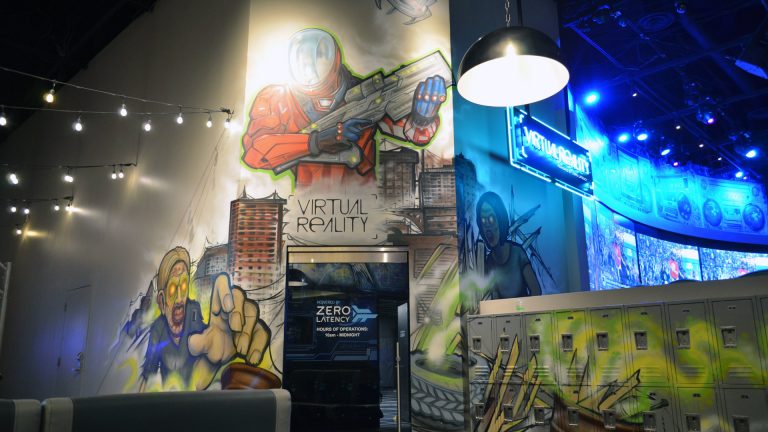
Zero Latency is an Australia-based creator of a VR attraction platform and content. Since its founding in 2013, the company has launched five co-op VR games supporting up to eight players. The company’s latest game, Sol Raiders, is the first to pit players against each other in a 4 vs. 4 format.
With 25 locations now in operation around the globe, Zero Latency is one of the leading VR attraction platforms today. The company develops the hardware, software, and content for the platform, which allows up to eight users to simultaneously play a shared virtual reality experience which unfolds in a large physical playspace that’s 60 × 30 ft (~18.3 × 9 m).
Zero Latency claims impressive growth over the last three years, culminating in 300,000 unique players and 420,000 unique plays in 2018 alone. At roughly $50 USD per play (with regional variances), the company’s platform appears to be generating tens of millions in revenue annually.
I visited the company’s Las Vegas location at the MGM Grand hotel and casino to preview the game first-hand.
‘The rift’ is a sub-reality of sorts which handles one of the most challenging elements of free-roam VR PVP gameplay: space management. When players die, they are teleported to the rift which looks sort of like being inside of a sci-fi wormhole, but with a concrete floor that’s crawling with ghost-like avatars. The avatars represent every other real player in the arena, allowing dead players to run back to a pre-defined spawn point without bumping into others. Once the dead player makes their way back to their spawn point, they are spawned back to life on the map proper.
It might sound a bit complicated on paper, but it works surprisingly well and doesn’t require players to really understand what the rift’s function is behind the scenes.
As PVP action is more fast-paced and a bit more frantic than the co-op games, it’s important that players not come too close to each other for fear of bumping into one another or accidentally smacking someone with the hefty gun. To create some buffer space around players, the avatars are oversized from the start, including virtual guns which are quite a bit longer and larger than their real-life counterparts.
Zero Latency further uses virtual space distortion to turn Sol Raiders into something that’s dynamic in ways that real life small arena attractions like paintball or laser tag can’t be because of their physical limitations. The best example of this is on the third map where players from each side ride small gondolas away from their base towards a central platform where lots of close quarters fighting happens. In virtual reality, players feel like they’ve moved across a large space, but in reality they’re still standing right next to where they started.
Zero Latency recently announced that it’s working with HP and Microsoft to formulate its next-gen hardware platform, which will hopefully do even more to capitalize on the company’s impressive content development work.
LetinAR is a Korean startup company, which is specialized in the development of novel optics for AR glasses. LetinAR's PinMR™ technology will set new standards for the production of these wearables. Therefore they have applied the so-called “Pinhole Effect” to tiny mirrors and embedded them with eyeglass lenses. Respective PinMR™ reflects the light generated by a microdisplay and guides it into human pupils. Users may view the virtual image created via microdisplay equipped with magnifying see-through optics as well as the image from the real world at ease. Human eyes cannot detect the mirrors, which are smaller than pupils. Only the virtual image formed by the light reflected by those mirrors is visible.
This specially developed Pin Mirror optic (PinMR™) has now been combined with Fraunhofer FEP's ultra-low-power OLED microdisplay technology, known for its ultra-low power consumption. The extremely small size of the ultra-low power OLED microdisplay is perfectly suited for small, miniaturized and lightweight systems that are wearable and simple to integrate into glasses, caps, or helmets. The display's OLED technology enables sharp images with very high contrasts and brightness over very wide dynamic range (monochrome green so far, yet basically expandable to full-color). In addition, an extra, innovative Bluetooth concept now makes it possible to communicate with the wearable/display in an energy-saving manner. Data transmission from, for example, scanner data to storage locations or filling levels can be transmitted directly to the AR glasses of a picker in logistics. And this without having to interrupt the work shift for loading times of the glasses.
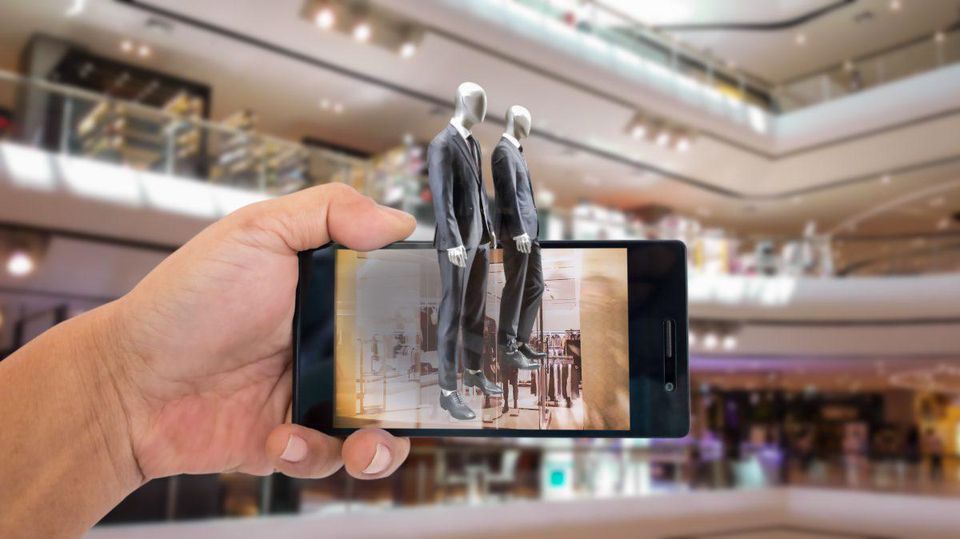
Tenth Street Hats – a family-owned retailer in business since 1921 partnered with AR solutions provider Vertebrae to fulfill an obvious use case – allowing customers to try on hats from the comfort of their own home.
CEO Carson Finkle told me that an encounter with a Vertebrae rep on the golf course piqued his interest in the technology.
The system lets users view hats on their head at any angle, matching them with outfits they are wearing and snapping pictures if they hit on a particularly sharp look.
The performance will be measured by whether pages, where customers are funneled towards the AR experience, will convert more successfully than pages that don't.
Speaking of pages, a major factor in Tenth Street’s decision to work with Vertebrae was the fact that their solution is implemented directly into existing websites. Rather than using an app, Tenth Street customers see the option of launching the AR experience as soon as they touch down on the homepage.
This was an important factor as asking customers to download a new app creates friction.
A young woman enters the crowded waiting room of a clinic and takes a seat. Soon, she is beckoned into an office by a health care worker who administers an HIV test. “I’ll call you for the results,” says the nurse. As the young woman waits, we are right there with her, sharing in her anxiety. And when she learns that she is HIV-positive, we are with her still.
Could the experience of being alongside someone as they go through the process of getting tested for HIV encourage more young people to get tested themselves? That’s what we hope to learn with 360HIV, a series of virtual reality (VR) films which aim to demystify HIV testing by using VR glasses to give viewers a close look at the process.
Eastern and southern Africa struggle with some of the highest rates of HIV in the world. Many young people in these regions don’t know their status: according to a 2016 release from UNAIDS, only 29 percent of girls and 20 percent of boys between the ages of 15 and 19 have ever received their HIV test results.
While the first film, Walking Through the Doors, follows Lihle Bhebhe as she reenacts her experience of receiving a positive diagnosis and attending a peer support group, the second film, These Children Today, features actual clinic staff and is intended for nurses. It shows clinic staff acting out different scenarios and depicting how positive and negative behaviors can deter youth from learning their status.
We showed the films to youth and healthcare workers, most of whom had never watched a VR film before. They marveled at how they felt they were “part of the story,” and an overwhelming majority of the young viewers—over 94 percent—said they were more likely to test for HIV after seeing the film. Meanwhile, around 90 percent reported that the video made them want to learn more about HIV treatment.
MIT professor Sherry Turkle and others have done studies on the intensity of the bond people tend to form with what she calls "relational artifacts" such as robots. Turkle defines relational artifacts as "non-living objects that are, or at least appear to be, sufficiently responsive that people naturally conceive themselves to be in a mutual relationship with them." Immersive VR experiences also offer a level of intensity that is qualitatively different from other sorts of media.
We believe that in the coming decades, as these technologies become more sophisticated and more widespread, there will be an increasing number of people who will choose to find sex and partnership entirely from artificial agents or in virtual environments.
A digisexual is someone who sees immersive technologies such as sex robots and virtual realitypornography as integral to their sexual experience, and who feels no need to search for physical intimacy with human partners.
Marginal sexual identities almost invariably face stigma, and it is already apparent that digisexuals will be no exception. The idea of digisexuality as an identity has already received strong negative reactions from many commentators in the media and online.
Our research addresses one specific piece of the puzzle: the question of how technology impacts sexual-identity formation, and how people with technologically based sexual identities may face stigma and prejudice. Yes, there are dangers. But whips and paddles can hurt too.
Executives say AI-enabled tools are not a threat to human employees,” but rather “allow journalists to spend more time on substantive work.” The AP was a pioneer in machine-generated software, signing on with Automated Insights in 2014, to “to generate minor league and college game stories” as well as “beef up its coverage of company earnings reports.” Since adopting Automated Insights, the AP has “gone from producing 300 articles on earnings reports per quarter to 3,700.”
“The work of journalism is creative, it’s about curiosity, it’s about storytelling, it’s about digging and holding governments accountable, it’s critical thinking, it’s judgment — and that is where we want our journalists spending their energy,” said the AP director of news partnerships Lisa Gibbs. The Washington Post relies on “an in-house robot reporter called Heliograf, which demonstrated its usefulness with its coverage of the 2016 Summer Olympic Games and the 2016 elections.”
We developed two virtual reality demonstrations for electromagnetism. For statics, we use spherical building blocks and superposition to calculate the electric field of a user-generated configuration of charge. The electric field information is displayed on a three-dimensional grid using vector arrows. A second demonstration displays field information for electromagnetic fields generated by a particle moving along a user-generated path (at arbitrary speed). We used the Unity game creation engine to efficiently develop the demonstrations, and tested them on an HTC Vive VR headset with handheld controllers.
Jacob Kogan had no idea he was living with convergence insufficiency, a vision disorder where the eyes don’t work together to focus on an object.
The virtual reality program is meant to replace a variety of traditional home therapy techniques that prove effective only 30 percent percent of the time.
“So a child especially, but this could also be done for young adults or older patients as well, is basically playing a game,” Alvarez said. “And they don’t actually realize that what we’re doing is working their vergance eye muscles, so their ability to see in 3D, similar to you going to the gym.”
Alvarez is working to bring the program to the kids who need it into schools where they’re screened, optometry offices where they’re treated, and to sports doctors who treat young athletes with concussions. She hopes by this time next year, she’s reached many more children.
/cdn.vox-cdn.com/uploads/chorus_asset/file/13601618/BW_Trailer.gif)