What happens to free speech when we all live in a virtual world?
 “I worry about a time in the future where people are spending a huge amount of time in virtual spaces and do not have the ability to talk about certain ideas, with the ability to really have any concept of free speech,” Luckey said. “I worry about a world where we have a hypothetical right to free speech ... out in the real world, and that that right doesn’t matter because very few people even spend most of their time there.”
It’s an interesting concept. If it’s true that we’re all going to spend time “living” in virtual reality, who will be tasked with making the rules of that society? The government? The tech company that created it? Will there be any rules?
See the full story here: https://www.recode.net/2018/11/8/18075744/palmer-luckey-free-speeh-virtual-reality-facebook
The rising power of virtual influencers
 Computer-generated virtual models are supplanting real flesh and blood fashionistas.
Meet Miquela, a Brazilian-American “pop star” with a follower count on Instagram of more than 1.4 million. Created as part of a digital project in 2016, Miquela also known as Lil Miquela, has become a source of fascination for many on social media and has even managed to turn heads in the fashion world.
Mimicking human influencers by uploading selfies and posing for photographs, virtual influencers are designed to portray an ideal lifestyle, with their accounts attracting people from all over the world.
“What matters is not whether something exists or not, rather how creatively can a story be built around it – take the example of any Marvel or DC superhero,” said Bhalla.
See the full story here: https://gulfnews.com/uae/the-rising-power-of-virtual-influencers-1.59679832
Tencent Might Follow Facebook Into This Unloved Market
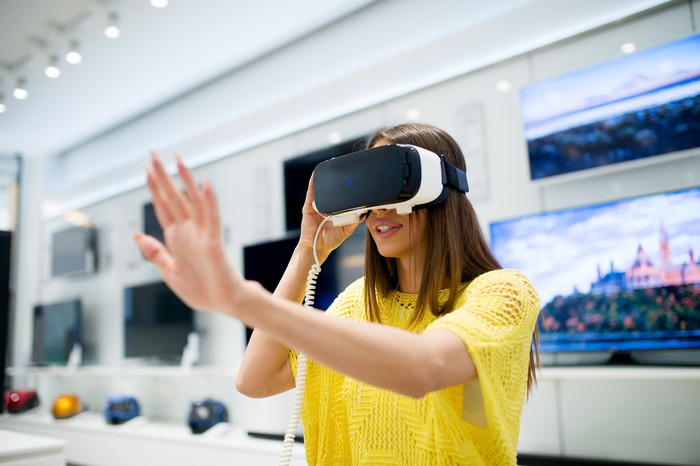 CEO Pony Ma recently stated that his company would "seriously consider" adding VR features to its flagship mobile app WeChat. Ma made the statement during his keynote speech at the 2018 Wuzhen International Internet Conference, and predicted that companies would "exhibit more portable VR devices" at next year's conference. ...
That "video game winter" forced Tencent to restructure its businesses in October to emphasize the growth of its non-gaming businesses -- including WeChat, its digital content platforms, and its cloud and AI services. Ma's idea of expanding WeChat, the top mobile messaging app in China with 1.06 billion monthly active users (MAUs), into a VR platform complements that strategic shift.
...That's why Facebook pivoted away from the high-end Oculus headsets, which need to be tethered to high-end PCs, toward cheaper stand-alone devices like the $200 Oculus Go. SuperData predicts that the Go will fare better with 1.8 million shipments, but that represents just 0.08% of Facebook's 2.28 billion monthly active users (MAUs) worldwide.
Tencent is also expanding WeChat's ecosystem into adjacent markets. It recently introduced with a new smart vehicle system that uses WeChat as a control interface, and plans to launch new "virtual assistant" features for business users. Tencent also recently collaborated with Tonot to launch smartglasses for Weishi, its short video rival to ByteDance's TikTok. In that context, it would be logical for Tencent to collaborate with headset makers to launch a VR platform comparable to Facebook Spaces for WeChat users.
See the full story here: https://www.fool.com/investing/2018/11/10/tencent-might-follow-facebook-into-this-unloved-ma.aspx
Augmented reality exhibition takes virtual art outdoors in Hong Kong
- Three art installations and five virtual artworks on show at Asia Society Hong Kong
- International line-up of artists includes Carla Chan, Peter Nelson and Kikuji Kawada
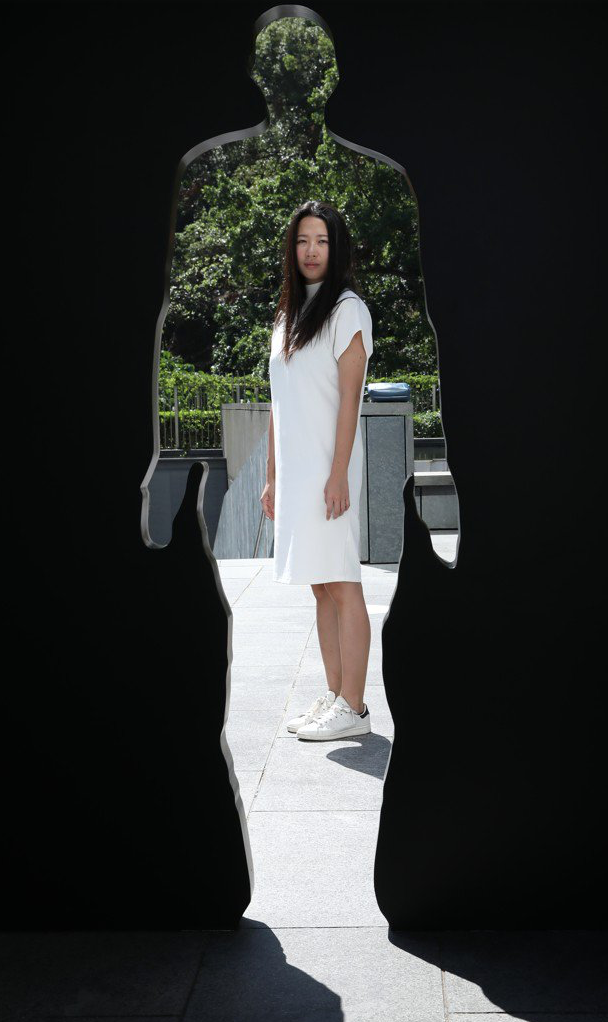 The three commissioned art installations all explore the relationship between humans and technology, according to Wong.
When We are Disappearing in the Digital by contemporary artist Carla Chan features a site-specific mural in the centre’s roof garden with a cut-out of a human silhouette that the audience can physically pass through.
When viewed through an AR app (developed by BNY Mellon) on a mobile phone, human-shaped silhouettes in front of the mural become distorted and pixelated. Chan teases a more symbolic idea.
The next art installation, Data Stones by visual artist Peter Nelson, is a set of computer-generated stone sculptures that visualise his online conversations with two other people.
Hidden at a scenic lookout on the site is A Crescent, Poplars, and Moon Trailing, Tokyo, a black-and-white photograph by Kikuji Kawada, which is part of BNY Mellon’s Arts and Artifacts collection.
Upon scanning a marker with the mobile app and pointing the phone at the sky, the original photograph will appear on the screen.
“It’s a photograph where you see the waning crescent [moon], superimposed with a moon trail.
See the full story here: https://www.scmp.com/lifestyle/arts-culture/article/2172468/augmented-reality-exhibition-takes-virtual-art-outdoors-hong
The Unreal Garden Is San Francisco’s Selfie Museum For The Burning Man Generation

 I’m surrounded by flowers and animals, some virtual, some real, with a $5000 Microsoft Hololens strapped to my head. In front of me unfolds a phantasmagorical wonderland, with floating neon bushes and luminous rabbits and birds. “The environment reacts to you, touch something and it will change,” explained Leila Amirsadeghi cofounder of Onedome, who soft launched this surreal botanical scene — a.k.a. The Unreal Garden — in San Francisco, mid-October. “And here are the selfie stations.”
Yes, this world of magically augmented reality has selfie stations. After all, your cell phone can only capture what your eyes see unassisted — what’s really happening takes place in the Hololens. The selfie station merges virtual and physical reality to create a shareable picture, a psychedelic blurring of parallel worlds.
“The stations cater to consumer behavior,”Amirsadeghi said. “People want to have fun but also to share that, it’s about wanting to be out there and seen doing different things. We try and provide visually stimulating areas for those for those photographs.” Onedome’s set to open ten more venues across America over the next three years, and they have a ten year lease for their current building.
Sold out experiences like The Selfie museum and the Museum of Ice Cream have whetted people's appetite for experiences that are also Instagram worthy — here the tech crowd gets a turn. The Burning Man crowd may be bashful about ‘mainstream’ selfie opportunities, but in tech-heaven, they can duckface with the best of them.
Amirsadeghi said they designed it with an emphasis on storytelling — it’s not super obvious but all those little decor tricks come together to create a “world placed on magical ley lines and nature took over what was formerly inhabited by humans.” She says they may make this more apparent in future iterations.
“Our mission is to create artful immersive spaces inviting a shift from Me to We,” said Bertram Meyer, Onedome’s CEO. “We are specifically choosing interactive experiences that are built to be shared with friends or family, and that invites a moment of awe and beauty, collaboration and presence.”
See the full story here: https://www.forbes.com/sites/zarastone/2018/11/11/the-unreal-garden-is-san-franciscos-selfie-museum-for-the-burning-man-generation/#2e4e6a0e422d
HTC Vive Focus – Launch and Business Application review
- On Thursday, virtual reality company HTC VIVE announced its new headset called the Vive Focus, which is aimed at enterprises.
- Although VR has previously mostly been used for gaming, it is quickly growing for enterprise use.
- It can be used for business collaboration, training and education, such as teaching medical students about sleep apnea, showing car designers how to fix and prototype a car, and conducting remote meetings in a 3D virtual space.
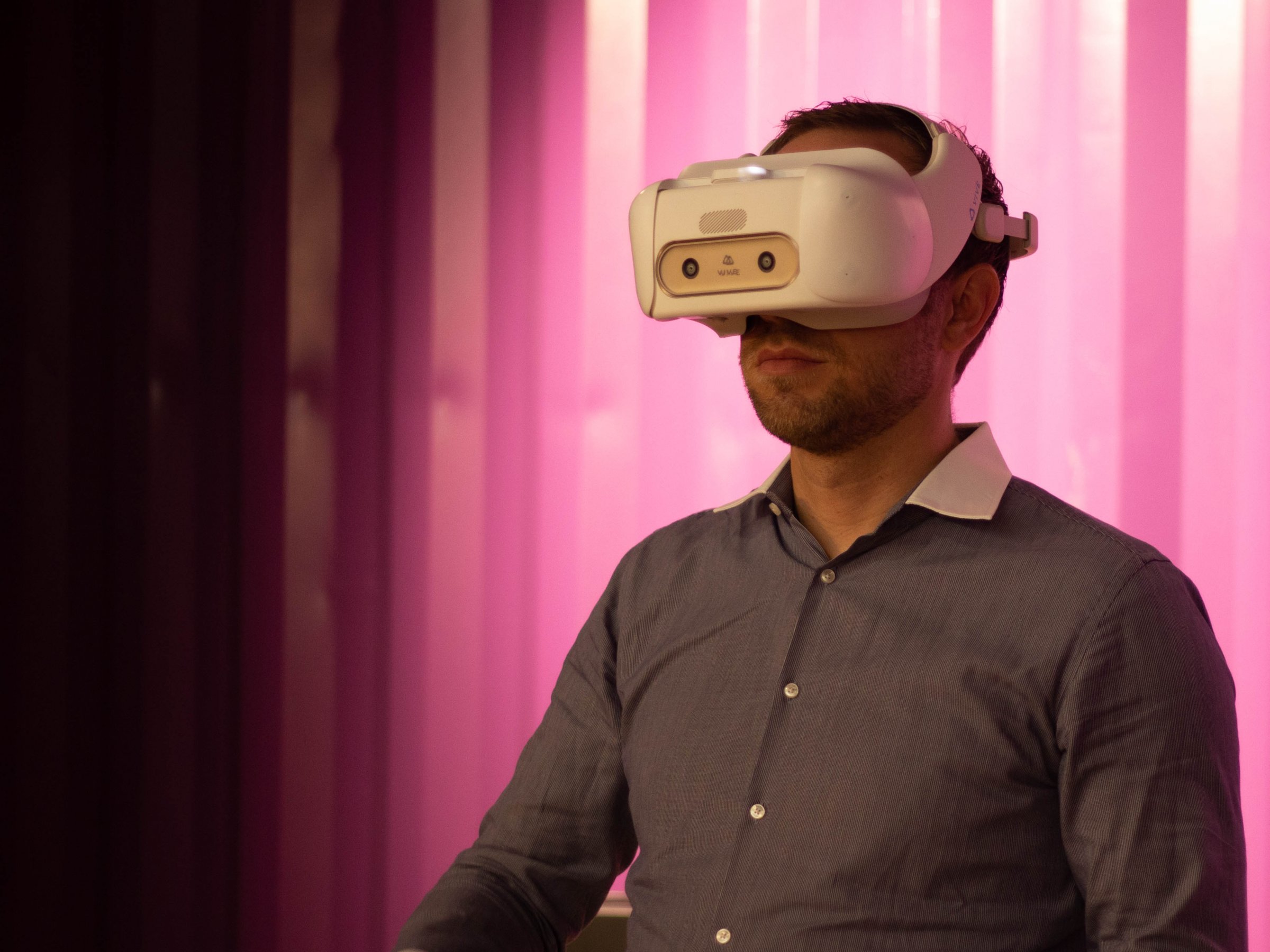 VR can also be used to collaborate on code. Primitive, which creates software development visualizations, created an app to review code. When I tried out this simulation, I was transported to a dark space with floating lines of code connected by a laser web -- a scene almost straight out of "The Matrix."
It showed me how different files of code were linked, and with my laser pointer, I could pull up an entire floating page of code in front of my eyes. With this application, developers can work together to review code, circle the parts they want to highlight and dig through open source projects.
 "It was quite fascinating because I was not a software coder myself," O'Brien said. "It's also about efficiency. When I sat in and watched 5 developers get in the space together, they were having intense conversations about the code."
See the full story here: https://www.greenwichtime.com/technology/businessinsider/article/I-explored-the-inside-of-a-human-nose-and-it-13381958.php
At China’s Internet Conference, a Darker Side of Tech Emerges
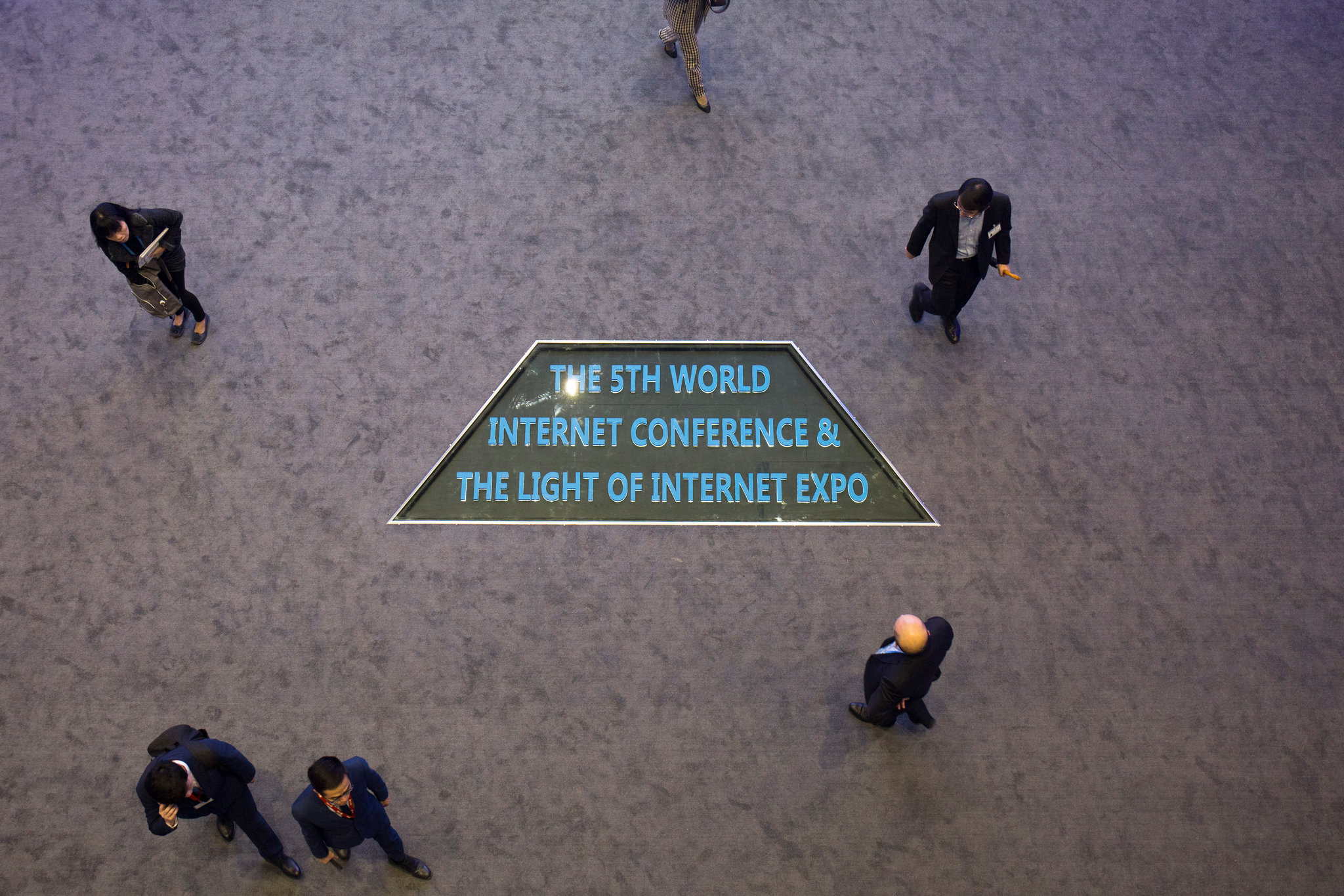 China’s tech industry is becoming more serious about grappling with its products’ unintended consequences — and about helping the government.
Discussions of technology’s promise were leavened with contemplation of its darker side effects, such as fraud and data breaches. A forum on protecting personal information featured representatives from China’s highest prosecutor and its powerful internet regulator. And several tech companies pledged their support for Beijing’s counterterrorism efforts, even as China faces international criticism for detaining and indoctrinating Muslims in the name of fighting terrorism in the western region of Xinjiang.
Emissaries from Silicon Valley were also in short supply. Last year, the speakers at Wuzhen included Tim Cook, Apple’s chief executive, as well as Sundar Pichai of Google. This year, the sole Western tech executive to give a keynote address was Steve Mollenkopf, the chief executive of the chip maker Qualcomm.
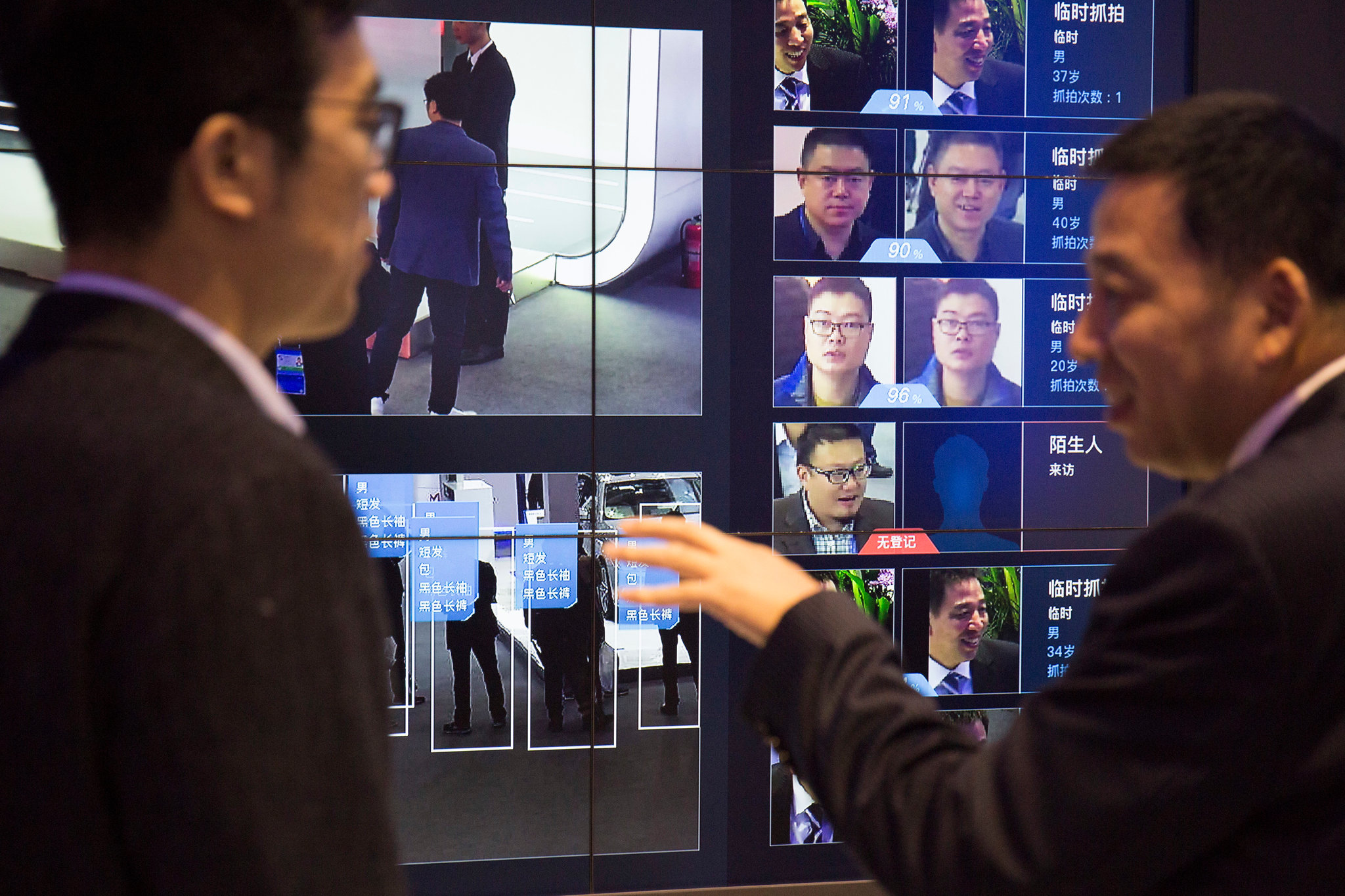 Among Chinese companies this week, private enterprises showed off the ways in which they increasingly support and work with the government, while state-backed companies demonstrated they were not doomed to be tech laggards.
Mr. Chen said Tencent reports illegal activity discovered on its platforms to the government, after which the authorities can request specific user information. Metadata describing when and where users logged into a Tencent app can be stored for up to six months, he said. But Mr. Chen denied that the company gave law enforcement officials a back door through which they could freely peruse chat records and user data.
“We only store the content that the law prescribes,” he said. “However long the law says to store it, that’s how long we store it. Whatever the law says to store, that’s what we store.”
See the full story here: https://www.nytimes.com/2018/11/08/technology/china-world-internet-conference.html
Startup Within to Release Augmented Reality App for Children
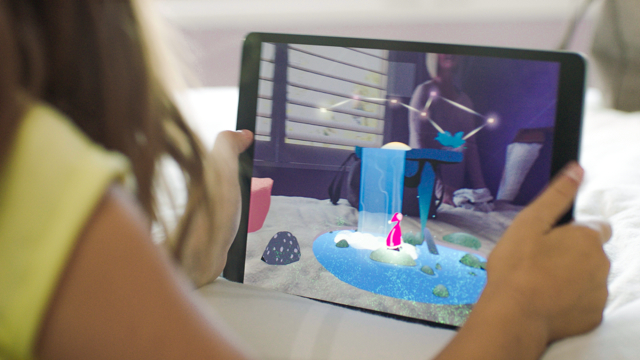 Los Angeles-based immersive media startup Within plans to release Wonderscope, an augmented reality app for children, later this month. With Wonderscope, mobile AR superimposes characters, scenes and stories onto an iPad camera view of a real-world environment. Within chief executive Chris Milk noted that, with Wonderscope and a smartphone, anyone can have “this new magical ability.” “It’s like a lens for invisible magical things that you couldn’t see with your naked eye,” he added.
Variety reports that “Little Red the Inventor,” a twist on the classic fairy tale, will be one of the first stories to be released. In the updated story, Red is “devoted to science and engineering” and combats a wolf “that Milk describes as a #MeToo-like villain.” She wins the day with the help of the viewer “who communicates with her via speech-recognition technology.”
“Parents love the idea that their kids aren’t sitting there vegged out,” said chief technology officer Aaron Koblin. “They’re actually engaged and moving around, they’re reading out loud. It’s a way more active experience, which we’re really excited about.”
Because AR works in a real world environment, Milk stressed that, “you have to build a story that can work in someone’s kitchen, in someone’s backyard, next to someone’s pool.”
See the full story here: http://www.etcentric.org/startup-within-to-release-augmented-reality-app-for-children/
Google Ups Investment in YouTube’s Anti-Piracy Content ID
 According to VentureBeat, YouTube began offering Content ID (which was called Video Identification initially) in 2007. The technology “automatically identifies copyrighted content on the video-streaming service and asks the rightsholders” whether they want to monetize the video by showing ads or block it.
Earlier in 2018, YouTube stated that, “it would begin using Content ID data to display full music credits and link to the official videos.” The downside to Content ID is that it can target “barely audible music playing in the background” and end up blocking a “short non-publicly listed video of your kid performing in a school show.”
The report also revealed that, “98 percent of copyright claims in 2017 were made through Content ID, and more than 90 percent of Content ID claims lead to some form of monetization.” Google also paid “more than $1.8 billion to the music industry in ad revenue from October 2017 to September 2018.”
Content ID allows it to “exert some control over the content that is uploaded to its platform.”
See the full story here: http://www.etcentric.org/google-ups-investment-in-youtubes-anti-piracy-content-id/