Startups Use Blockchain to Democratize Artificial Intelligence
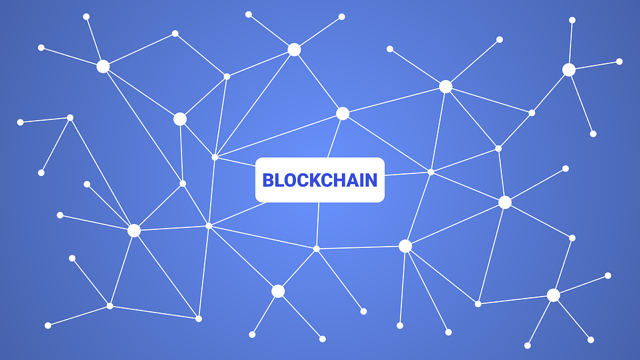 To that end, “several startups are setting up blockchain-based marketplaces, where people can buy and sell data,” and the Berlin-based Ocean Protocol is “building the infrastructure so that anyone can set up a marketplace for any kind of data, with the users of data paying the sources with digital tokens.” These marketplaces will not have the data — unlike Facebook and Google — but “will just be places for people with data to meet, ensuring that no central player can access or exploit the data.”
“Blockchains are incentive machines,” said an Ocean Protocol founder Trent McConaghy, who noted that the goal is to “decentralize access to data before it’s too late.”
Personal data privacy is one of the biggest worries around Facebook, Google and their ilk’s data collection. In the Oasis blockchain network, which Song is working on, “all data moving through the system will be locked into encrypted bundles.”
See the full story here: http://www.etcentric.org/startups-use-blockchain-to-democratize-artificial-intelligence/
Hands-on: HaptX’s VR Glove is the Closest I’ve Come to Touching the Virtual World
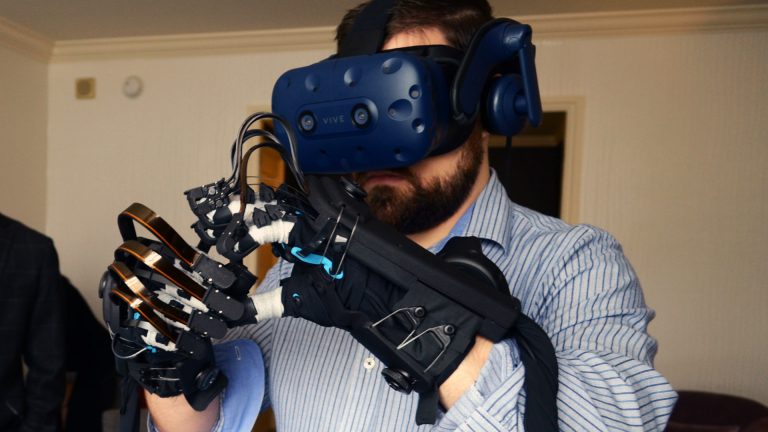 If nothing else, HaptX is a great proof of the importance of taking haptics beyond the simple rumbling mechanisms available in most of today’s VR equipment. The glove can create brief moments where you really feel like you’re touching something that isn’t actually there.
For me this was clearest when doing something seemingly mundane: using my fingers to rotate a cube. I probably did so for a good five or ten minutes, using cubes of various sizes, because I wanted to understand why it felt convincing.
New schemes teach the masses to build AI
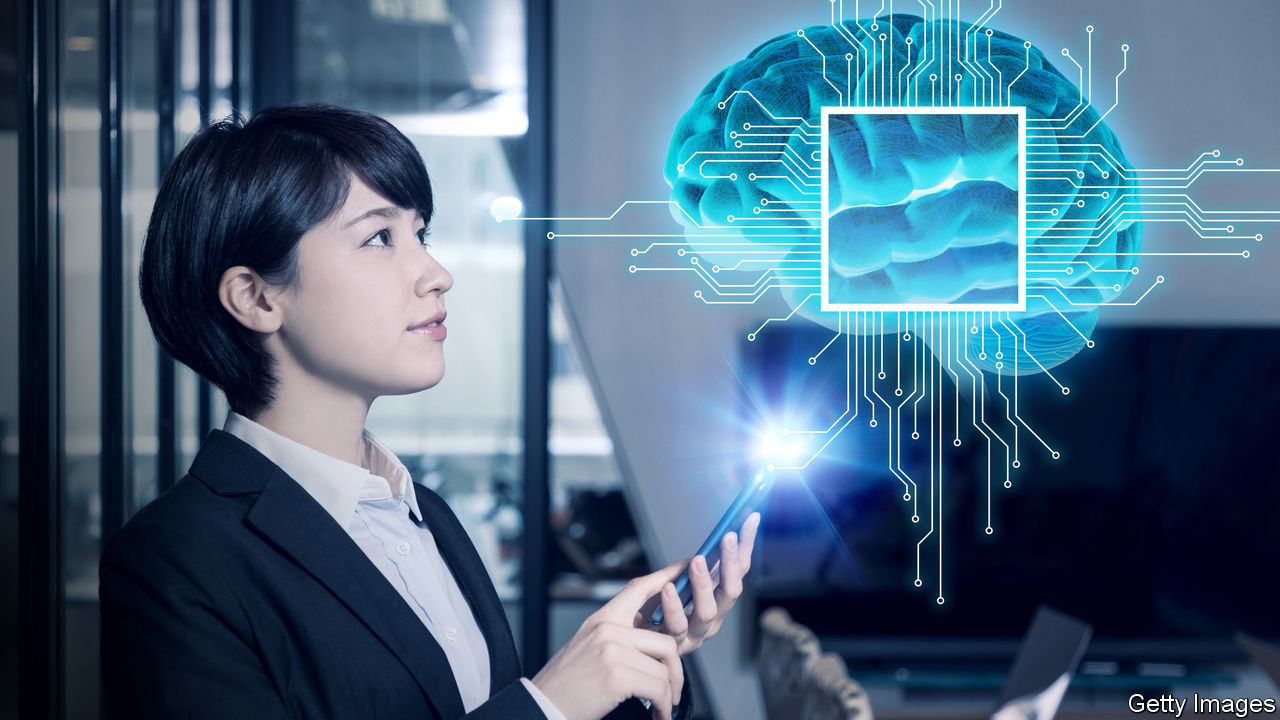 Demystifying the subject, to make it accessible to anyone who wants to learn how to build ai software, is the aim of Jeremy Howard, who founded fast.ai with Rachel Thomas, a mathematician. He says school mathematics is sufficient. “No. Greek. Letters,” Mr Howard intones, thumping the table for punctuation.
Fast.ai’s is not the only alternative ai programme. ai4all, another non-profit venture, works to bring ai education to schoolchildren in the United States that would otherwise not have access to it. Andrew Ng, another well-known figure in the field, has started his own online course, deeplearning.ai.
See the full story here: https://www.economist.com/business/2018/10/27/new-schemes-teach-the-masses-to-build-ai
A.I. Is Helping Scientists Predict When and Where the Next Big Earthquake Will Be
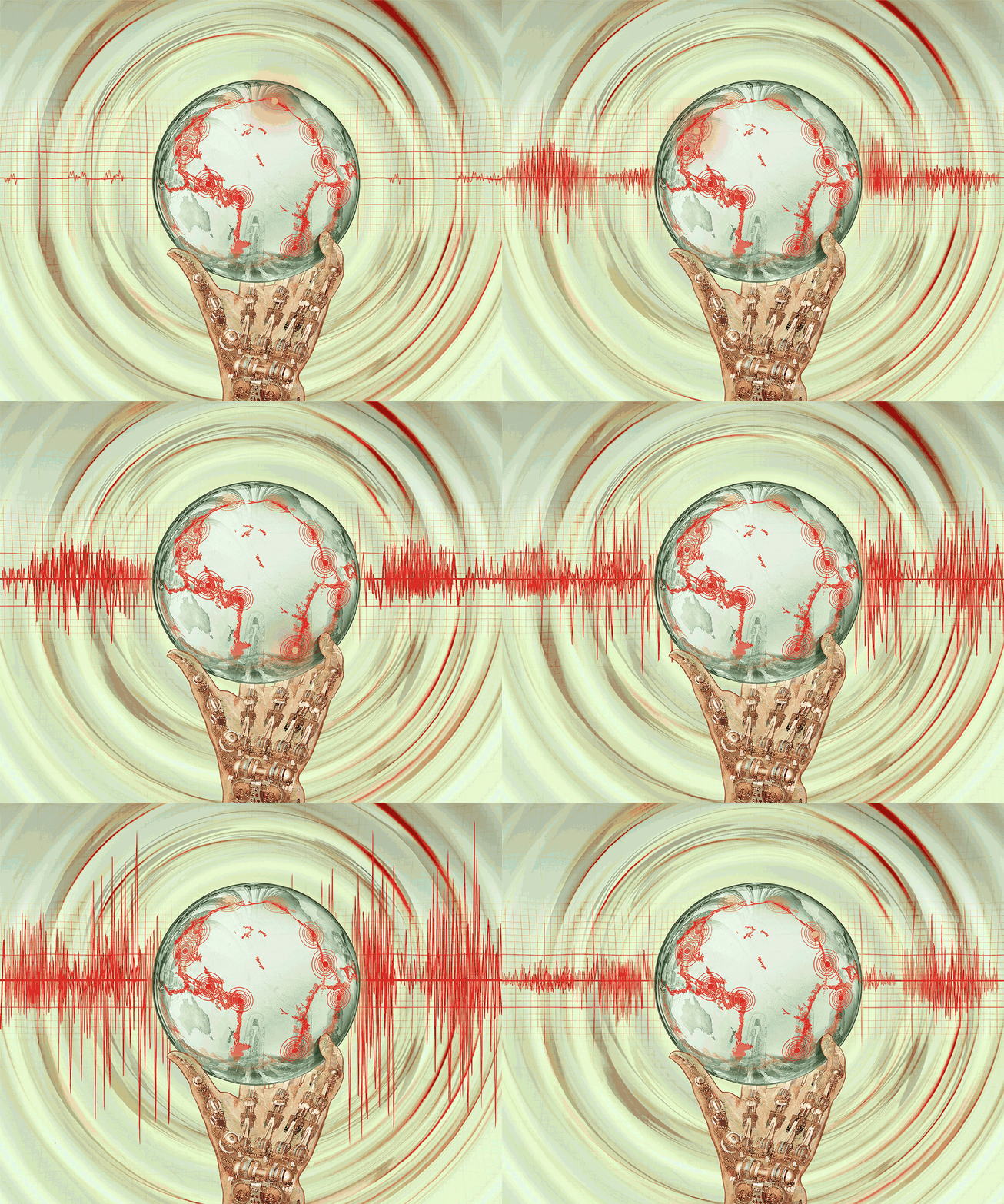
Now, with the help of artificial intelligence, a growing number of scientists say changes in the way they can analyze massive amounts of seismic data can help them better understand earthquakes, anticipate how they will behave, and provide quicker and more accurate early warnings.
“I am actually hopeful for the first time in my career that we will make progress on this problem,” said Paul Johnson, a fellow at the Los Alamos National Laboratory who is among those at the forefront of this research.
Since the average interval between these big earthquakes was 135 years, a common interpretation is that Southern California is due for a big earthquake. Yet the intervals between earthquakes are so varied — ranging from 44 years to 305 years — that taking the average is not a very useful prediction tool. A big earthquake could come tomorrow, or it could come in a century and a half or more.
Dr. Meade also found that these A.I. techniques could lead to new insights. In the fall, with other researchers from Google and Harvard, he published a paper showing how neural networks can forecast earthquake aftershocks. This kind of project, he believes, represents an enormous shift in the way earthquake science is done. Similar work is underway at places like Caltech and Stanford University.
Scientists working on these projects said neural networks have their limits. Though they are good at finding familiar signals in data, they are not necessarily suited to finding new kinds of signals — like the sounds tectonic plates make as they grind together.
But at Los Alamos, Dr. Johnson and his colleagues have shown that a machine-learning technique called “random forests” can identify previously unknown signals in a simulated fault created inside a lab. In one case, their system showed that a particular sound made by the fault, which scientists previously thought was meaningless, was actually an indication of when an earthquake would arrive.
See the full story here: https://www.nytimes.com/2018/10/26/technology/earthquake-predictions-artificial-intelligence.html
Anatomy of a High-Tech High Heel
 “The way it’s constructed, basically 85 percent of your body weight is pitched forward on the ball of your feet.” In asking male engineer friends to construct a design that would allow more of the body weight to rest on the heel, “I told them not to think of this as a shoe, but as building a chassis for the human body,” she says.
The result is a shoe with an exterior that is made in Italy while a tech supplier in Singapore makes the internal architecture, which includes a cushion comprised of a proprietary blend of thermal and ballistic-grade plastic polyurethane.
Singh isn’t a scientist or engineer herself, but fortunately she had friends at SpaceX, where she was the head of talent recruiting from 2008 to 2013, followed by two-and-a-half years recruiting for the virtual reality company Oculus VR (now owned by Facebook) while getting Thesis Couture off the ground.
See the full story here: https://robbreport.com/muse/thought-leaders/anatomy-of-a-high-tech-high-heel-2824809/
This ‘Pokemon Go’ clone lets you collect Catholic saints and learn biblical lessons
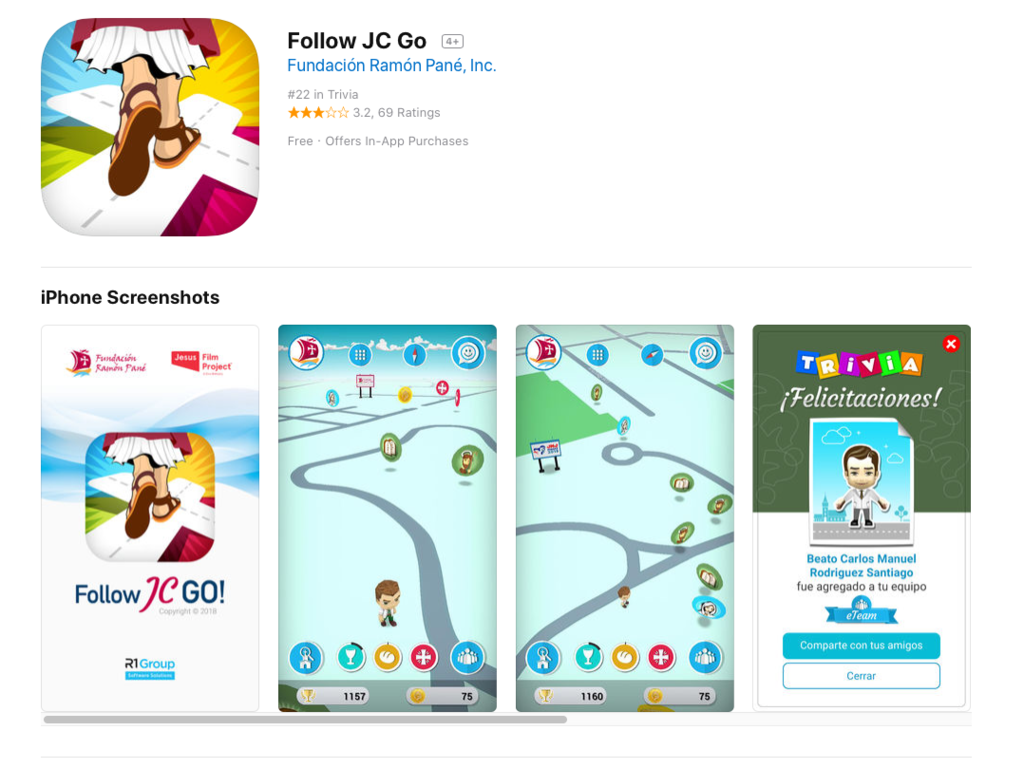 The new game “Follow JC Go” allows players to roam around town in search of saints and Biblical figures.
“Never has the Church had a project like this … this is the Catholic app with the most advanced technology there is,” said Argentinian Ricardo Grzona, executive director of the Foundation Ramon Pane.
The app cost $500,000 to develop through sponsors and private donors.
See the full story here: https://www.heraldmailmedia.com/life/this-pokemon-go-clone-lets-you-collect-catholic-saints-and/article_e9bd9cc7-7fce-5168-83f2-9fbb33a733bd.html