‘New magic’ at Disneyland: How the iconic theme park is enhancing its content with digital touches
 I’d put the enhancements into three technology buckets: embedded animation/multimedia, digital projections, and CGI characters. It wasn’t always clear to me which technique was being used, or how many were used in combination (I was usually watching them from a moving ride vehicle). But they created incremental improvements that kept even the oldest attractions fresh and, importantly, more in line with out-of-Disneyland viewer expectations.
...
For me, the epitome of flexibility is Star Tours: The Adventure Continues. When it opened more than 30 years ago as just Star Tours (before Disney owned the entire Star Wars universe) I interviewed Disney Imagineers who told me the multi-person motion simulators were designed to handle potential updates to their video adventures. That concept was astonishing in a time when it took a then-advanced 386 personal computer to control a single audio-animatronic figure you’d see while waiting in line for the attraction — and that was an improvement from audio-animatronic figures once run by mini-computers.
Now, Star Tours sports stunning high-resolution digital screens, 3D video (added in 2011 when the attraction was fully refreshed), a fully CGI “spokesdroid,” and a bumpy changeable adventure with dozens of variations including, most recently, footage with the First Order. This time, C3PO is your pilot, replacing an original droid pilot voiced by Pee Wee Herman.
The latest Lincoln, updated since my last visit, is based on electronics instead of hydraulics. It’s said to represent the first of a new generation of audio-animatronic figure, autonomatronics, which can incorporate sensors and cameras. This Mr. Lincoln showed more emotion and simply more fluid motion than its predecessors.
Not every digital aspect of Disneyland is in a fixed location. Disney does have its free Disneyland mobile app, useful for quickly checking attraction wait times and, for a daily fee, buying a MaxPass with added features (I also like, and use, the inexpensive third-party subscription TouringPlans.com Lines app to help me limit time in line). Disney has announced a new Play Disney Parks app coming this summer with promised location-based in-park experiences, probably also helpful when you’re stuck in a line.
It is still possible to find classic Disneyland attractions that haven’t received an obvious digital makeover. The Enchanted Tiki Room is one, though in 1963 it did reflect cutting-edge tech as the first use of audio-animatronics anywhere. It’s a Small World is another, annoying adults and charming children with a masterpiece of an earworm since 1966, now enhanced with traditional Small World-style Disney characters such as Stitch.
See the full story here: https://www.geekwire.com/2018/with-a-physical-theme-park-as-content-disneyland-enhances-the-storytelling-with-digital-touches/
Don’t be AI-vil: Google says its algorithms will do no harm
 Google has created a set of principles for its artificial-intelligence researchers to live by—and they prohibit weapons technology.
The company has created a set of seven principles for its artificial intelligence researchers to live by—and they prohibit weapons technology.
An AI code of ethics: Google’s new guidelines prohibit it from helping develop autonomous weapons in future, but leave sufficient wiggle-room for it to benefit from lucrative defense deals. Google’s CEO, Sundar Pichai, announced the new code in a blog post yesterday.
The principles state... Google’s AI should:
-
Benefit society
-
Avoid algorithmic bias
-
Respect privacy
-
Be tested for safety
-
Be accountable to the public
-
Maintain scientific rigor
-
Be made available to others in accordance with the same principles
Some background: The announcement comes in the wake of employee protestover the Department of Defense’s use of Google’s AI to improve the accuracy of drone strikes, among other things.
See the 7 principles in detail here:https://blog.google/topics/ai/ai-principles/
See the story here: https://www.technologyreview.com/s/611379/dont-be-ai-vil-google-says-its-algorithms-will-do-no-harm/
Expert View: How Technology is Making Us Rethink the Way We Think
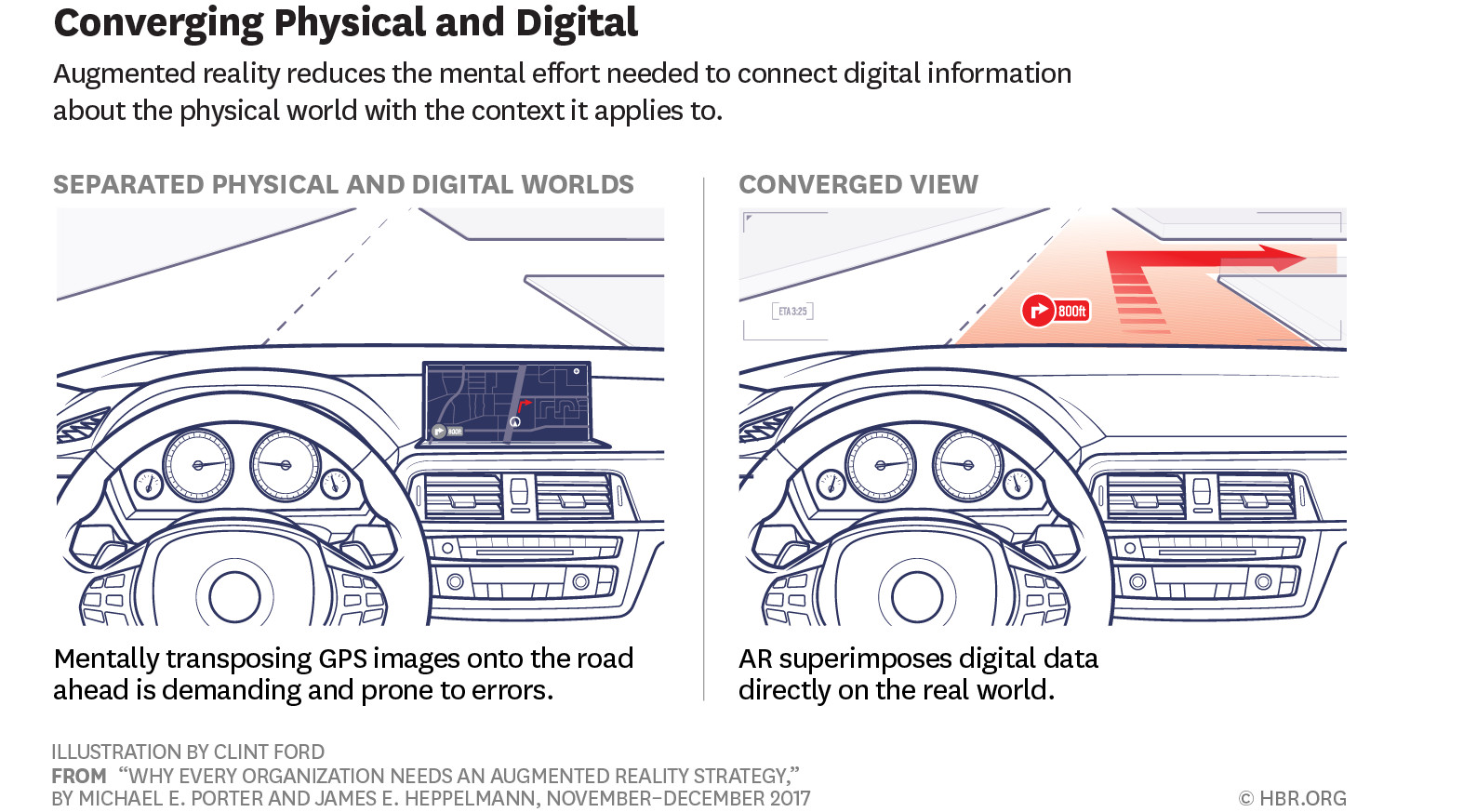 Michael. E Porter from Harvard Business Review says that “By superimposing digital information directly on real objects or environments, AR allows people to process the physical and digital simultaneously, eliminating the need to mentally bridge the two.”
” The ultimate computer, for me, is this mixed-reality computer, where your field of view becomes an infinite display, where you see the world. And you see virtual objects and holograms. That’s definitely what we are building today with HoloLens” , says Satya Nadella, CEO of Microsoft.
Immersive Tech invites us to use “space” around us as a medium to interact with technology. The advent of technology like Magic Leap – a game changing mixed reality headset – will trigger a new way of looking at space and content, because we are designing the spaces with which you think: spatial computers .
Where in the World is AR Research Happening?
Searching Scopus we can find that there have been over 19,800 research papers published with the term “Augmented Reality” in their title, abstract or collection of keywords. The first of these was Steve Feiner’s work on Knowedge-Based Augmented Reality [2], using a see-through head mounted display to superimpose virtual graphics over the real world to help in a training task.
Scopus allows us to find the top 160 authors in AR and the institutions that they come from. This based on the number of publications produced by each author. The figure below shows a map of world with the locations of these authors plotted on it, with larger circles representing more researchers.
See the full article here: https://medium.com/@marknb00/where-in-the-world-is-ar-vr-research-happening-ddebbdc6436b
Contributing to a culture of pioneers, MIT students explore the technical, philosophical, and artful dimensions of VR.
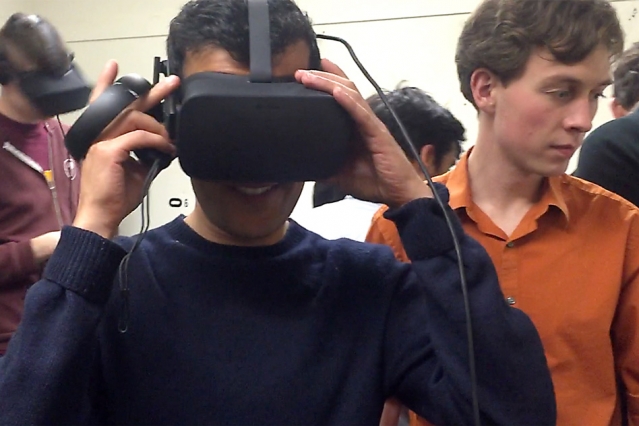 In the hands-on humanities class CMS.339 (Virtual Reality and Immersive Media Production) students are grappling with multiple dimensions of making virtual reality (VR), among them: technical challenges, such as how to prevent the fatigue common to users of VR devices; philosophical questions, such as the difference between “presence” and “immersion”; and issues related to the art of storytelling, especially discovering the visual languages and narrative forms that VR enables.
“It takes eight minutes to learn how to make the 360-video camera work. The rest — figuring out the experience you want to make — is your mind,” says instructor Sandra Rodriguez, who first taught the semester-long class in 2017 in collaboration with William Uricchio, professor of comparative media studies. Their class, which made history as the first VR class ever to be offered at MIT, ran again this term.
See the full story here: http://news.mit.edu/2018/class-hacking-virtual-reality-0601
Solo’s Train Heist Was Designed With the Help of One Big Virtual Reality Leap
 So, one important part of the train heist is the ability of the characters to jump from car to car. But as reported by StarWars.com, there was some doubt as to whether the protagonists would be able to make those jumps. To make sure the sequence made sense, James Clyne, a design supervisor at Lucasfilm, used Lucasfilm’s Virtual Scout technology, which typically lets creators check out CGI-ed sets on virtual reality, to investigate personally.
“You put the goggles on and you’re standing on a train car 60 feet up,” Clyne says. The gear was set up in a relatively small office space. “Could I run and try to jump?” he recalls asking. “They were like, ‘Well, we’ve never done that. We usually just have people slowly walking around the room.’”
OKC’s deadCenter Film Festival launching techCenter conference focused on VR, AR and drones
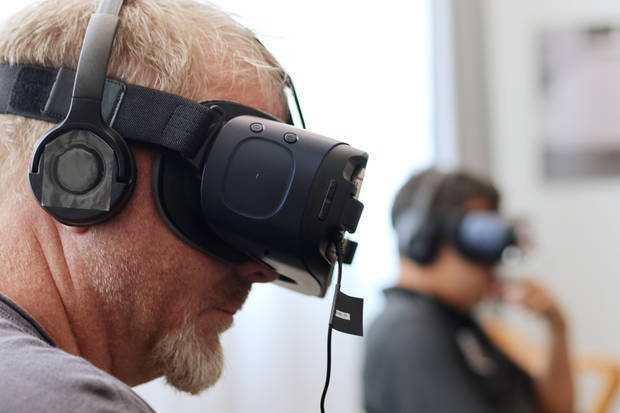
Frank Towerly, Norman, takes part in a 360 film experience at the 21c Museum Hotel during deadCenter in downtown Oklahoma City, Saturday, June 10, 2017. Photo by Doug Hoke, The Oklahoman.
deadCenter Film Festival is partnering with The Chickasaw Nation to launch a new technology conference in conjunction with the annual film festival, which starts Thursday in downtown Oklahoma City.
The conference, called techCenter, will take place Friday through Sunday at 21C Museum Hotel and will focus on virtual reality, augmented reality and drones, according to a news release.
The plan for techCenter is to explore how the technologies changing the film and entertainment industry are also rapidly expanding businesses in a variety of sectors.
techCenter will kick off at noon Friday with an augmented reality ribbon cutting for Trifecta Communication, followed by a series of keynote speakers and industry panels from 1 to 5 p.m.
Baker Hughes/GE Research will headline the event with a presentation about how they are using these new technologies in the oil and gas industry, according to the release.
See the full story here: https://newsok.com/article/5596869/okcs-deadcenter-film-festival-launching-techcenter-conference-focused-on-vr-ar-and-drones