How Mikaela Jade built augmented reality startup Indigital from deep in Kakadu National Park
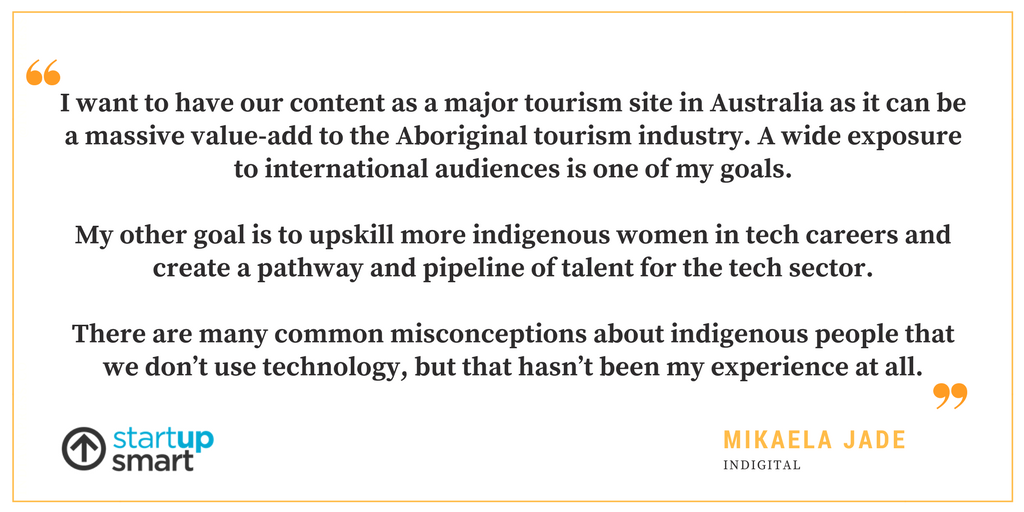 If you were to pick a place to launch an augmented reality startup six years ago, there’s a good chance the remote Australian town of Jabiru — hours out of Darwin — would not have been your first choice.
But that didn’t deter Mikaela Jade from establishing her startup Indigitial in 2012. The goal was to bring augmented and mixed reality to Australia’s Indigenous communities, telling their stories on country through these new and emerging technologies.
Indigital’s products include a line of t-shirts and postcards, emblazoned with Aboriginal art that comes alive when paired with the startup’s mobile application. But the company also creates applications for other businesses and is currently working with Microsoft to tell the story of Namande — the 60,000-year-old figure of the Kakadu national park — using the tech giant’s HoloLens product.
The startup is also working with traditional owners in the community to create holograms of themselves talking about their stories in their own language, and Jade says Indigital’s overarching goal is to constantly push the boundaries of what mixed reality technology can do.
See the full story here: https://www.smartcompany.com.au/startupsmart/news-analysis/mikaela-jade-augmented-reality-startup-indigital-kakadu-national-park/
DREAMSCAPE IMMERSIVE CEO BRUCE VAUGHN ON ALIEN ZOO & WHERE THE FUTURE OF VR IS HEADED
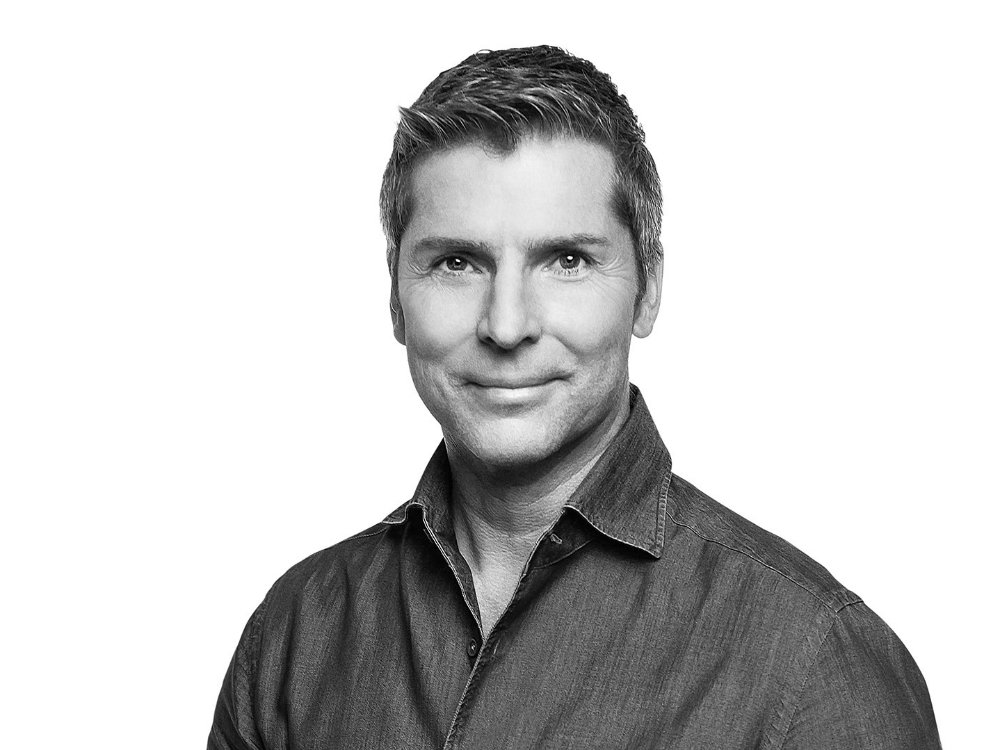 Dreamscape Immersive, the virtual reality startup backed by Hollywood’s elite including Steven Spielberg, made a splash last month with its Alien Zoo pop up at Westfield Century City. Alien Zoo, an immersive virtual reality experience, combines the thrill of an epic theme park attraction with cinematic storytelling to create an unforgettable experience for guests. We spoke with Bruce Vaughn, CEO of Dreamscape Immersive about the Alien Zoo and what’s next for the VR industry.
How did the concept for Alien Zoo form?
BRUCE VAUGHN: Alien Zoo was a concept that Walter Parkes and Steven Spielberg considered making as a movie when he ran Dreamworks, but they never did. It came up when we were brainstorming a first Dreamscape title, and we all felt going to an Alien Zoo in VR would be an incredible experience.
Why was it important to make Alien Zoo a shared group experience?
BV: One of the most important qualities of a Dreamscape experience is that it’s a shared experience. I learned from my 25 years as a Disney Imagineer that people want to consume their entertainment together. We are social creatures. We like to go out with friends and family and do amazing things together. Given all the options for entertainment these days, the experience has to be unique and mind blowing.
What’s currently in the works for Dreamscape Immersive after Alien Zoo?
BV: We are taking the learnings from our successful pop up and fine tuning every aspect of our process and product. We’re actively identifying locations for permanent venues. And we have several titles in production and in development. We’re moving fast!
See the full story here: https://la-confidential-magazine.com/bruce-vaughn-on-the-future-of-virtual-reality
What an ‘infinite’ AI-generated podcast can tell us about the future of entertainment
 Sheldon County is a podcast that will never sound the same twice. Every time someone listens to it, they’ll begin by typing a random number into a website. This “seed” will set in motion a Rube Goldberg machine of calculation that will create characters, relationships, jealousies, betrayals, and maybe even a murder or two. These plot points will be turned into a text narrative, read aloud by a voice synthesizer, and then zipped up into an audio file. Each time it will be a unique version of Sheldon County’s story. A podcast made just for you.
That’s the dream anyway — the current execution still needs work. So far, only a few episodes of this procedurally generated podcast exist (you can listen to two below), and its creator, PhD student James Ryan, is still working on a website. He says the back-end software is mostly finished, but a few finishing touches are needed, like creating a program to automatically add the music to each episode. “Right now I’m proving the concept,” he tells The Verge. “And then I’ve got a dissertation to start.”
In other words, it might be a while.
...See, for example, video games with generative elements like No Man’s Sky, which created unique planets for each player to explore; and Middle-earth: Shadow of War, which made enemies with elaborate histories that fascinated players as much as the game’s story.
...
For Ryan, Sheldon County is the latest step in a life-long quest to build computers that generate fictional worlds. He’s a linguist turned programmer, whose work with the Expressive Intelligence Studio at the University of California, Santa Cruz is dedicated to finding new ways to use machines expressively.
From this simple start, Ryan made ever more complex world-generators. Sheldon Countyitself is built on a program of his called Hennepin, which creates characters, their social networks, and the world they live in. Ryan compares Hennepin to “the biggest Excel spreadsheet in the world,” with endless rows of cells that correspond to characters, traits, relationships, professions, and so on.
...1980s... “It was initially because computers at the time didn’t have much storage, so you couldn’t ship gigantic games,” he explains. “That meant it was incumbent on early titles, like Rogue, NetHack, and so on, to generate mazes on CPUs using some very fast and cheap algorithms.”
What’s interesting, though, is that modern AI techniques like deep neural networks aren’t actually that well-suited for projects like Sheldon County. Ryan says he mainly uses what’s sometimes called symbolic AI or, pejoratively, “good old-fashioned AI.” This approach is less about mining data to look for patterns, as with deep learning, and more about creating sets of rules and logical instructions that guide a process.
...He suggests Ryan’s project is interesting not necessarily because of the narratives it creates, but because it questions our idea of what a podcast is and what makes one good in the first place.
See the full story here: https://www.theverge.com/2018/3/11/17099578/ai-generated-podcast-procedural-storytelling-art-sheldon-county?mc_cid=2d9a3b385d&mc_eid=79d3ad3512
The web’s creator says: regulate Big Tech.
Tim Berners-Lee has written an open letter describing how to clean up the web.
The status quo: Berners-Lee points to fake news, election meddling, and huge hacks to argue that the web is no longer the "free, open, creative space" it was.
Big problems: Just "a handful of platforms ... control which ideas and opinions are seen," says Berners-Lee. Firms like Facebook and Google, he says, gobble talent, hoard data, and have business models "built to maximise profit [not] social good."
A solution? "A legal or regulatory framework that accounts for social objectives may help ease those tensions," suggests Berners-Lee. He doesn’t provide details.

|
See the original post here: https://webfoundation.org/2018/03/web-birthday-29/
Today, March 12, is the World Wide Web’s 29th birthday. Here’s a message from our founder and web inventor Sir Tim Berners-Lee on what we need to ensure that everyone has access to a web worth having.
Today, the World Wide Web turns 29. This year marks a milestone in the web’s history: for the first time, we will cross the tipping point when more than half of the world’s population will be online.
When I share this exciting news with people, I tend to get one of two concerned reactions:
- How do we get the other half of the world connected?
- Are we sure the rest of the world wants to connect to the web we have today?
The threats to the web today are real and many, including those that I described in my last letter — from misinformation and questionable political advertising to a loss of control over our personal data. But I remain committed to making sure the web is a free, open, creative space — for everyone.
That vision is only possible if we get everyone online, and make sure the web works for people. I founded the Web Foundation to fight for the web’s future. Here’s where we must focus our efforts:
Close the digital divide
The divide between people who have internet access and those who do not is deepening existing inequalities — inequalities that pose a serious global threat. Unsurprisingly, you’re more likely to be offline if you are female, poor, live in a rural area or a low-income country, or some combination of the above. To be offline today is to be excluded from opportunities to learn and earn, to access valuable services, and to participate in democratic debate. If we do not invest seriously in closing this gap, the last billion will not be connected until 2042. That’s an entire generation left behind.
In 2016, the UN declared internet access a human right, on par with clean water, electricity, shelter and food. But until we make internet access affordable for all, billions will continue to be denied this basic right. The target has been set — the UN recently adopted the Alliance for Affordable Internet’s threshold for affordability: 1 GB of mobile data for less than 2% of average monthly income. The reality, however, is that we’re still a long way off from reaching this target — in some countries, the cost of 1GB of mobile broadband remains over 20% of average monthly income.
What will it take to actually achieve this goal? We must support policies and business models that expand access to the world’s poorest through public access solutions, such as community networks and public WiFi initiatives. We must invest in securing reliable access for women and girls, and empowering them through digital skills training.
Make the web work for people
The web that many connected to years ago is not what new users will find today. What was once a rich selection of blogs and websites has been compressed under the powerful weight of a few dominant platforms. This concentration of power creates a new set of gatekeepers, allowing a handful of platforms to control which ideas and opinions are seen and shared.
These dominant platforms are able to lock in their position by creating barriers for competitors. They acquire startup challengers, buy up new innovations and hire the industry’s top talent. Add to this the competitive advantage that their user data gives them and we can expect the next 20 years to be far less innovative than the last.
What’s more, the fact that power is concentrated among so few companies has made it possible to weaponise the web at scale. In recent years, we’ve seen conspiracy theories trend on social media platforms, fake Twitter and Facebook accounts stoke social tensions, external actors interfere in elections, and criminals steal troves of personal data.
We’ve looked to the platforms themselves for answers. Companies are aware of the problems and are making efforts to fix them — with each change they make affecting millions of people. The responsibility — and sometimes burden — of making these decisions falls on companies that have been built to maximise profit more than to maximise social good. A legal or regulatory framework that accounts for social objectives may help ease those tensions.
Bring more voices to the debate on the web’s future
The future of the web isn’t just about those of us who are online today, but also those yet to connect. Today’s powerful digital economy calls for strong standards that balance the interests of both companies and online citizens. This means thinking about how we align the incentives of the tech sector with those of users and society at large, and consulting a diverse cross-section of society in the process.
Two myths currently limit our collective imagination: the myth that advertising is the only possible business model for online companies, and the myth that it’s too late to change the way platforms operate. On both points, we need to be a little more creative.
While the problems facing the web are complex and large, I think we should see them as bugs: problems with existing code and software systems that have been created by people — and can be fixed by people. Create a new set of incentives and changes in the code will follow. We can design a web that creates a constructive and supportive environment.
Today, I want to challenge us all to have greater ambitions for the web. I want the web to reflect our hopes and fulfil our dreams, rather than magnify our fears and deepen our divisions.
As the late internet activist, John Perry Barlow, once said: “a good way to invent the future is to predict it”. It may sound utopian, it may sound impossible to achieve after the setbacks of the last two years, but I want us to imagine that future and build it.
Let’s assemble the brightest minds from business, technology, government, civil society, the arts and academia to tackle the threats to the web’s future. At the Web Foundation, we are ready to play our part in this mission and build the web we all want. Let’s work together to make it possible.
Sir Tim Berners-Lee
Please share this letter on Twitter using the hashtag #HappyBirthdayWWW
The Web Foundation is at the forefront of the fight to advance and protect the web for everyone. For updates on our work, sign up for our newsletter and follow us on Twitter @webfoundation.
Virtual Reality Lets Rare Works of Art Take a Field Trip
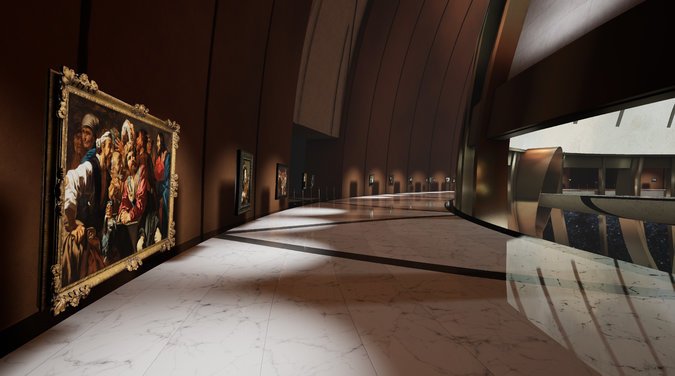
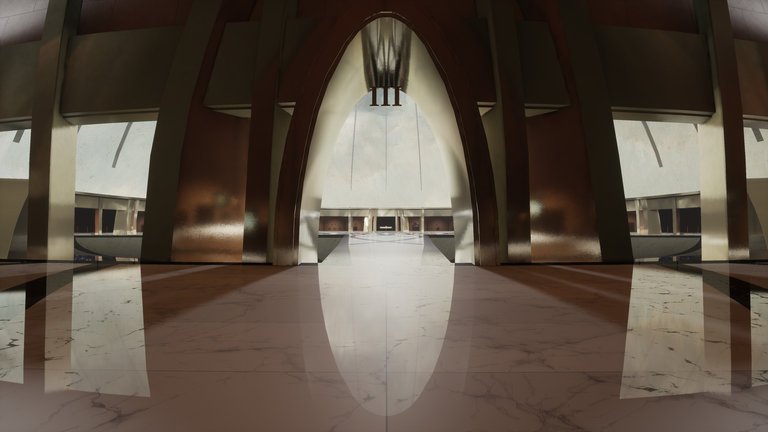 AMSTERDAM — This museum is floating in outer space.
In front of you, there is a line of stunning European old master paintings to observe and explore. Behind you is a sleek walkway over the infinite void of sky and stars. If you were to take a running leap, you’d fly out into nothingness and never stop.
The Dutch art collectors George and Ilone Kremer decided to combine these two developments: They’ve reproduced 74 artworks from their own stellar art collection, to create a traditional museum experience using video-game technologies and a 21st-century twist.
This month and next, the Kremer Museum is rolling out its first mobile app, which will allow people worldwide to visit a virtual museum using any Google Daydream-ready phone and virtual reality headset, simply by placing the smartphone sideways into the headset and turning it on. The app is free, and through a program they’ve also created called Mighty Masters, the Kremers plan to donate smartphones and virtual reality helmets to selected schools, beginning in India with the help of the Delivering Change Foundation.
The idea for a virtual-reality museum came from their son Joël, who had worked in the United States for Google. Joël eventually became the director of the museum and spearheaded the project.
Each painting in the collection was photographed about 3,000 times and then merged into a 3-D image using photogrammetry, or measurements of surface points. Visitors to the museum can therefore look not only at the front of a picture, but also walk around and see labels and other markings on the back.
Glitches still need to be worked out. The image resolution still appears to be inadequate to create a sufficiently high-resolution reproduction.
See the full story here: https://www.nytimes.com/2018/03/10/arts/virtual-reality-art.html
READING IN VIRTUAL REALITY: THE GOOD AND NOT-SO-GOOD
To actually start reading in virtual reality, I used Bigscreen, which lets you use your desktop in a VR environment.
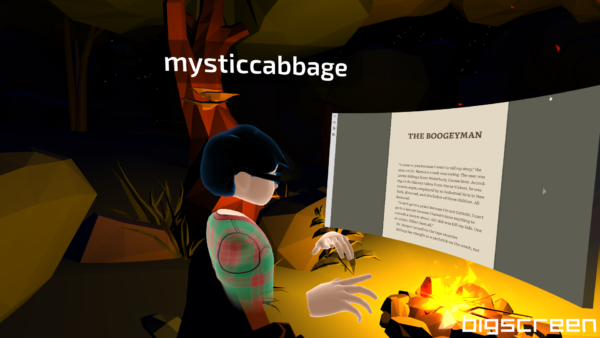 With the crackle of the campfire in the background, I surprised myself how easily I was drawn into the story. While the boogeyman slithered and tortured the poor narrator’s children, I found myself occasionally peeking at the shadows and dark lit trees; I really felt alone and lost in the woods, and it was wonderful. I’ve read the horror story before, but now it felt new, fresh…and personal.
(And best of all, I got to go camping without the hassle of going outside. Huzzah!)
THE (VERY) GOOD: ATMOSPHERE
If you like playing music while you read to set the mood — this is the ultimate next step. Bigscreen lets you set the background to numerous different environments. So, I huddled up in my hammock, put on the headset, and found myself sitting by a cozy campfire at night, reading Stephen King’s “The Boogeyman” from Night Shift.
CONCLUSION
Yes, VR is not perfect yet, and reading in VR is definitely in its infancy. Nevertheless, I’m really excited about the future for virtual reality bookworms. Just an hour or two in another world made reading feel genuinely magical again. And that to me is worth all the hassle in the world, just for those small moments of being entirely lost, mentally and physically, in a book.
See the full story here: https://bookriot.com/2018/03/10/reading-in-virtual-reality-the-good-and-not-so-good/
Bose is developing augmented reality glasses with a focus on sound
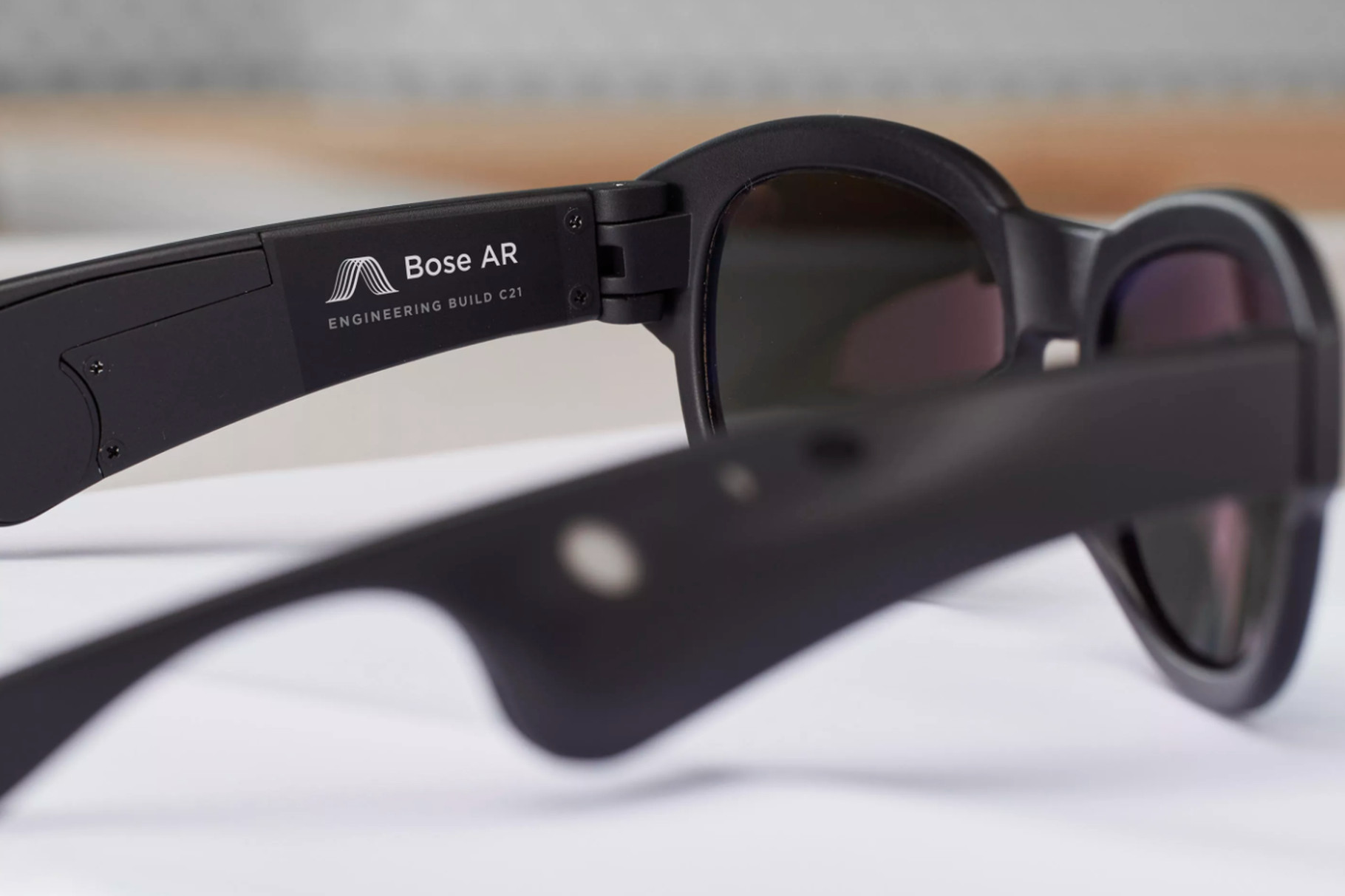 Bose has announced at SXSW that it’s working on its own pair of augmented reality glasses, but not in the way that you’d think. Instead of superimposing data over the world visually, like Google Glass or Intel’s Vaunt glasses, Bose’s AR concept unsurprisingly focuses on audio, adding “audible layer of information and experiences” to the real world, according to a report from CNET.
Bose isn’t just working on one pair of glasses, either. The company has bigger ambitions for its audio AR as an entire platform for developers to build off, and to that end, the Bose is releasing a Bose AR SDK and setting up a $50 million fund to invest in companies that will build things with Bose AR.
Bose is releasing a Bose AR SDK and setting up a $50 million fund to invest in companies that will build things with Bose AR.
The company envisions having a Bose AR device reenact historical events or speeches from landmarks and statues as you visit them, or get audio directions to your gate when your GPS detects that you’ve arrived at the airport. The company also aspires to combine visual information with the Bose AR platform, too, so you could hear a translation of a sign you’re looking get, get a weather report when you look out your window, or hear the history of a painting in a museum.
See the full story here: https://www.theverge.com/circuitbreaker/2018/3/9/17100410/bose-ar-platform-audio-augmented-reality-glasses-headphones-sxsw