Google Is Bringing Augmented Reality Functionality to Chrome
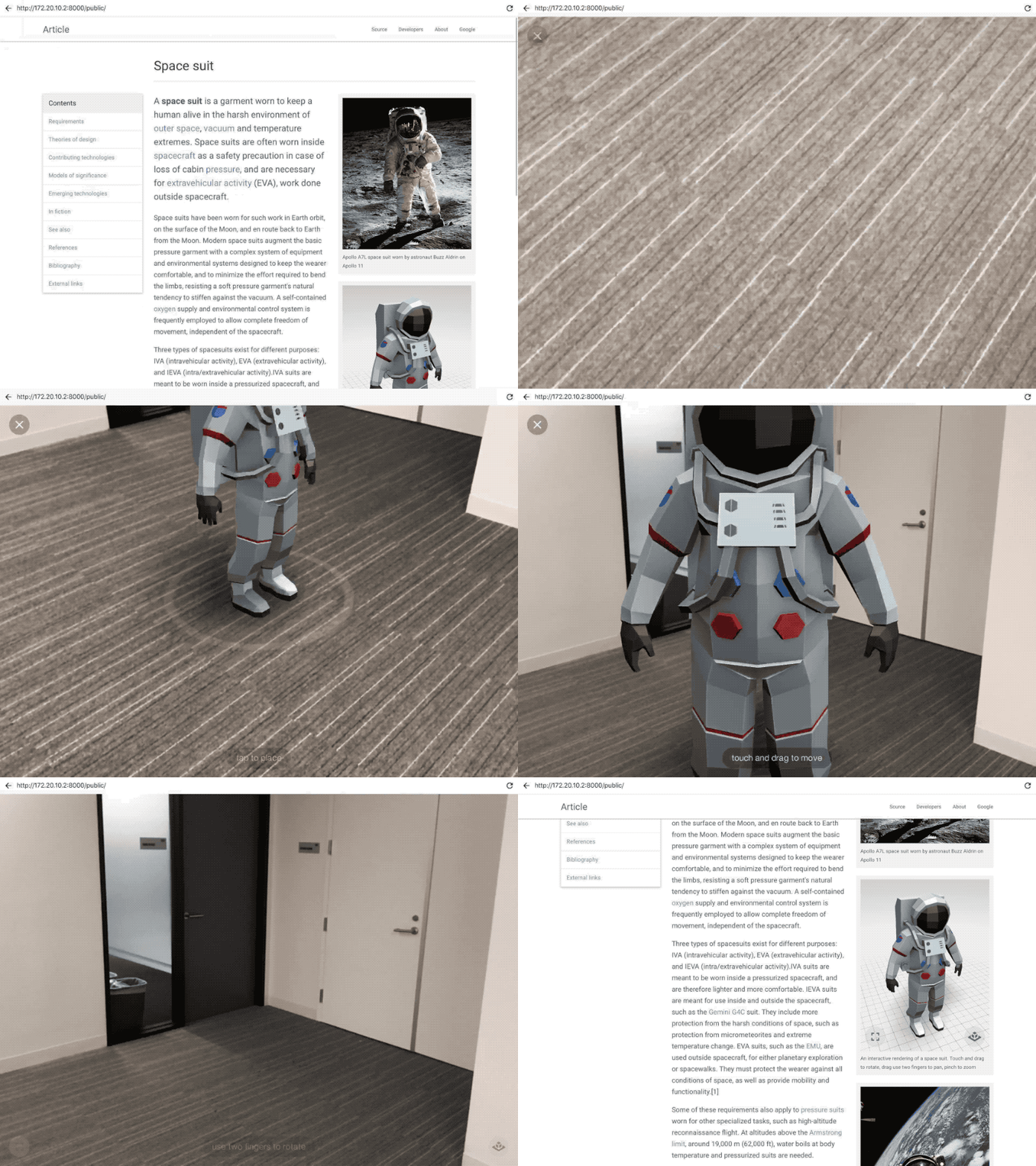 Google looks like it is trying to extend its cross-platform edge to the world of augmented reality (AR) with a new product, tentatively called Article, which will integrate AR into the company’s Chrome browser. In a blog post, Google said, “To help bring (AR) to as many users as possible, we’ve been exploring how to bring augmented reality to the web platform, so someday anyone with a browser can access this new technology.”
Article is likely meant to compete with Apple’s proprietary ARKit.
See the full story here: https://futurism.com/google-bringing-augmented-reality-functionality-chrome/
Tech Giants Brace for Europe’s New Data Privacy Rules
[Access the GDPR here: https://gdpr-info.eu ]
 Over the past two months, Google has started letting people around the world choose what data they want to share with its various products, including Gmail and Google Docs.
Amazon recently began improving the data encryption on its cloud storage service and simplified an agreement with customers over how it processes their information.
And on Sunday, Facebook rolled out a new global data privacy center — a single page that allows users to organize who sees their posts and what types of ads they are served.
While these changes are rippling out worldwide, a major reason for these shifts comes from Europe: The tech giants are preparing for a stringent new set of data privacy rules in the region, called the General Data Protection Regulation.
Set to take effect on May 25, the regulations restrict what types of personal data the tech companies can collect, store and use across the 28-member European Union. Among their provisions, the rules enshrine the so-called right to be forgotten into European law so people can ask companies to remove certain online data about them. The rules also require anyone under 16 to obtain parental consent before using popular digital services. If companies do not comply, they could face fines totaling 4 percent of their annual revenue.
“G.D.P.R. is going to introduce very fundamental changes to the way the internet works for everyone.”
The rush of activity is a reminder of how Europe has set the regulatory standard in reining in the immense power of tech giants, while other places — including the United States — have largely taken a noninterventionist stance.
Since the new rules require individuals to give their consent before a company accesses data, for example, Google has had to redesign many consent agreements, as well as change underlying technology to make it easier to remove someone’s data.
On Sunday,[Facebook] began offering a new privacy center that puts user security settings on one page instead of dispersing them across different sections of the social network.
Amazon, too, has made changes. Last April, the company wrote a blog post outlining its efforts to comply with the new European regulations. The internet retailer said it would strengthen the encryption around the data it stores on its cloud storage services, and reaffirmed the rights of customers to choose which region — Europe or otherwise — where they want their data stored.
See the full story here: https://www.nytimes.com/2018/01/28/technology/europe-data-privacy-rules.html
Among the new policies approved on Tuesday:
■ Allowing national watchdogs to issue fines, potentially totaling the equivalent of hundreds of millions of dollars, if companies misuse people’s online data, including obtaining information without people’s consent.
■ Enshrining the so-called right to be forgotten into European law, giving people in the region the right to ask that companies remove data about them that is either no longer relevant or out of date.
■ Requiring companies to inform national regulators within three days of any reported data breach, a proposal that goes significantly further than what is demanded by American authorities.
■ Obliging anyone under 16 to obtain parental consent before using popular services like Facebook, Snapchat and Instagram, unless any national government lowers the age limit to 13.
■ Extending the new rules to any company that has customers in the region, even if the company is based outside the European Union.
See the full story here: https://www.nytimes.com/2015/12/16/technology/eu-data-privacy.html
Google for Education Launches Beta for ‘Create Your Own’ Virtual Reality Experience
 Educators and their students can now be part of a beta program to create their own Google Expeditions virtual reality experiences. The opportunity was unveiled this week at Bett, the world’s largest educational technology show here.
Classes enrolled in what Google calls its “pioneer program” will be able to create their own immersive virtual experiences with a 360-degree camera and the Google app.
A “create your own” experience “is the top feature that teachers and students wanted in Google Expeditions,” said Holland. The students can collaborate on and share one another’s creations.
See the full story here: https://marketbrief.edweek.org/marketplace-k-12/google-education-launches-beta-create-virtual-reality-experience/
Researchers Used Virtual Reality to Gain Insight into How Our Brains Assemble Memories
 Researchers from the University of California, Davis, studied how our brains assemble memories within context of time and space by immersing participants in a VR experience. Afterwards, the scientists used functional magnetic resonance imaging, or fMRI, to observe activity in the hippocampus while the subjects recalled their memories of the experience.
In the VR experience, the subjects “went” into different houses that had different objects in them. They tried to memorize the objects in two separate contexts — which video and which house. This tested both episodic (video) and spatial (house) memory, which each activated different regions of the hippocampus.
See the full story here: https://futurism.com/virtual-reality-brains-assemble-memories/
MyndVR Taps Littlstar to Launch Exclusive Virtual Reality Content Service for 55-Plus Adult Communities Nationwide
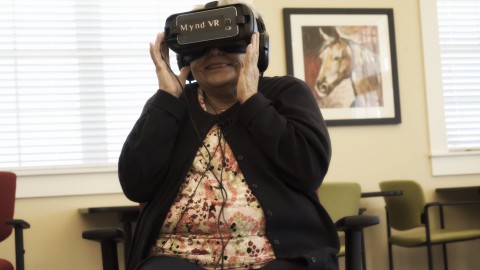 MyndVR, the national leader in providing virtual reality (VR) solutions for senior living communities, and Littlstar, a global content network dedicated to virtual reality, 360-degree video and immersive experiences, are pleased to announce an exclusive partnership to deliver VR content to older adults. MyndVR powered by Littlstar will provide seniors with access to immersive and meaningful experiences from the top content producers in the world, including DiscoveryVR, National Geographic, USA Today Network, and The Wall Street Journal.
MyndVR’s goal is to provide a unique blend of licensed and original content designed to improve the lives and cognitive outcomes of adults 55-plus. Using Littlstar’s industry-leading streaming capabilities and a customized MyndVR interface, the partnership will provide freshly updated content on a regular basis as part MyndVR’s end-to-end solution which also includes VR headsets and technical support.
See the full story here: https://www.businesswire.com/news/home/20180123006234/en/MyndVR-Taps-Littlstar-Launch-Exclusive-Virtual-Reality
ABOUT MYNDVR
MyndVR is a health and wellness company providing virtual reality solutions to senior living communities, home health care agencies and directly to senior consumers. The company is intelligently curating a vast library of VR content and creating innovative genres of recreational, prescriptive and on-demand content. MyndVR offers a promising future of cognitive health and wellness for the dynamic aging population. MyndVR uses a compassionate approach and understands the best way to deliver the right content to adults 55-plus. Pilots have demonstrated the positive impacts on seniors.
MyndVR is committed to conducting clinical trials in order to measure the therapeutic effect of VR. These trials will also measure the health care outcomes, including cognitive, visual, emotional and physical effects on seniors. The company plans to bring happiness and wellness by providing immersive virtual reality experiences revolving around meaningful content with a purpose.
Now you can watch Plex in virtual reality with Google Daydream
And you can bring several friends
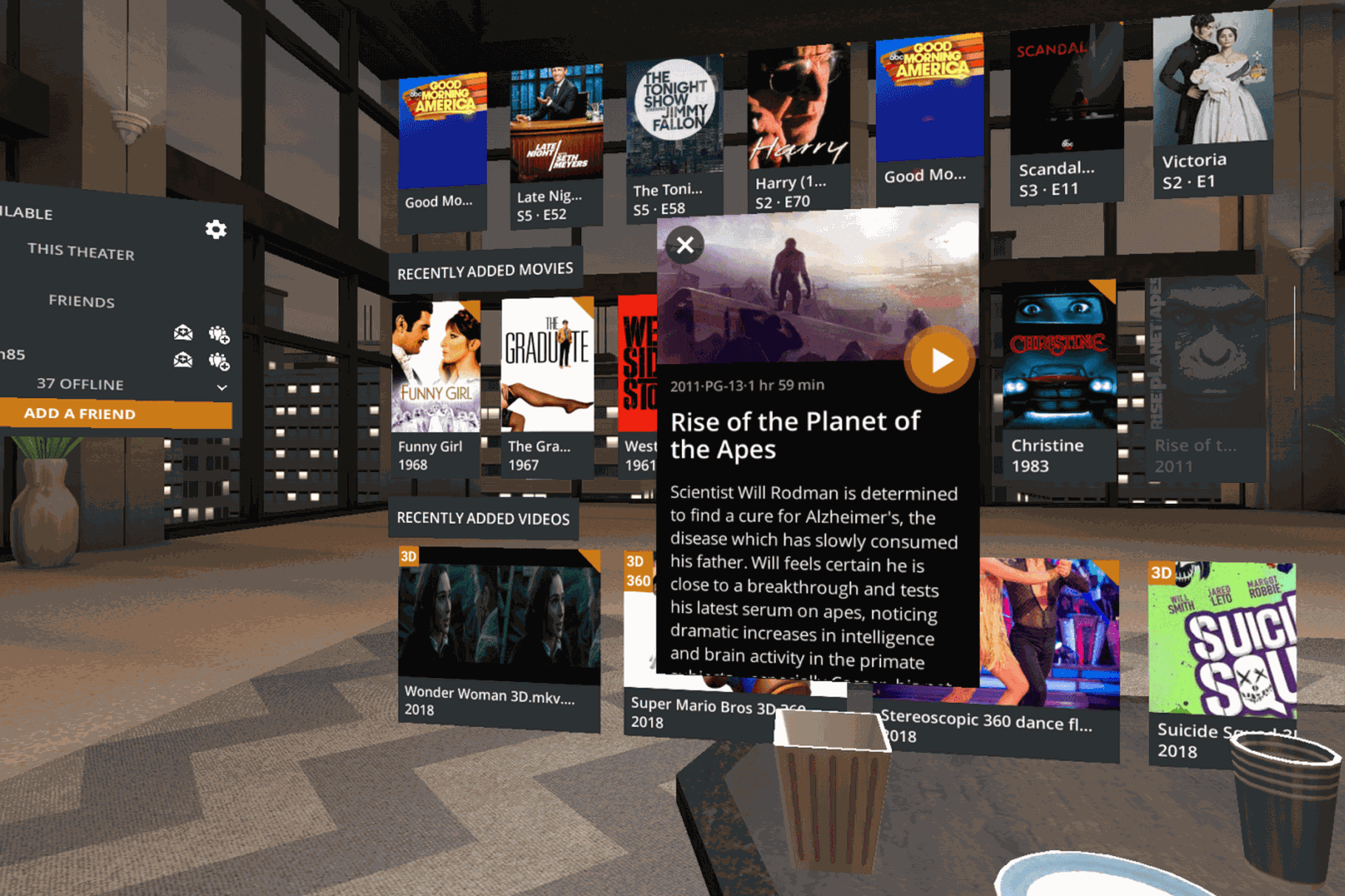
Plex, the hugely popular media streaming app, is adding support for Google’s Daydream VR today. With a Daydream-compatible Android smartphone and the requisite headset, you’ll be able to watch movies or TV shows from any media server linked to your Plex account in virtual reality. Plex has several interactive viewing environments you can choose from, ranging from a luxurious loft apartment to a drive-in movie theater. Once you start playing something, that content will take up “a large percentage of your visual field.”
 Plex VR lets you browse through your entire media server collection and those belonging to friends who’ve shared access with you, and the company has done some clever things to help with queue management. You can grab the individual artwork cards for movies and shows and “stack” them on the couch next to you for fast access.
See the full story here: https://www.theverge.com/circuitbreaker/2018/1/24/16927136/plex-vr-google-daydream-now-available-features
Experience on Demand: What Virtual Reality Is, How It Works, and What It Can Do
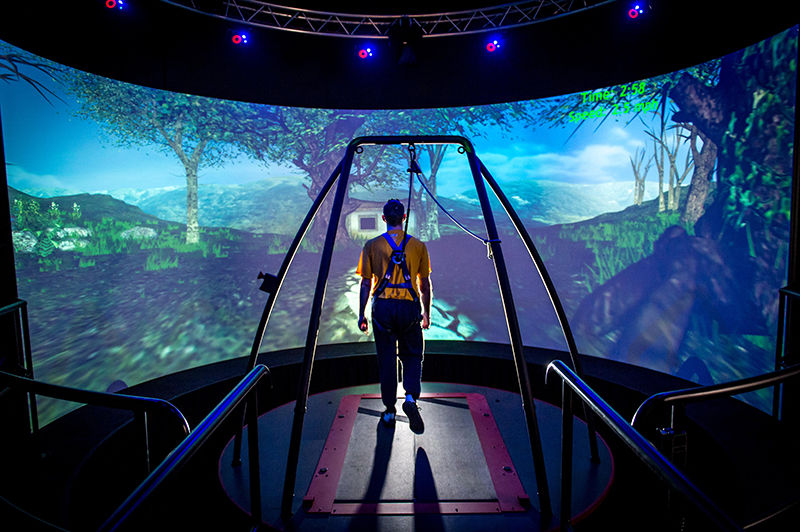 A book by Jeremy Bailenson W. W. Norton: 2018
Reviewed here: https://www.nature.com/articles/d41586-018-00894-w
ARKit upgrade makes augmented reality apps better than ever
 The upgrade adds a big new feature to AR developers’ toolset: wall detection. Previous versions of ARKit only focused on horizontal plane detection, meaning that it only able to detect floors for objects to be placed onto. With the new upgrade, AR developers will now be able to add walls into the mix — for instance, creating a game in which you throw darts at a wall-mounted board.
On top of this, resolution is improved so that ARKit will now look at the “real world” in 1080p, rather than 720p. That means that there should now be less disparity between the “fake” parts of an ARKit scene (which, oddly, looked more realistic due to their higher resolution) and the “real” parts, which previously appeared low resolution.
See the full story here: https://www.cultofmac.com/525043/arkit-1-5-upgrade/
Is Virtual Reality Art the Real Deal?
More artists are jumping on the VR bandwagon, but does the experience match the hype—or is it inherently "nauseating"?
 Last January, the New Museum and Rhizome commissioned six VR artworksthat could be accessed via a free app and viewed on smartphone screens using $15 Google Cardboard frames. Twelve months later, it seems VR is in the art world for the long haul, but it arrives with some questions. How do you exhibit VR? How do you maintain the value of a VR work? Once you own a VR work, how do you accommodate changes in technology? Should you restrict access to VR works with disturbing content? Why use VR in the first place?
See the full story here: https://garage.vice.com/en_us/article/gyw7xw/is-virtual-reality-art-the-real-deal