NBC to offer virtual reality coverage of PyeongChang Olympics
 NBC will provide more than 50 hours of live virtual reality coverage powered by Intel True VR during the XXIII Olympic Winter Games from PyeongChang, South Korea, to authenticated users with Windows Mixed Reality headsets, Samsung Gear VR, and both Google Cardboard and Google Daydream, with compatible iOS or Android devices via the NBC Sports VR app.
This effort will mark the first time ever that VR will be available for a Winter Olympics and that Olympic VR programming will be live in the U.S on a wide range of devices and platforms.
The more than 50 hours of live VR programming, supplied to NBC Olympics by its partner Olympic Broadcasting Services, will include the Opening and Closing Ceremonies, alpine skiing, curling, snowboarding, skeleton, figure skating, short track, ski jumping, ice hockey, big air and more.
In addition, NBC Olympics will offer VR replays of all events previously livestreamed; one daily 360-degree video of a sport not available in VR the previous day; and packaged highlights from the day before.
The VR experience is enabled by Intel True VR technology, which uses multiple camera pods at each event to create interactive 360-degree virtual reality environments.
Viewers will also be able to “fly” through the Olympic world, tour Olympic venues and different areas throughout Korea.
Programming will span every day of the Games – with the exception of Feb. 18 – beginning the day of the Opening Ceremony on Friday, Feb. 9, and concluding with the Closing Ceremony on Sunday, Feb. 25. The content will be available to authenticated users on Samsung, Google, Windows, and Android and iOS devices through the NBC Sports VR app.
See the full story here: http://www.newscaststudio.com/2018/01/09/nbc-olympics-virtual-reality/
The Huawei VR2 is a stunningly comfortable virtual reality headset
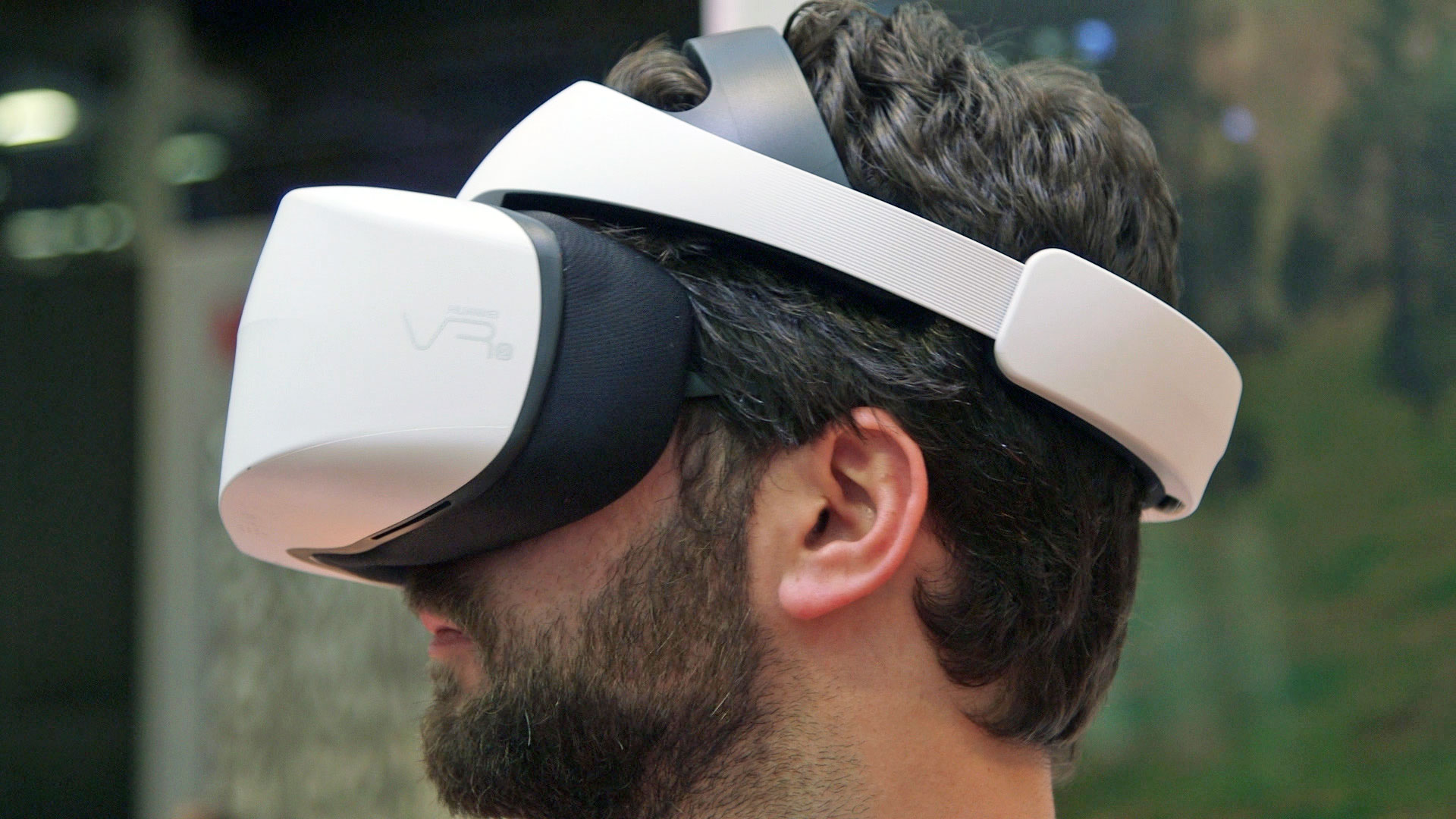 Unlike the original Huawei VR, this is a standalone unit that hopes to take on the likes of Oculus and Vive, not the Gear VR. You don't slide a phone inside, instead you connect a phone, tablet or even a PC to it via USB-C. Then you can enjoy your virtual worlds in glorious 3K -- that's a resolution of 1,600 x 1,440 per eye. And thanks to the 90Hz refresh rate, eye strain and motion sickness should be kept to a minimum. I tend to be particularly sensitive to VR sickness but felt fine after about 20 minutes split between two demo stations.
The controller was made of the same bright white polymer as the headset and should seem familiar to anyone that's used a Gear VR or Daydream headset before. There's a small clickable touchpad at the top, a home button and a back button below that and a trigger on the underside.
Huawei has lined the entire inside with soft fabric stuffed with plenty of cushioning.
Unfortunately, there's still a lot we don't know about the Huawei VR2, most importantly a price or release date.
See the full story here: https://www.engadget.com/2018/01/09/huawei-vr2-hands-on/
CES Reporter’s Notebook: Paramount Brings ‘Downsizing’ to Life With Augmented Reality
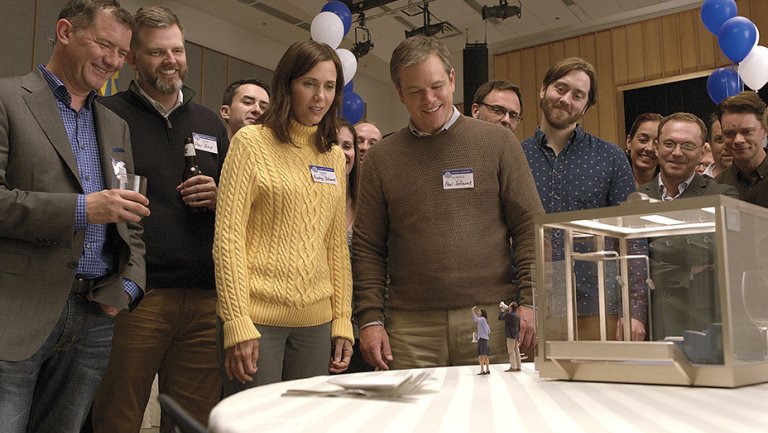 Paramount’s Downsizing got the augmented reality treatment at CES this week.
To help startup Mira launch its Prism augmented reality device — which, like the Samsung Gear VR, requires a mobile phone to operate — the studio helped Mira create a unique AR experience using assets from the Alexander Payne film, which is based on the premise that people may downsize themselves and their world to save money and control overpopulation.
Paramount futurist Ted Schilowitz explains that users see trailer material in the headset and can select and "downsize" certain items that appear. In following the film's theme, the experience ends by displaying how much money the viewer would have saved with the downsized items.
The Downsizing AR experience can be viewed at Mira's booth on the show floor at CES, where the company is launching the Prism system and making it available to developers.
See the full story here: https://www.hollywoodreporter.com/behind-screen/ces-reporters-notebook-paramount-brings-downsizing-life-augmented-reality-1073533
Lumus shows off the latest of its increasingly tiny augmented reality displays
 The company builds what are called reflective waveguides. The interesting, rather sleek pieces of display technology rely on microscopic etchings in transparent glass lenses that catch light being projected into their edges. While these systems are limited in how much of a viewer’s field-of-view they can fill, they are unparalleled in the small form factors they can reach and will likely be what powers your first pair of smart glasses.
The company gathered headlines recently as it reached a deal with Quanta, a manufacturer used by Apple, to begin building AR displays. The Israeli company has raised $57 million from companies including Quanta, Alibaba and HTC.
In a moderately sunny room, the waveguide displayed images of a rocket that was bright enough to nearly block out the real world person that was walking in front of me.
See the full story here: https://techcrunch.com/2018/01/09/lumus-shows-off-the-latest-of-its-increasingly-tiny-augmented-reality-displays/
CES 2018: Hands-On With Sansar’s Ready Player One VR Experience
 Like most other Sansar environments this Ready Player One scene is a social space and you can walk around and check out the movie set just like you’re actually standing there. Jason Gholston, Director of Business Development at Sansar, explained that they worked directly with Warner Bros. to painstakingly recreated every detail of the set. In this way, this is almost like a behind-the-scenes look at the film.
In the movie each shot is going to be zoomed in on the characters and limit how much fo the whole set you can see, but in this VR environment you’re free to walk around and explore every inch at your own pace. In fact, Gholston told me that they were able to cram even more pop culture Easter eggs and references into the VR garage than there are in the film for the simple reason that players can see more of it than viewers can.
Players can check out the full Ready Player One garage VR location in Sansar right now.
See the full story here: https://uploadvr.com/ces-2018-hands-sansars-ready-player-one-vr-experience/
Artificial Intelligence Startup Oben Raises $10 Million
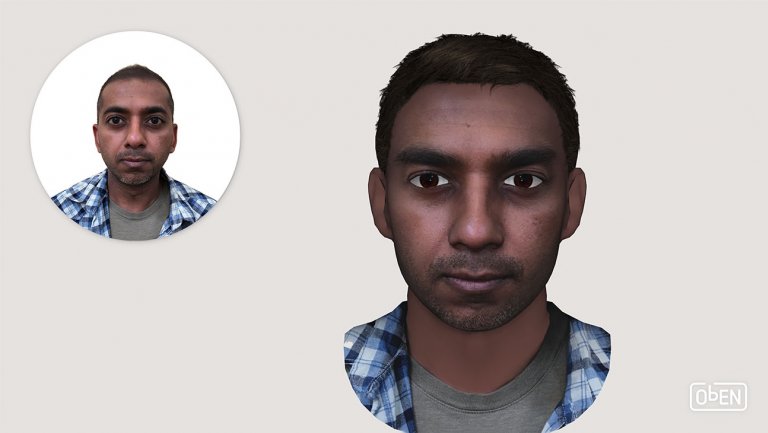 Pasadena-based artificial intelligence startup Oben has raised $10 million, bringing its total funding to roughly $23.7 million.
Its new investor is entrepreneur Adrian Cheng’s K11, the company behind a museum-retail concept, the “art mall,” that already has sites in Hong Kong and Shanghai.
Oben intends to use the funding to further develop its platform for creating AI-driven avatars. Part of the plan is to incorporate custom avatars at K11 locations as guides.
As previously reported, Oben also has been reaching out to Hollywood talent agencies with an eye toward creating digital "copies" of actors and celebrities for a variety of uses. For instance, Siri’s voice could be replaced by that of a famous actor or actress.
See the full story here: https://www.hollywoodreporter.com/behind-screen/artificial-intelligence-startup-oben-raises-10-million-1073508
Lytro is Positioning Its Light Field Tech as VR’s Master Capture Format
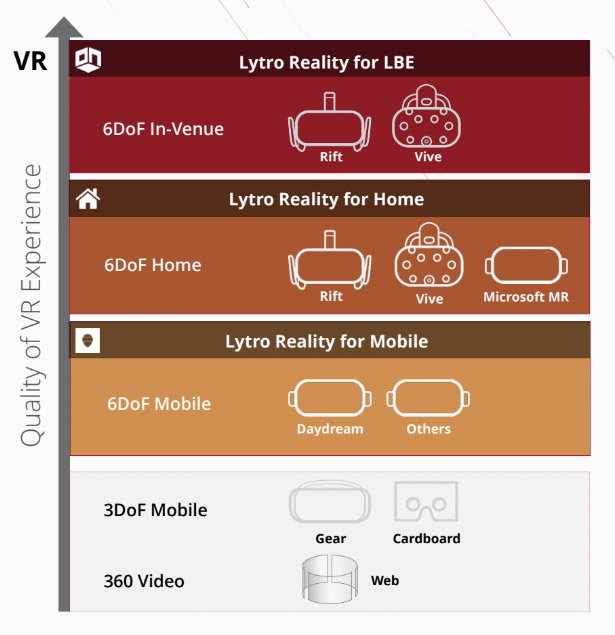 There’s three main pieces of Lytro’s toolset that makes it all possible. First is the company’s light-field camera, Immerge, which enables high-quality live-action light-field capture; we recently detailed its latest advancements here. Then there’s the company’s Volume Tracer software which renders synthetic light-fields from CG content. And finally there’s the company’s playback software which aims to enable the highest-fidelity playback on each device.
For example, a creator could create a high-fidelity CGI scene like One Morning—a Lytro Reality Experience which the company recently revealed—with their favorite industry-standard rendering and animation tools, and then output that experience as a Lytro Reality Experience which can be deployed across high-end, low-end, and even 360 video without needing to modify the source content for the specific capabilities of each device, and without giving up the graphical quality of raytraced, pre-rendered content.
Lytro is keeping its tools close to the chest for now; the company is working one on one with select customers to release more Lytro Reality Experiences, and encourages anyone interested to get in touch.
While Rosenthal says the company is still working on reining in light-field file sizes, the company provided Road to VR with a fresh look at the their current data envelopes for each consumption end-point:
- 0.5TB/minute for 6DoF in-venue
- 2.7GB/minute for in-home desktop
- 2.5GB/minute for tablet/mobile devices
- 9.8MB/minute for 360 omnistereo
See the full story here: http://www.virtualrealitypulse.com/edition/monthly-apple-htc-2017-12?open-article-id=7659216&article-title=lytro-is-positioning-its-light-field-tech-as-vr-s-master-capture-format&blog-domain=roadtovr.com&blog-title=road-to-vr
Why Print Legacies Like Time Are Betting Big on Augmented Reality
 Last week’s issue of Time magazine is the first edited by a guest editor in its 94 years of existence. It’s also the first issue to feature augmented reality activations—four of them, all on the issue’s theme of optimism.
According to Mia Tramz, managing editor of Life VR, and Claire Howorth, assistant managing editor of Time, the original impetus to include AR in this issue came from Bono, who wanted his contribution to have an AR or VR component. But the team, which includes the third-party Ryot Labs, had already been brainstorming ideas for over a year, since they had produced a “Capturing Everest” feature for Sports Illustrated. A single AR activation quickly became four.
“We’ve published about 23 or 24 VR projects since we launched Life VR last year,” Tramz said. “In the way that VR was nascent [for media companies] a few years ago, I think AR is right now.” The plan is to continue to develop AR activations across Time, Inc’s line of titles, as well as standalone AR and VR experiences.
“Since you’re using your phone for the activation, it’s almost like having Bono and Bill Gates in your hand,” Tramz said.
“A lot of the response we’ve gotten is, ‘What can we be first at with you? What can we really make an impact with?’
See the full story here: http://www.adweek.com/digital/why-print-legacies-like-time-are-betting-big-on-augmented-reality/