RESEARCH ARTICLEAPPLIED SCIENCES AND ENGINEERING
Magnetosensitive e-skins with directional perception for augmented reality
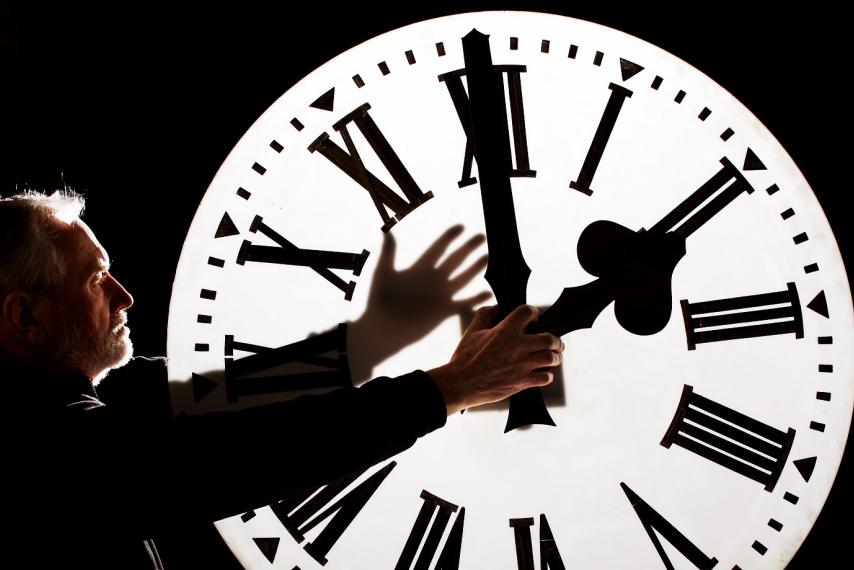 A Flick, which is exactly one seven hundred and five million six hundred thousandth of a second (1/ 705,600,000), allowing it to easily divide into frame rates, such as 24hz, 25hz, 30hz, 48 hz, and so on. This allows video and audio producers—as well as video game designers and other types of programmers—to use round numbers rather than awkward fractions.
See the full story here: http://www.newsweek.com/why-did-facebook-just-invent-new-unit-time-virtual-reality-unit-unveils-flick-787780
 In what will be the the largest-scale virtual reality event to date and the first live virtual reality broadcast of the Olympic Winter Games, Intel will rotate roughly two dozen 180-degree cameras that it built in-house across 18 live events over the two-and-a-half week event. It’ll shoot 30 events in total — another 12 with 360-degree cameras — to create a mix of VR live streams and video-on-demand content.
For the live events, three to six cameras will be dedicated to each, offering multiple camera views that viewers can switch between at will. During downhill skiing, one at the gate might show an athlete preparing to start, while a few others might be placed at key turns on the course and the finish line.
Intel’s in-house production team will also provide a fully-produced version of the VR experience known as the VR Cast. By switching back and forth between the 180-degree panoramic, stereoscopic camera views, a director’s cut will stitch together an automated story for the end user, similar to the one viewers have come to expect from the traditional TV broadcast.
Data overlays from the traditional broadcast, such as the athlete’s name and nationality, real-time statistics, a leaderboard, medal counter and post-event results, will be provided by the Olympic Broadcast Service and available to users in VR as well.
The live feeds will then be sent to the cloud where they’ll be distributed across Google Daydream, Samsung Gear VR, Windows Mixed Reality, and the rights holders’ apps and web browsers, such as the new NBC Sports VR app and non-U.S. broadcasters, such as CBC in Canada and Discovery in Europe.
See the full story here: https://www.sporttechie.com/inside-intel-plans-capture-2018-pyeongchang-olympics-virtual-reality/
 Coupland, who made the forecast while speaking at the Verbier Art Summit in Switzerland over the weekend, added: “The post-millennial generation, around one and a half generations from now, is going to have people who have no connection to the real world”.
Describing VR as “probably the hottest medium, because it is completely immersive”, the Generation X author went on to controversially suggest: “Maybe books are overrated. Maybe they are an interim technology on the way to VR and we can now get rid of our books.”
Art in the Digital Age was the theme of the conference, which loosely attempted to address the question of what technology means for the traditionally conservative and technophobic art world, which trails behind the gaming, movie and pornography industries when it comes to VR.
“The Duchamp of the VR world is yet to emerge,” he said.
See the full story here: https://www.theartnewspaper.com/news/douglas-coupland-says-rise-of-virtual-reality-might-mean-we-can-now-get-rid-of-our-books
 Another example is digital twins and the potential they demonstrate for haptic technology. Using this concept, researchers can already see inside a running turbine that’s color-coded based on working condition, heat, and other factors. Imagine being able to feel a loose bolt or wear and tear around the engine as it runs in real time. This allows individuals in industries such as manufacturing and engineering to truly simulate their work environment in a virtual setting, providing a hazard-free space for training.
In fact, kinesthetic learning — learning by touching and doing — is one of the three major learning styles, the other two being visual and auditory.
... one report on assembly planning demonstrates how haptic-enabled VR allowed users to instantly modify features such as virtual objects’ weight, letting them test a number of use cases they would experience at work efficiently and without risk.
K.R. Sanjiv is the chief technology officer for Wipro Limited, a global information technology, consulting, and business process services company, where he’s overseen the development of Wipro HOLMESTM, the company’s proprietary AI system.
See the full story here: http://observer.com/2018/01/haptics-users-feeling-virtual-world-teslasuit-playstation-vr/
 A hotel room automatically adjusting to the tastes of each guest, virtual reality headsets as brochures: the tourism sector is starting to embrace new technologies, hoping to benefit from lucrative personal data.
In a prototype of the hotel of the future on display at Madrid's Fitur tourism fair, receptionists have disappeared and customers are checked-in via a mirror equipped with facial recognition.
Once the client is identified, the room adapts itself automatically to all demands made at reservation: temperature, lighting, Picasso or Van Gogh in the digital frames hanging on the walls.
"Technology will allow us to know what the client needs before he even knows he wants it," says Alvaro Carrillo de Albornoz, head of Spain's Hotel Technology Institute, which promotes innovation in the sector.
The mattress is equipped with sensors and records the movements of those sleeping, which could prompt hotel staff to offer them a coffee when they wake up.
Restricted in some countries, the latter involves placing a beacon in the hotel that will detect customers' smartphones, meaning they will know how much time they spend in their rooms, for instance, or at what time they go to the pool.
"We're in a completely pioneering phase," says Marcial Correal, head of the Spanish association for virtual travel agencies, who is promoting this tool to tourism professionals as the brochure of the future, without too much success so far.
See the full story here: http://www.thejakartapost.com/travel/2018/01/21/ai-virtual-reality-make-inroads-in-tourism-sector.html
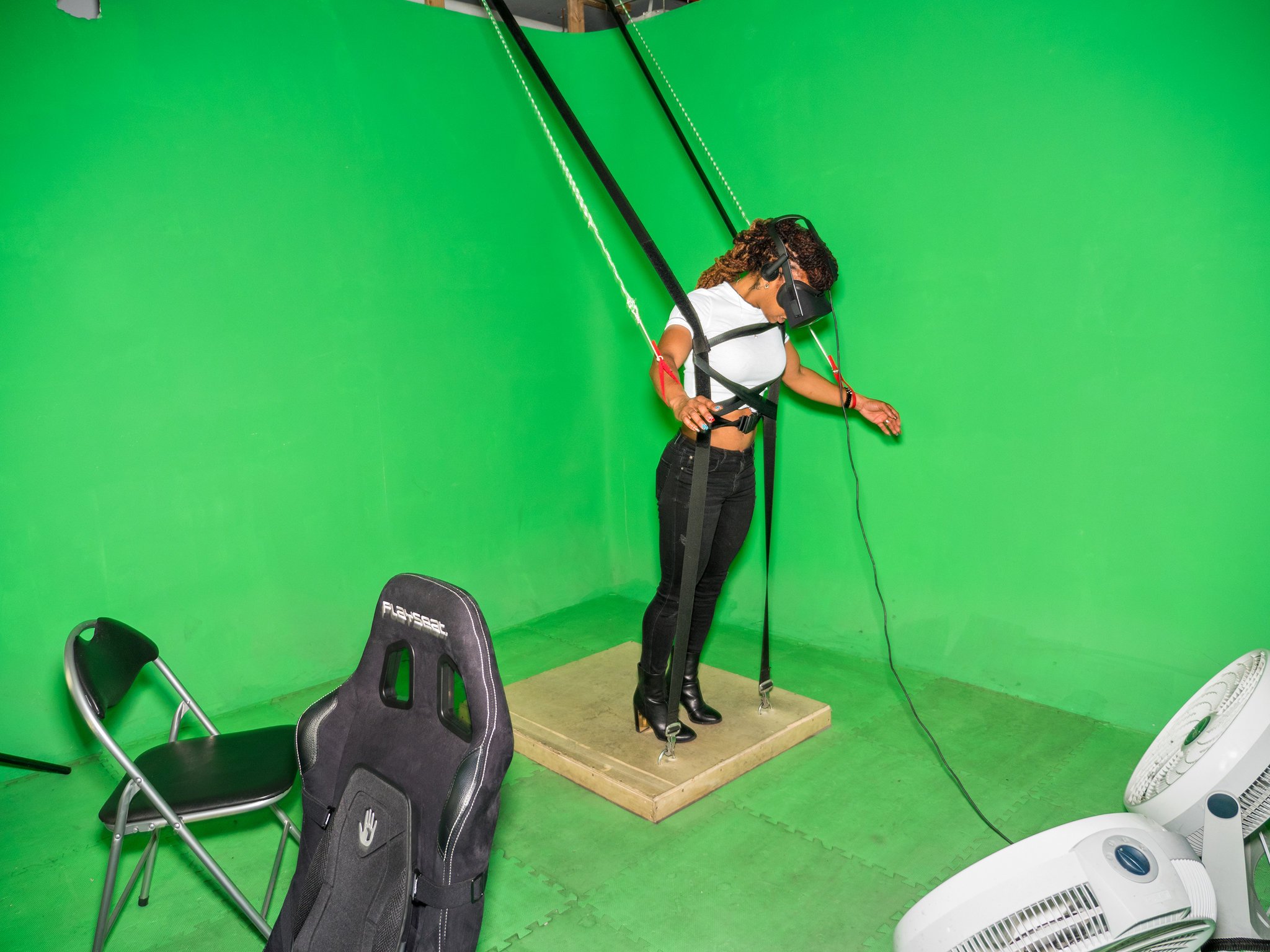 Nassima points to the challenges of a VR experience his company recently created for the Museum of Sex. “You don’t know what you’re getting into; you have to have a certain amount of trust to go into this experience,” he said. He also noted that VR is “not very good for social settings,” and that the user is “completely isolated.”
That’s why VR World, where a two-hour pass costs $39, and its ilk create “a livelier atmosphere” that allow users waiting for their time to don a headset to imbibe alcohol and dance to 90s tunes in a space enhanced by “trippy lighting.”
Another such space, Hubneo VR Lab, on Suffolk Street on the Lower East Side, “cultivates a more underground vibe.” There, users can enjoy speeding on a European racetrack, and “the steering wheel feels heavy with the friction of the tires on the asphalt, and the machines are sensitive to what’s happening on the track.”
Each virtual racing machine costs about $15,000 and the VR experience costs $25 or $80 for four. Hubneo chief executive/founder Ilya Polokhin reports that its guests come from “the community of gamers” rather than “random foot traffic.”
Multiplayer VR experiences are brand new, but may also play a role in future VR experience centers.
See the full story here: https://www.nytimes.com/2018/01/17/nyregion/virtual-reality-arcades-in-new-york-city.html
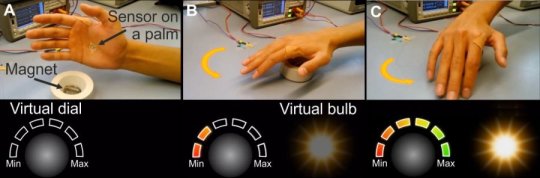 Physicists have now developed an ultrathin electronic magnetic sensor that can be worn on skin. Just by interacting with magnetic fields, the device enables a touchless manipulation of virtual and physical objects.
At first glance, the shiny little gold elements look like a modern tattoo. But on this extremely thin, almost invisible foil that sticks to the palm of the hand like a second skin, there are sensors which provide people with a "sixth sense" for magnetic fields.
See the full story here: http://advances.sciencemag.org/content/4/1/eaao2623
and the technical source story here: http://advances.sciencemag.org/content/4/1/eaao2623
 Director Pete Billington says Lucy’s character builds on work that Oculus Story Studio did on the Emmy-winning Henry, which invited viewers to connect with an anthropomorphic hedgehog.
“In the middle of Henry we did this thing, we had the character make eye contact with the audience,” said Billington. “It gave us all the chills. ‘Wow a character just acknowledged our presence.’ It was powerful.”
At the same time, Billington said, the team knew Oculus was developing touch controllers that would give viewers the ability to use their hands in a virtual environment.
“We walked out of that thing saying ‘OK, this is exactly what we want to do. How do we do it?’ ” said Billington. “A live actor can improvise. We have a virtual actor.”
There’s a moment in the early minutes of the first chapter where Lucy begins to sketch out a chalk drawing on the floor, and the viewer feels compelled to squat down next to her, to watch. In another scene, Lucy hands the viewer a Polaroid — which the viewer can hardly resist the urge to accept.
“All those interactions are completely intentional,” said Billington.
“A camera can only do so much,” said Puran. “But taking that information and computationally creating new worlds and places that are only imagined in our heads, to become a fourth dimension of reality, that’s mind-blowing and exciting.”
See the full story here: http://deadline.com/2018/01/virtual-reality-pixar-neil-gaimans-wolves-in-the-walls-facebook-1202248101/