A Team of MIT Scientists Taught an AI to Get Emotional Over Movies

INSIDE OUT – Pictured: Joy. ©2015 Disney•Pixar. All Rights Reserved.
“We developed machine-learning models that rely on deep neural networks to ‘watch’ small slices of video—movies, TV, and short online features—and estimate their positive or negative emotional content by the second,” the team wrote in a blog post Monday morning.
The approach didn’t just pay attention to the general plot line of a movie, but also to more subtle aspects, including the score, and close-ups of a person’s face. Using these clues, the project’s machine learning algorithms were able to identify positive and negative emotions, and map out the extend to which each scene would provoke emotional responses — something the researchers called “visual valence.”
...the fact that artificial intelligence can be used to analyze the emotional arc of a movie, and with that predict an audience response, could be profound for Hollywood, the researchers argued.
See the full story here: http://variety.com/2017/digital/news/ai-emotional-arcs-mit-mckinsey-1202635570/
AI-Assisted Fake Porn Is Here and We’re All Fucked
 The video was created with a machine learning algorithm, using easily accessible materials and open-source code that anyone with a working knowledge of deep learning algorithms could put together.
It's especially striking considering that it's allegedly the work of one person—a Redditor who goes by the name 'deepfakes'—not a big special effects studio that can digitally recreate a young Princess Leia in Rogue One using CGI. Instead, deepfakes uses open-source machine learning tools like TensorFlow, which Google makes freely available to researchers, graduate students, and anyone with an interest in machine learning.
Like the Adobe tool that can make people say anything, and the Face2Face algorithm that can swap a recorded video with real-time face tracking, this new type of fake porn shows that we're on the verge of living in a world where it's trivially easy to fabricate believable videos of people doing and saying things they never did. Even having sex.
Artificial intelligence researcher Alex Champandard told me in an email that a decent, consumer-grade graphics card could process this effect in hours, but a CPU would work just as well, only more slowly, over days.
Ethically, the implications are “huge,” Champandard said. Malicious use of technology often can’t be avoided, but it can be countered.
“We need to have a very loud and public debate,” he said. ”Everyone needs to know just how easy it is to fake images and videos, to the point where we won't able to distinguish forgeries in a few months from now.
Champandard said researchers can then begin developing technology to detect fake videos and help moderate what’s fake and what isn’t, and internet policy can improve to regulate what happens when these types of forgeries and harassment come up.
“In a strange way,” this is a good thing, Champandard said. “We need to put our focus on transforming society to be able to deal with this.”
ARTIFICIAL INTELLIGENCE SEEKS AN ETHICAL CONSCIENCE
 Crawford’s good-humored talk featured nary an equation and took the form of an ethical wake-up call. She urged attendees to start considering, and finding ways to mitigate, accidental or intentional harms caused by their creations. “Amongst the very real excitement about what we can do there are also some really concerning problems arising,” Crawford said.
One such problem occurred in 2015, when Google’s photo service labeled some black people as gorillas. More recently, researchers found that image-processing algorithms both learned and amplified gender stereotypes. Crawford told the audience that more troubling errors are surely brewing behind closed doors, as companies and governments adopt machine learning in areas such as criminal justice, and finance. “The common examples I’m sharing today are just the tip of the iceberg,” she said. In addition to her Microsoft role, Crawford is also a cofounder of the AI Now Institute at NYU, which studies social implications of artificial intelligence.
On Thursday, Victoria Krakovna, a researcher from Alphabet’s DeepMind research group, is scheduled to give a talk on “AI safety,” a relatively new strand of work concerned with preventing software developing undesirable or surprising behaviors, such as trying to avoid being switched off.
Krakovna’s talk is part of a one-day workshop dedicated to techniques for peering inside machine-learning systems to understand how they work—making them “interpretable,” in the jargon of the field.
“A lot of decisions about the future of this field cannot be made in the disciplines in which it began,” says Terah Lyons, executive director of Partnership on AI, a nonprofit launched last year by tech companies to mull the societal impacts of AI. (The organization held a board meeting on the sidelines of NIPS this week.) She says companies, civic-society groups, citizens, and governments all need to engage with the issue.
See the full story here: https://www.wired.com/story/artificial-intelligence-seeks-an-ethical-conscience/
China’s iQiyi bets on digital girlfriend to boost virtual reality headset sales
 For iQiyi, Vivi assists users in accessing the company’s content based on the history of which videos they prefer to watch. The avatar can also answer simple queries raised by users, such as the time, weather or scheduled television shows, and even help complete missing portions of a poem.
And for those so inclined, Vivi can flirt, compliment a user’s looks and act coy when asked about her age. Because it is VR, a user can “touch” Vivi, who would giggle, act playful or pretend to be angry as part of the interaction.
“I’m already a middle-aged man, and if I like it, I’m sure younger people would like it too,” Ma said. “If a nerd wants to see her dance, he can order her to, and she would go into dancer mode.”
The company declined to release sales figures for the headset, which bears the Qiyu brand. It sells for 3,499 yuan (US$529) in China, compared with 3,999 yuan for Taiwan-based HTC’s Vive Focus.
The Qiyu headset did not rank among the top five VR headset brands in China in the second quarter, which is led by Shanghai-based Deepoon VR, HTC and Japan’s Sony, according to industry research group Canalys.
See the full story here: http://www.scmp.com/tech/social-gadgets/article/2123599/chinas-iqiyi-bets-digital-girlfriend-boost-virtual-reality
Gaiman-Inspired ‘Wolves in the Wall VR’ to Premiere at Sundance
 Wolves in the Walls VR pulls users into a digital storybook, where they must help a girl named Lucy discover what’s hiding in the walls of her house. The story touches on themes like how children are often the most observant and least believed in our families, modern social issues and diversity. At Sundance, “Chapter 1” will introduce festival attendees to an ambitious new level of interactivity which casts the experience’s viewer as one of the characters.
“Early VR narratives were about adapting what we knew from other formats. But VR is coming into it’s own now. We always ask ourselves, why VR? What can we do to that is only uniquely possible in this medium?” said Billington. “Good story is really about great characters, so that’s where we invested all of our energy … Subjective POV [with VR cinematography] allows the audience to see the world the way that Lucy feels the world.We can put you inside Lucy’s imagination, her drawings, her emotions”
After graduating from Oculus VR short Henry, the team wanted to plumb new depths of character interactivity. They met with game developers and other immersive storytellers to learn the fine points of creating compelling interactive moments that don’t distract from the overall narrative. Wolves’ Lucy is engaging and emotive, changing her performance based on user action. She keeps track of your movements, exchanges objects, confide in you and mold her responses while tracking your actions through the story.
Executive producer Saschka Unseld added: “No one has yet cracked what the promise of storytelling in VR is: How to organically combine a compelling and emotional story with interactive worlds and characters. Wolves in the Walls will be exactly that.”
See the full story here: http://www.animationmagazine.net/top-stories/gaiman-inspired-wolves-in-the-wall-vr-to-premiere-at-sundance/
Vuzix To Supply Augmented Reality Smart Glasses To Toshiba
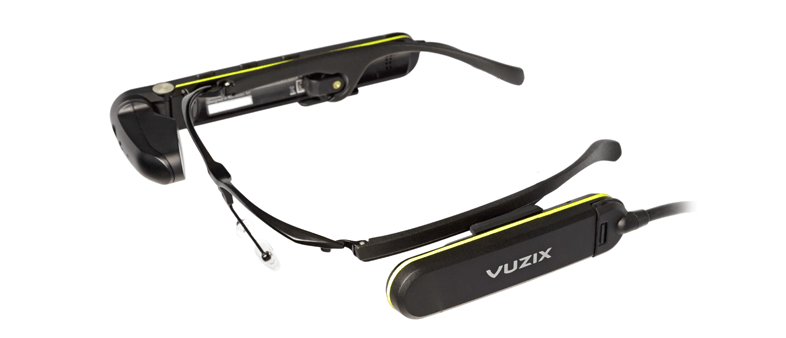 Vuzix Corporation has inked a deal with Toshiba in which the American technology firm will supply its custom M300 smart glasses to the Japanese conglomerate company over a three-year term. Under the agreement, Vuzix will deliver its augmented reality (AR) smart glasses exclusively to Toshiba for up to 12 months after the Tokyo, Japan-based company submits purchase orders for the said consumer electronics products worth at least $5 million, with the Vuzix-powered smart glasses slated to carry the Toshiba brand and set to be sold on a global scale. Vuzix also said that the smart glasses will ship with a mobile computing system to accompany the head-mounted device.
Other than Toshiba, Vuzix also previously entered into agreements with other tech companies that wanted to grow their stake in the smart glass segment. Last August, the company formed a AR smart glass partnership with BlackBerry, which also marked the Canadian multinational company’s first foray into the wearable category.
See the full story here: https://www.androidheadlines.com/2017/12/vuzix-supply-augmented-reality-smart-glasses-toshiba.html
Now you can track the bitcoin mania bubble in augmented reality
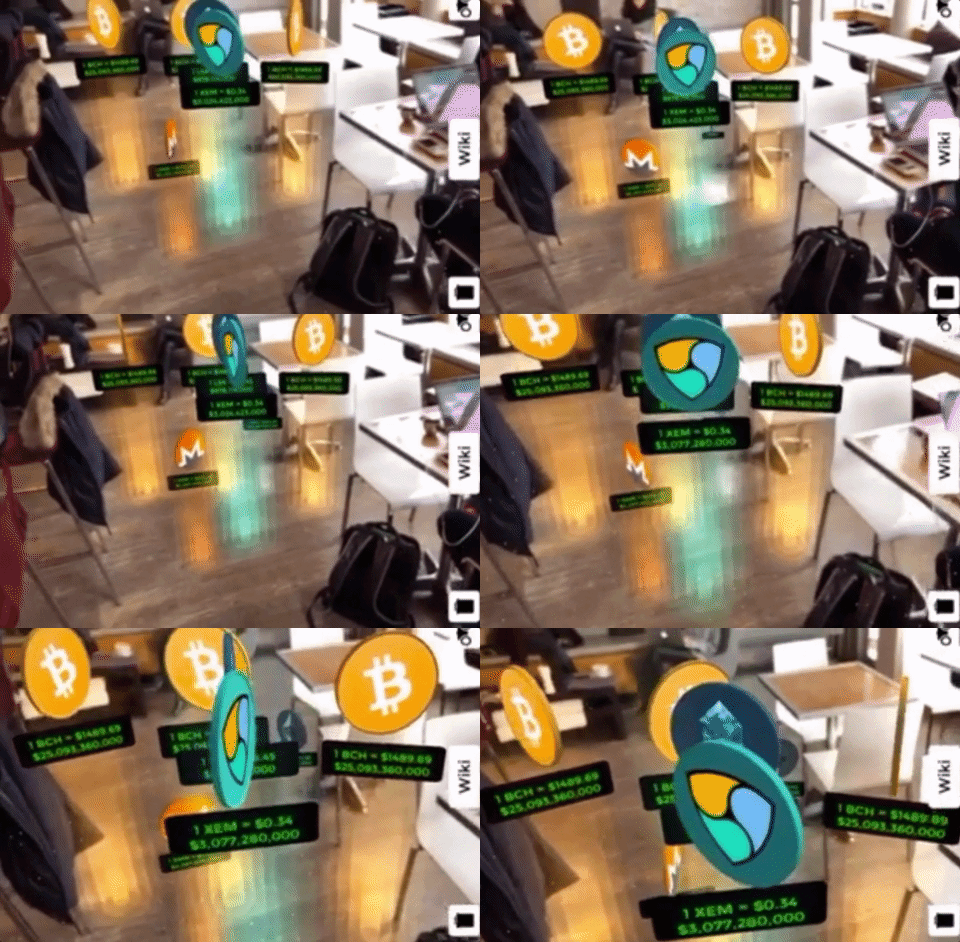 Created by Los Angeles-based developer Bryan Edelman, Bitcoin AR (only available for iOS) is about as simple as it gets when it comes to AR apps.
The app's main function allows you to track the value of various cryptocurrencies as they hover in real space, represented by the logos of the various cryptocurrency brands.
See the full story here: https://mobile-ar.reality.news/news/now-you-can-track-bitcoin-mania-bubble-augmented-reality-0181572/