Minecraft Available On Windows VR Headsets
 Minecraft has made the leap from Rift and Gear VR headsets to the Windows Store, with a beta version of the game now available for headsets from Acer, HP, Lenovo and others running on Microsoft’s Windows Mixed Reality platform.
See the full story here: https://uploadvr.com/minecraft-available-on-windows-vr-headsets/
Pimax “8K” Surpasses Oculus Rift as Top VR Headset Kickstarter Project, $2.45M Raised So Far
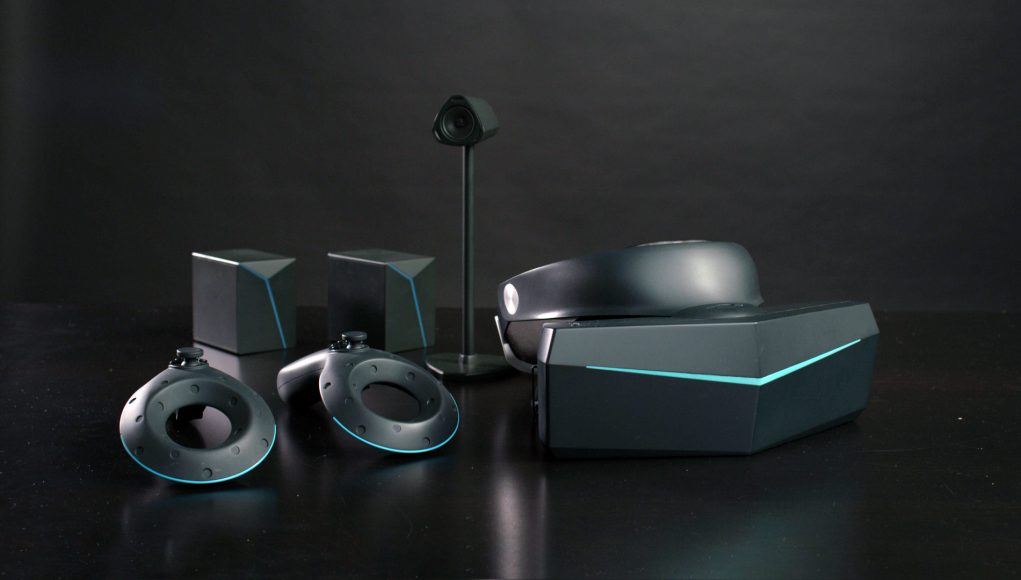 As Pimax surpasses Oculus’ original Kickstarter, it only really signifies consumer interest in the ‘next generation’ of VR. Although Pimax calls their headsets “8K” and “5K”, they actually respectively feature dual 3,840 × 2,160 LCD panels and dual 2,560 × 1,440 OLED panels. The standard “8K” headset also actually upscales a 4K signal to 8K, hence the “8K” in quotation marks. An “8K” X is also on offer that removes the upscaler, and making it capable of accept 8K input, but the headset’s effective per-eye 4K resolution remains the same. Questionable marketing aside, these display resolutions are quite a bit higher than Oculus Rift or HTC Vive, which both offer dual 1080 × 1200 OLED displays.
The real fanfare though comes from the headsets’ reported 200 degree FOV, and ability to hook into Valve’s SteamVR tracking solution, making it both the first consumer-grade high FOV headset and the first publicly available headset outside of HTC Vive to use Valve’s room-scale positioning tech.
As Pimax stands on the shoulders of giants with a valid product in hand, it remains to be seen if they can craft the obvious consumer interest into a business that will make them leaders in the field over time.
See the full story here: https://www.roadtovr.com/pimax-8k-surpasses-oculus-rift-top-vr-headset-kickstarter-project-2-45m-raised-far/
Does Saudi robot citizen have more rights than women?
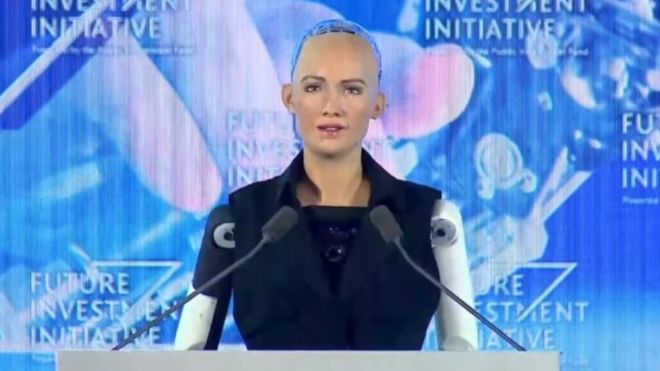 Meet Sophia, a robot who made her first public appearance in the Saudi Arabian city of Riyadh on Monday.
Sophia was such a hit she was immediately given Saudi citizenship in front of hundreds of delegates at the Future Investment Initiative in Riyadh on 25 October.
But as pictures and videos of Sophia began circulating on social media many started to ask why a robot already seemed to have secured more rights than women in the country.
What A Defaced Jeff Koons Sculpture Tells Us About Land Ownership In Augmented Reality
 In the case of cybersquatting, the reliance on legally protected identifiers with a long body of trademark case law from the physical world made it possible for the courts to eventually circumscribe much of the practice. Augmented reality, on the other hand, poses something fundamentally new – geographic overlays that do not have natural correspondence with existing legal frameworks. Air rights, land rights, water rights, mineral rights – the classes of property rights that exist in the United States are numerous, yet all rely on usage of physical space in the physical world.
In contrast, attaching a piece of content in a virtual world to a GPS coordinate poses more complex challenges to the notion of “ownership” and “control” of space.
Can a company exert the right to commercial activity at a specific latitude and longitude coordinate across all digital applications present and future merely because they own that right in the physical world? Do online companies enjoy the right to plaster public spaces with digital billboards and commercialize government-owned land for free? What happens when an augmented reality startup is bought by another company – do all of the geofenced advertisements it had sold (themselves essentially micro-term digital land leases) transfer to the purchasing company? Does a company in the physical world have to pay money to Facebook to run an advertisement for users visiting its physical location? Or does Facebook’s digital overlay count itself as a new form of land ownership where it alone acts as landlord and legal system? Moreover, given the nature of the online world, a company in Russia can easily sell geofenced ads across the United States and vice-versa, meaning companies across the world can now act as virtual landlords across all the world’s physical space. Even if the US were to pass a law tying virtual use of a location to its physical ownership, could it stop a foreign company from erecting its own overlays over US soil?
In contrast, assigning ownership to abstract sequences of numbers across myriad applications that grow in number each day representing constructed overlays atop our physical world begs a deeper question of just what it means to “own” a space and in our ever-more-virtual world just what rights we have to the spaces we inhabit.
See the full story here: https://www.forbes.com/sites/kalevleetaru/2017/10/25/what-a-defaced-jeff-koons-sculpture-tells-us-about-land-ownership-in-augmented-reality/#692fc14c3b43
And a related article here: https://shift.newco.co/weve-not-thought-through-the-legal-and-ethical-disruption-of-augmented-reality-e244769c6e9b
We’ve Not Thought Through the Legal and Ethical Disruption of Augmented Reality
Let’s not repeat the mistakes we made with social media
Nomadic’s forthcoming free roam attraction brings physical objects into the virtual world
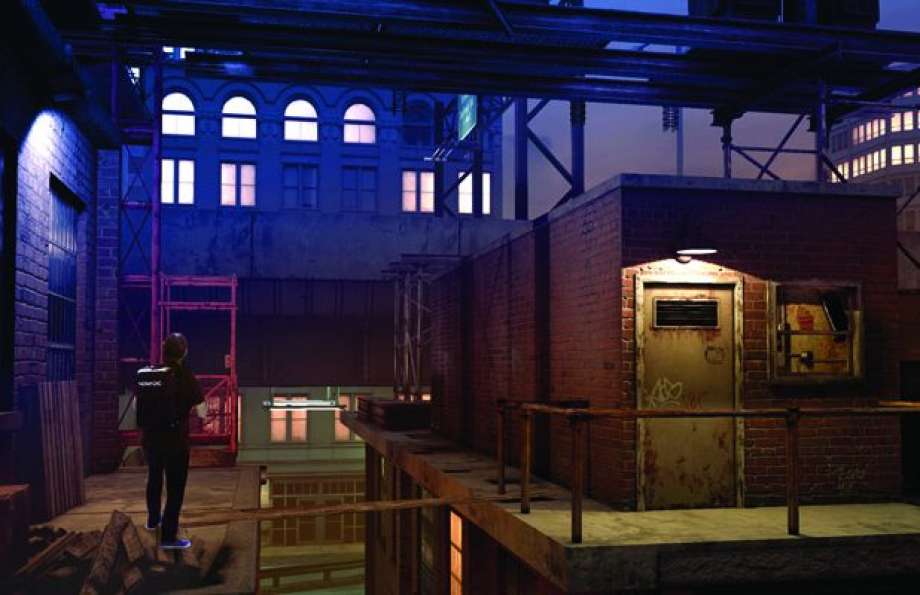 TheWrap went on that VR adventure at a demo set up by virtual reality startup Nomadic, a company founded by former Lucasfilm special effects execs that was running a temporary installation at the Technicolor Experience Center in Culver City, California. The objects were all real – TheWrap held an actual flashlight with a working switch and opened a rickety file cabinet – and are fitted with sensors and mapped in 3-D so they appear in the virtual world in the exact same place they do in reality. That precision is critical to the whole thing; after all, reaching for a doorknob that’s off by an inch or two would ruin the illusion.
Nomadic’s platform involves being strapped to a computer-equipped backpack connected to a headset, which allows users to roam freely and feel truly immersed.
See the full story here: http://www.stamfordadvocate.com/entertainment/the-wrap/article/Is-This-How-Virtual-Reality-Goes-Mainstream-12307096.php
How virtual reality can defuse conflicts over building projects
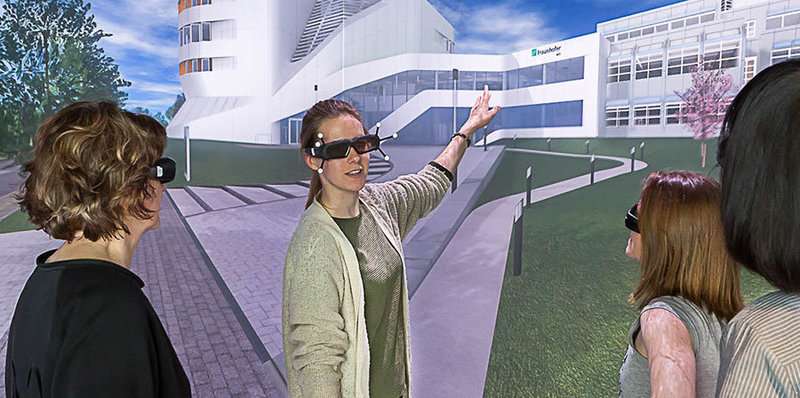 New visualization technologies bring projects to life before they are built. In virtual reality simulations, citizens can explore buildings, play out use scenarios, and inspect visual relationships – as if they were actually there on site. Comparing alternatives becomes child's play: one click and you can replace one façade with another, move the access road to a different location, or see what it looks like with new grass on the plaza. Moreover, planning criteria and environmental impediments finally become visible and easy to comprehend. "Virtual reality not only furthers the utility of public participation, but it also inspires citizens to get involved," says Prof. Frank Brettschneider, who heads up the University of Hohenheim's involvement in the "Visualization in Public Participation" (VisB+) project. Peter Steinhagen, Head of Business Development at Ed. Züblin AG, adds: "The combining of Building Information Modeling with new visualization techniques such as virtual reality is opening up fascinating new possibilities for stakeholder communication.
Read more at: https://phys.org/news/2017-10-virtual-reality-defuse-conflicts.html#jCp
Sony to Introduce 3D ‘Time-of-Flight’ Sensors for AR Devices
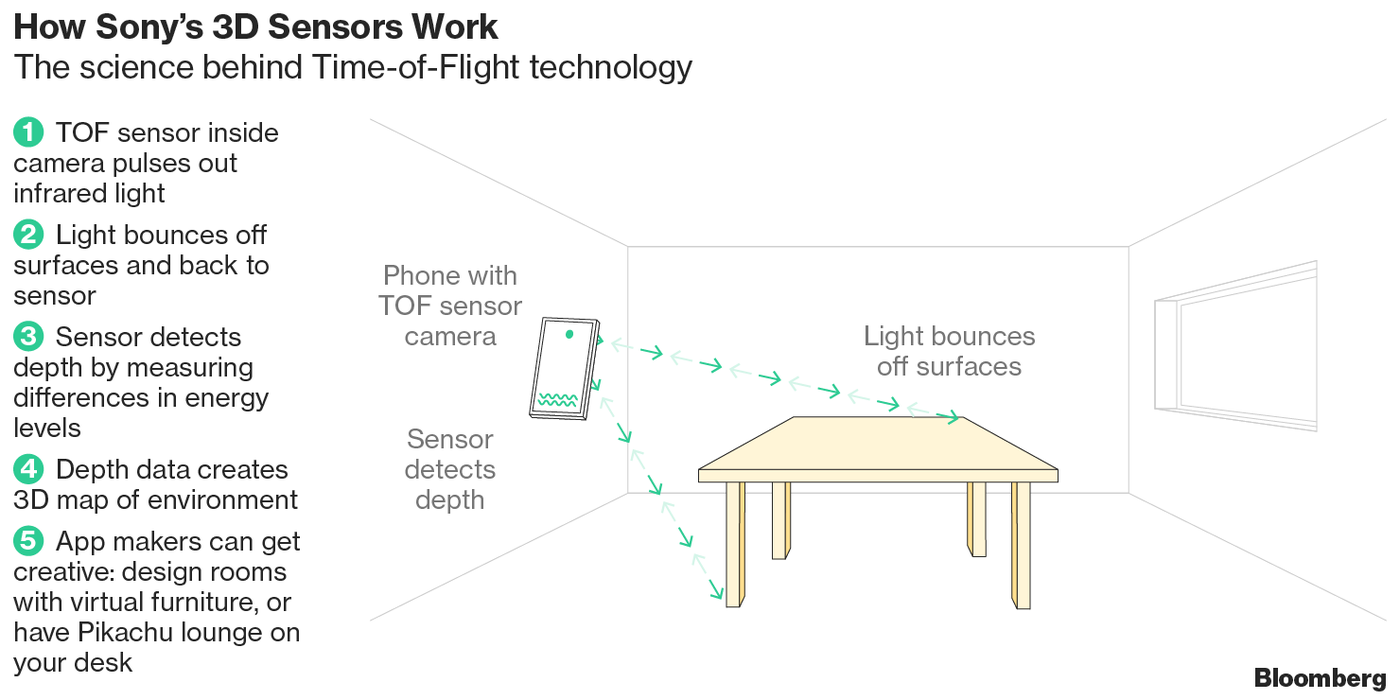 At Sony’s Atsugi Technology Center outside Tokyo, engineers are developing a new kind of 3D sensor aimed for use first in smartphones and augmented reality devices. The sensors will be able to detect people and objects by relying on calculations on how long it takes for light to reflect off their surfaces. Sony, which will go into mass production next year, is betting that the new sensors could eventually be used in drones, self-driving vehicles, gaming consoles, and other machines that interact with their environments.
“Instead of making images for the eyes of human beings, we’re creating them for the eyes of machines,” Yoshihara said. “Whether it’s AR in smartphones or sensors in self-driving cars, computers will have a way of understanding their environment.”
Sony’s TOF sensors, which are being made at its Kyushu factories, will likely be adopted by Apple for future devices, predicted Fuji Chimera Research sensors analyst Yusuke Toyoda, who said that other smartphone manufacturers will follow suit.
Sony’s chief rival in TOF sensors is the Geneva-based STMicroelectronics, whose FlightSense sensors are used “by Apple and more than 80 smartphone models.”
See the full story here: http://www.etcentric.org/sony-to-introduce-3d-time-of-flight-sensors-for-ar-devices/
The remarkable robots that are transforming filmmaking
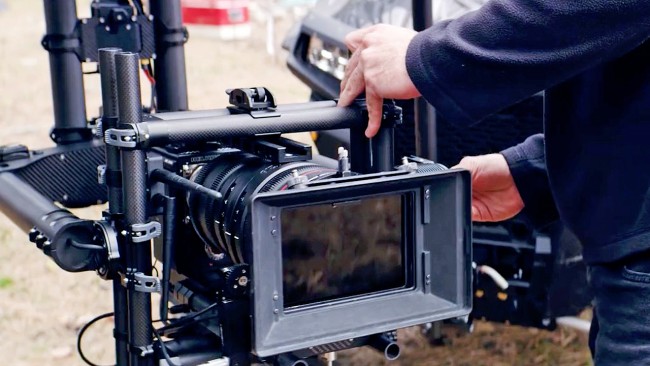 As the realm of the camera department comes to include advanced machinery, the roles of the engineer and technical artist are converging to create a position which requires considerable technical knowledge as well as the training to operate a system with multiple, incredibly strong, motors often right near an operator or technician’s fingers.
Remote control
In addition to camera stabilising hardware systems, modern cinema robotics also include remote controlled and under and over-slung suspension systems which allow for operators and directors of photography to pilot and direct the cinematography from a distance.
While an organic approach to filmmaking will likely continue to live on at the independent and lower budget levels of production, it is becoming very evident in studio cinema and in our world as a whole, that the robotic revolution is upon us, displacing the tried and true methods of the past.
By embracing the changing robotic revolution, a filmmaker today can breathe a sigh of relief as we finally have entered a period where the sky really is the limit when it comes to what is possible within the cinematic art form.
The days of the cyborg film crew are dawning and the possibilities of the art form in this future world are limitless and amorphous.
See the full story here: https://www.redsharknews.com/production/item/4983-the-remarkable-robots-that-are-transforming-filmmaking#.WfICGWeOsQs.facebook