FlirtAR: The World’s First Augmented Reality Dating Application
 According to FlirtAR visionary, Renan Godinho, "FlirtAR will use facial recognition, geolocation, and augmented reality to show user dating profiles and begin conversations with potential dates in the real world and in real time." In other words, the FlirtAR app offers the algorithmic possibility to discover love at first sight!
How? By algorithmically combining face recognition technology with geolocation information to not only allow registered users to access the dating profiles of other registered users* when they see that special someone, in the real world, but also to begin a conversation with him or her immediately.
Of course, privacy is very important to us at FlirtAR.* We will never show your profile to any unregistered user
See the full story here: http://www.crossroadstoday.com/story/35682515/flirtar-the-worlds-first-augmented-reality-dating-application
Worldwide Shipments of Augmented Reality and Virtual Reality Headsets Expected to Grow at 58% CAGR with Low-Cost Smartphone VR Devices being Short-Term Catalyst, According to IDC
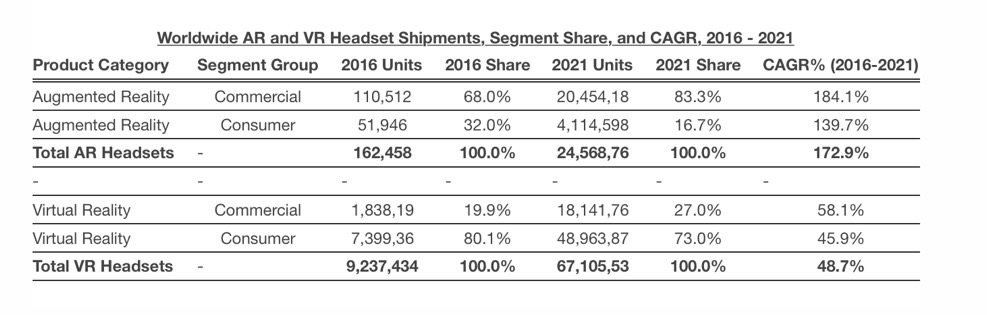 See the full press release here: http://www.businesswire.com/news/home/20170619005183/en/Worldwide-Shipments-Augmented-Reality-Virtual-Reality-Headsets
Varjo, the World’s First Human-Eye Resolution Headset
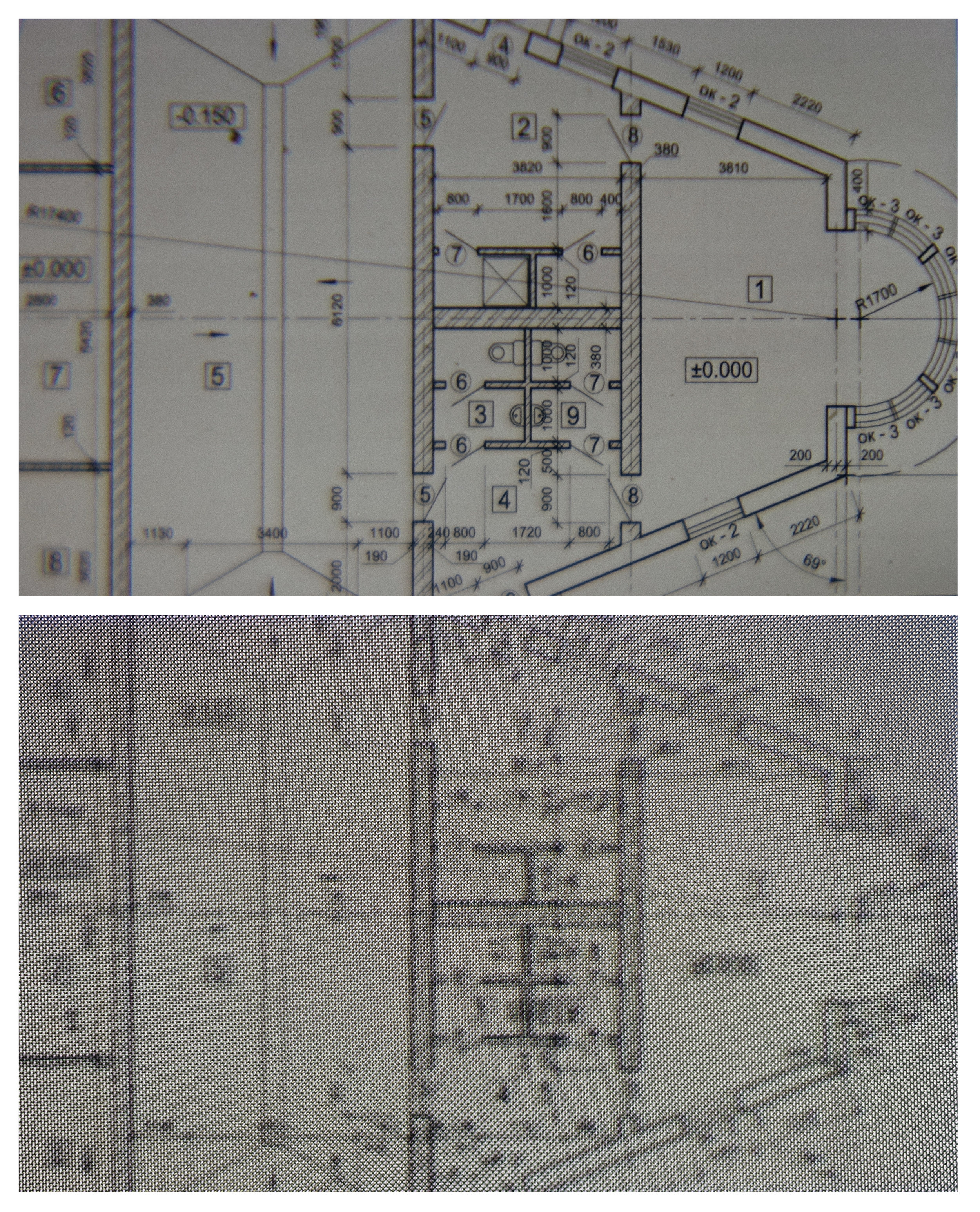 [Philip Lelyveld comment: It sounds like they are doing foviated rendering, so their full-screen resolution claims are suspect. But it still looks very promising.]
Varjo’s Human-Eye Resolution technology made me realize something I’d only known in a general sense prior: current visual fidelity in VR/AR has a long way to go. Varjo’s soon-to-launch headset catapults us a decade into the future in terms of what we’re actually able to see in immersive reality.
So what is Varjo? It’s a Helsinki-based company (“varjo” is “shadow” in Finnish) that’s been in stealth until now, working to develop a 70 megapixel solution for XR (by comparison, Oculus Rift and HTC Vive run about 1.2 MP).
The company’s virtual-reality prototype, which it let me try out last week during a company visit to San Francisco, builds on an Oculus Rift with a high-resolution micro OLED display and an angled glass plate in front of the headset’s regular display. The plate—an optical combiner—lets Varjo merge the two different displays into one image that you see when you put on the headset.
You can read writing from across the room.
Inspired by the saccade model of the eye during their research, the team at Varjo realized that the human-eye actually doesn’t see the world in “human-eye resolution” across the entire field of view. Instead, it only sees accurately at 2° in the center field of vision (at around 100 px/°).
In the periphery, the eye actually only takes in about (1 px/°). So, the Varjo display was built as a gaze-based, foveated-rendering system—in other words, what you’re looking at is in crystal clarity, while the surrounding area remains at “normal” VR resolution.
The first headset has not been designed with the kind of compromises that come with creating a consumer headset. Instead, Varjo first intends to partner with select independent software vendors (ISVs) and companies whose need for visual fidelity is most pressing—whether that might exist in architecture, design, simulations/training, or otherwise.
See the full story here: https://vrscout.com/news/view-xr-varjo-worlds-first-human-eye-resolution-headset/
Additional info here: https://www.technologyreview.com/s/608115/this-startup-is-making-virtual-and-augmented-reality-so-crisp-it-looks-real/
Could Wellington have the world’s first augmented reality island?
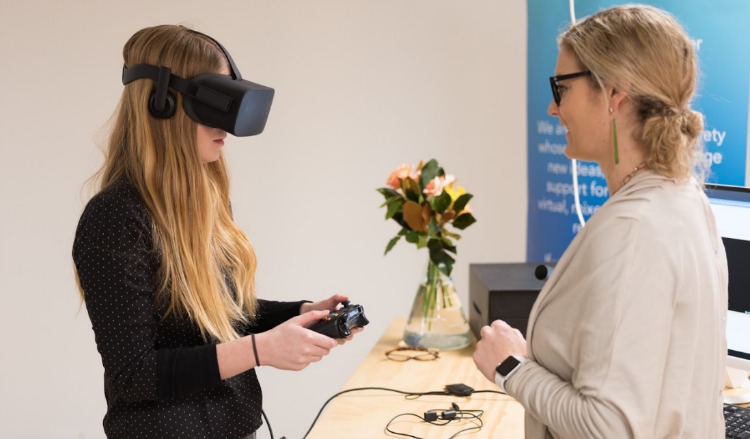 It’s kind of fitting that when we showed up to see Wellington’s newest cutting-edge virtual and augmented reality hub, it pretty much had nothing inside it. Wow. I knew the technology was good, but I didn’t know it was that good. To be fair, ProjectR has only just moved in, and there is already a stylish SMEG fridge, a cluster of computers adorned with Pop Vinyl figures, and a ‘girl boss’ mug that fittingly belongs to centre executive Jessica Manins.
Jessica is currently in charge of fitting out the enormous, sunny space on Taranaki Street to connect over 24 different VR, AR and MR Wellington businesses into one disruptive digital rat king to rule them all.
Wellington is a city that forces you to be creative, I think. And resilient as well, we’ve got the earthquakes and we’ve got the crazy wind. There are lots of easy things about living in the city because it’s so compact – but that also tests you. Being on the other side of the world, far from where the largest business hubs are, means you have to work a little bit harder. You have to think hard from day one and you have to be that little bit more creative.
Another job you have – for now – is organising Leading Ladies, why was there a need to carve out that kind of support space for Wellington women?
The first woman I messaged was Toni Moyse [CEO at 8i]. We got together, formed a bit of a plan, and from there co-created Leading Ladies. ... We meet monthly, and we’ve been going strong for 18 months or so now.
You’ve worked in LA, London, Edinburgh – all these giant cities in the world – so what makes you want to stay here?
I’m still trying to work out how to try and encourage talent to stay here and to work with the New Zealand companies that are trying to build themselves up – it all adds to the value and what we’re trying to create in New Zealand. Wellington is probably one of the most creative places, it’s fun, has great coffee, has good food. It’s a no brainer in terms of the city to live in.
See the full story here: https://thespinoff.co.nz/society/wreda/19-06-2017/could-wellington-have-the-worlds-first-augmented-reality-island/
Intel Teams with Sony Pictures Virtual Reality to Create ‘Spider-Man: Homecoming’ Virtual Reality Experience
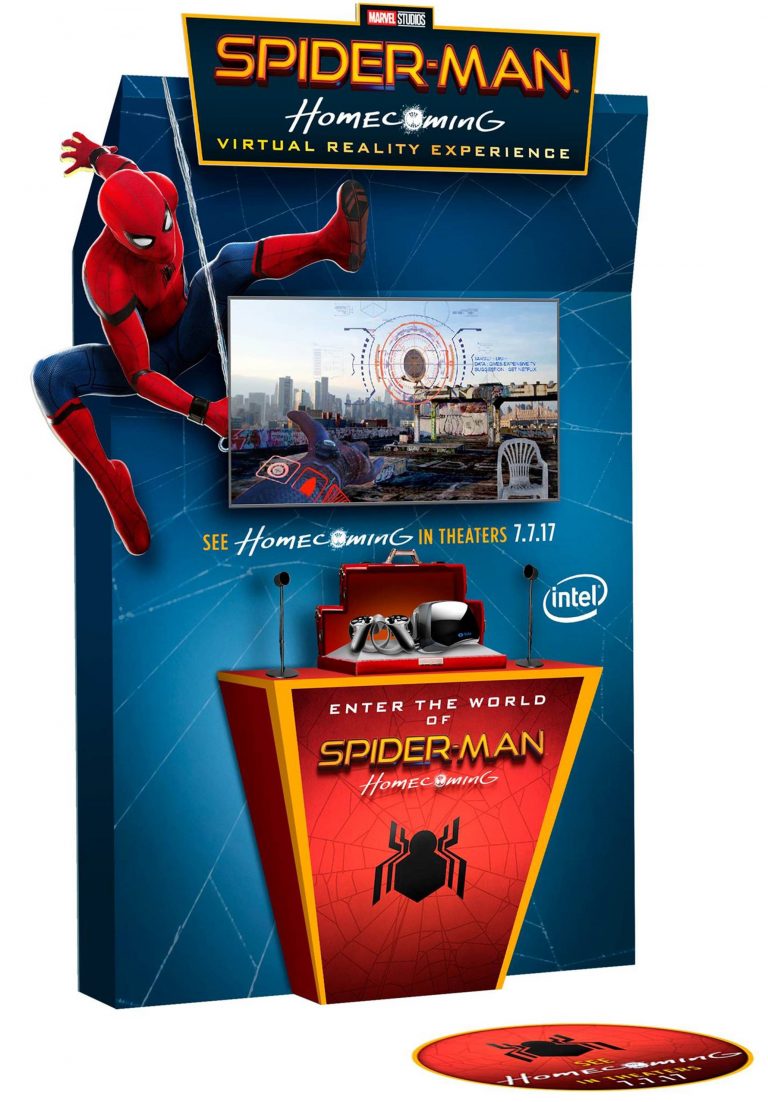 In continuation of Intel’s leadership in creating amazing VR experiences, the company collaborated with Sony Pictures* Virtual Reality to create a virtual reality experience (VRE) that complements Columbia Pictures upcoming “Spider-Man: Homecoming,” the most highly anticipated movie of the summer, arriving in theaters July 7. The VRE offers users the chance to suit up as Spider-Man, hone their web-shooting skills, and sling high above New York City in pursuit of the Vulture.
Starting today, the VRE is available in select Cinemark* locations across the U.S. and at special events worldwide. On June 30, availability extends across all major VR platforms, including PlayStation VR*, HTC Vive* and Oculus Rift* for free. “Spider-Man: Homecoming” opens in theaters July 7.
See the full press release here: https://newsroom.intel.com/news/intel-teams-sony-pictures-virtual-reality-create-spider-man-homecoming-virtual-reality-experience/
Mkt Res Report: Public VR Awareness Almost Doubling Annually with PSVR & Gear VR Leading the Way
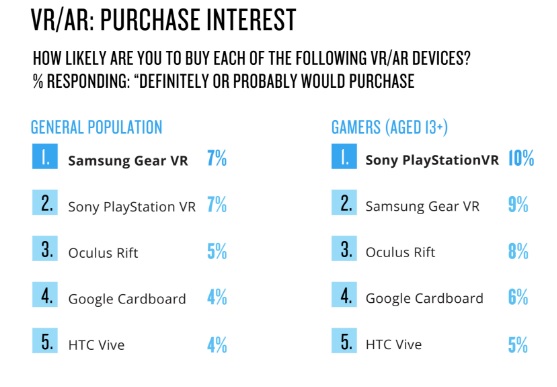 A new report from Nielsen suggests that not only is public awareness of virtual reality at record levels, it’s nearly doubled year on year.
Nielsen’s ‘U.S Games 360 2017‘ report states that from over 2000 people (50% male/female split) interviewed, 27% of people aged between 25-34 said that they intended to buy a VR headset, with 17% of 18-24 year olds saying the same. Of that group, 69% were men, 31% were women.
Download the full report for free here: http://www.nielsen.com/us/en/insights/reports/2017/us-games-360-report-2017.html
Kopin’s Prototype VR Headset is Incredibly Thin & Light, More Than 3x the Pixels of Rift and Vive
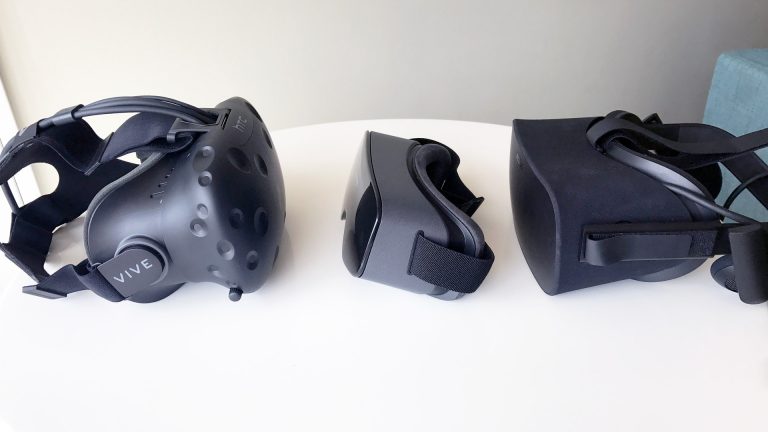 Kopin is touting a new prototype VR headset featuring their 4K OLED ‘Lightning’ microdisplay that they say is made specifically for VR. At nearly half the size of other headsets, and made from lightweight materials, the device feels featherlight compared to VR products on the market today.
Kopin is a publicly traded display manufacturer that was founded in 1984. With the massive buzz generated by VR, the firm has turned developed a roadmap for manufacturing displays specifically for VR headsets.
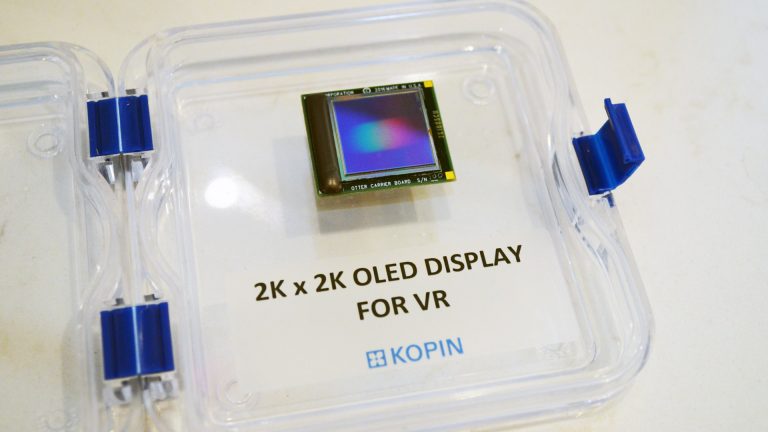 The first microdisplay that Kopin is positioning for VR is what they’re calling ‘Lightning’, a 1-inch display with 2,048 x 2,048 per-eye resolution and running at a whopping 120Hz.
The tiny size of the microdisplay also brings another advantage: the potential for a much shorter focal length.
Kopin has worked with Chinese ODM Goertek to develop a prototype VR headset that employs their Lightning microdisplay.
Meanwhile, microdisplays benefit from having incredibly tiny and dense pixels, but when it comes to VR, the challenge is—counterintuitively—actually making them larger. ... the image needs heavy magnification in order to achieve a wide field of view. They claim their current Lightning display is capable of delivering up to a 110 degree diagonal field of view using a dual-element Fresnel lens. They are also working in conjunction with 3M to develop an even smaller ‘pancake’ optic which they say can achieve a 100 degree field of view.
Technicolor Experience Center Opens, Launches Mars Project
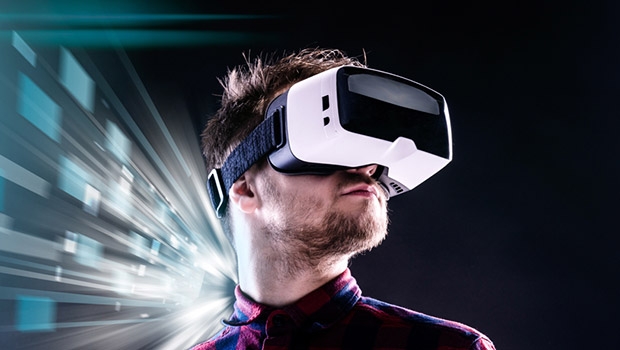 Technicolor officially opened its Technicolor Experience Center (TEC) for augmented reality, virtual reality and mixed reality last week, and announced an ambitious new project based on NASA research and images. The facility, on La Cienega in Los Angeles, launched last year and has been experimenting with immersive media. TEC has partnered with Hewlett-Packard and Nvidia to create a realistic simulation of what life could be on Mars for 1 million people. A community of engineers, designers, architects and artists will work under the direction of Technicolor to create this immersive experience. The project also involves Unreal Engine, Fusion, Autodesk and HTC Vive.
See the full story here: http://www.etcentric.org/technicolor-experience-center-opens-launches-mars-project/
Sphero’s new toy is a chatty Spider-Man
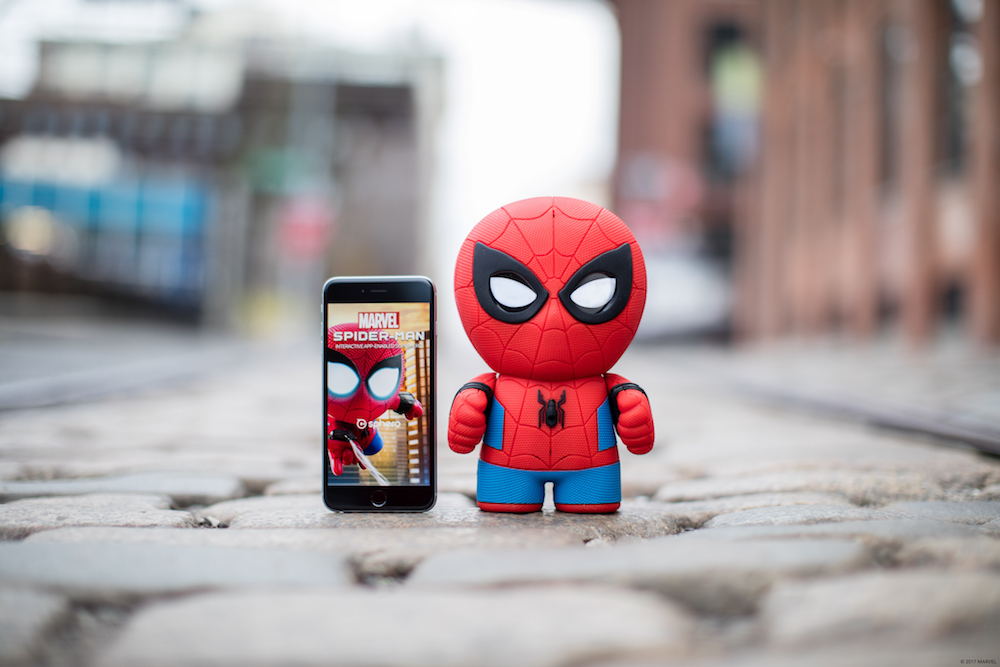 The toy includes expressive LCD eyes, a microphone, a speaker and an accelerometer — so he’ll offer enthusiastic commentary if you pick him up and pretend to fight with him. There’s even an infrared sensor, allowing Spider-Man to go into “guard mode,” warning off any intruders who enter his owner’s bedroom.
Aside from using third-party speech recognition technology, Wilson said Spider-Man’s conversational engine was built “from scratch” — in essence, he’s “a full Android device” inside a superhero-shaped toy. (While your main interactions will be through voice, you’ll also need either an iOS or an Android app to control him.)
Wilson also emphasized the importance of privacy and security. He said Spider-Man is only listening when the spider on his chest lights up, and the user’s voice is never stored or shared. (The security measures are certified by AppliedTrust.)
See the full story plus video here: https://techcrunch.com/2017/06/15/spheros-next-toy-is-a-chatty-spider-man/