Startup to Introduce Holographic TV Technology at NAB 2017
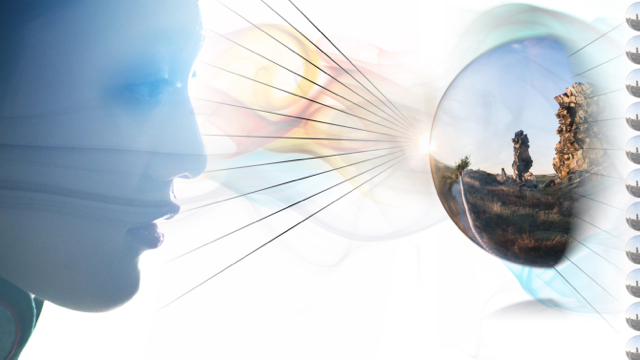 Startup Light Field Labs, founded by three former Lytro engineers, is working on creating holographic displays via light field technology. The goal is to create a TV set that can project a 3D hologram into the living room, with the further-off goal of enabling the user to touch it. Although that might sound like science fiction, the company founders stand behind their idea, and state the company will be able to ship a few displays to developers in 2018. Commercial production will be in operation by 2019 or 2020.
...the three founders — chief executive Jon Karafin, chief technologist Brendan Bevensee and vice president of engineering Ed Ibe — say commercial production will commence “either by licensing the company’s technology to partners or by building out its own production facilities.”
See the full post here: http://www.etcentric.org/startup-to-introduce-holographic-tv-technology-at-nab-2017/
TheWaveVR is a mesmerizing, trippy take on the future of music festivals
 TheWaveVR will remind you of drugs even if you’ve never done drugs and will probably also make you want to do drugs.
The virtual reality music app is launching a beta version today on Steam early access that brings you into a world of outlandish visuals and heavy electronic music inside a social arena.
Today, the Austin-based startup is also announcing that it has closed a $4 million seed round led by Upfront Ventures. Other investors in the round include RRE Ventures, KPCB Edge, Greycroft VR Gaming Tracker Fund, Luma Launch, Boost VC and The VR Fund.
I’d question the sustainability of that model if I hadn’t already experienced a concert, but the reality is that this app is going to be something that every worthwhile DJ — in LA or elsewhere — will be playing around with soon and I’m sure it won’t be long before users have their pick up some top artists inside the app. The team is building tools for artists to import tracks that they can play around with onstage.
See the full story here: https://techcrunch.com/2017/04/12/thewavevr-is-a-mesmerizing-trippy-take-on-the-future-of-music-festivals/
The Bizarre Digital Book You Must Destroy Before Sharing
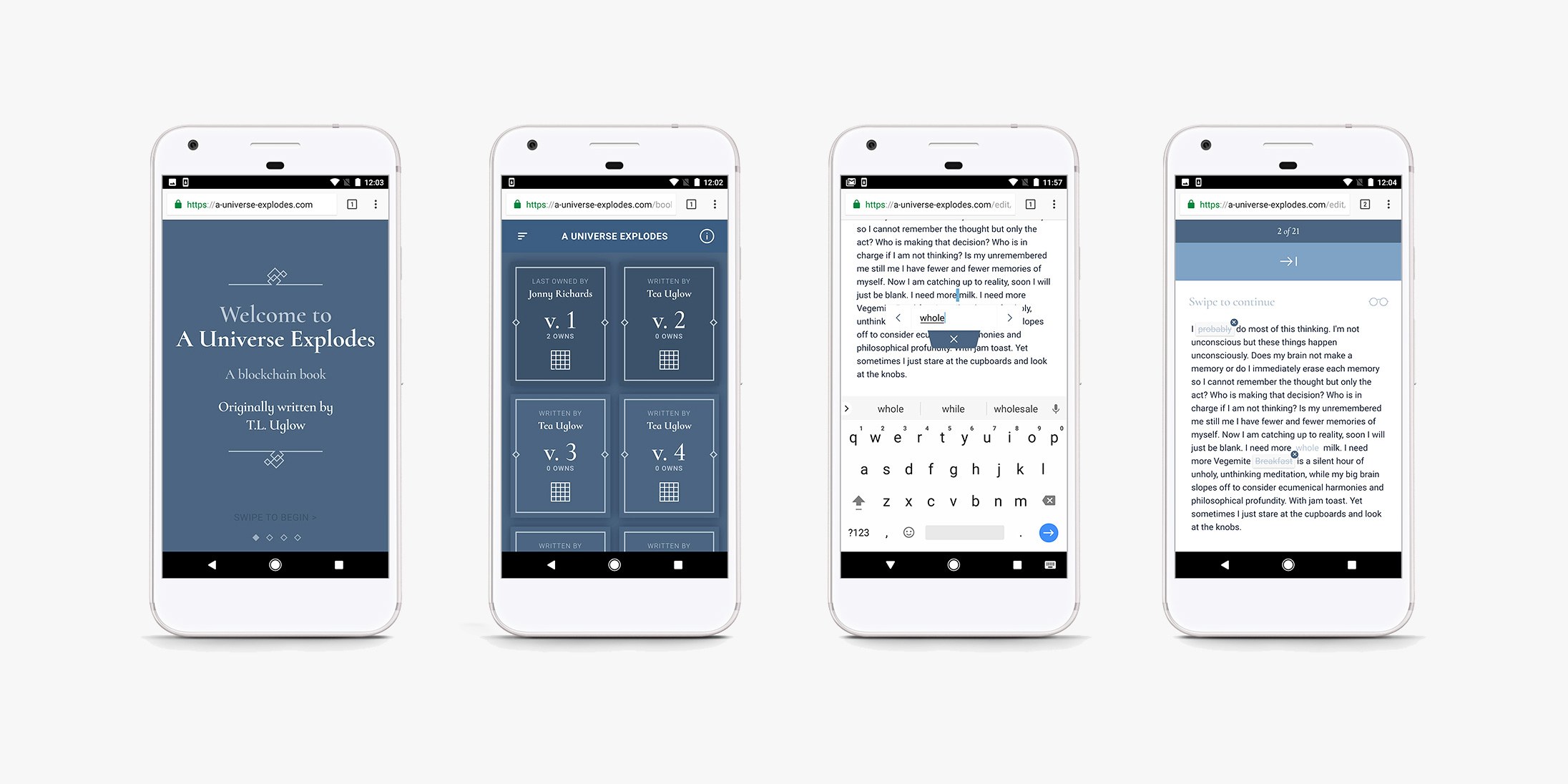 A Universe Explodes. The book, written by Google employee Tea Uglow, developed by design studio Impossible Labs, and published by Editions At Play, is actually more of a web app.
Before an owner can give her version away, she must remove two words and add one to every page, creating a personalized limited edition of the book.
These changes are saved to a public database using blockchain...
With every iteration of the book, more words disappear until there’s only one word left on each page. “Frankly, after 20 owners it will be unreadable,” Uglow says.
With something like bitcoin, the transactions are financial in nature—you can see who bought the cryptocurrency, when they bought it, and for how much, without the need of a bank. In the case of A Universe Explodes, it’s more about tracking creativity than the transaction itself. Uglow compares the book’s ledger to a library card—you can see who’s read the book and how they’ve changed it, even if you can’t change the book yourself. From the website, readers can trace the devolution of all 100 original volumes, as each is edited and passed down by its respective owner.
See the full story here: https://www.wired.com/2017/04/bizarre-digital-book-must-destroy-sharing/
The Man Who Makes Facebook’s Machines Think
 Boureau wants to create a world where we see as many opinions as we can handle — up until the point at which we start tuning them out. AI can help with this by mapping out patterns in text, understanding where something goes off the rails and potentially figure out a way to alter the conversation flow to stem the bad turn. “If we knew more about that learning process and how these beliefs get in people’s heads from the data then it might be easier to understand how to get more constructive conversations in general,” Boureau said.
In the aftermath of the 2016 election, LeCun publicly suggested Facebook had the technical capabilities to use AI to filter out fake news. Some saw his statement as a solution to a problem many blamed for the widespread polarization in the US, but LeCun said that the task was best left to third parties, instead of machines capable of introducing bias. “There’s a role AI can play there, but it’s a very difficult product design issue rather than a technological issue,” he said. “You don’t want to lead people into particular opinions. You kind of want to be neutral in that respect.”
Indeed, as LeCun cautions, AI is still far from reaching human level intelligence, or General AI as it's known.
See the full story here: https://www.buzzfeed.com/alexkantrowitz/meet-the-man-who-makes-facebooks-machines-think?utm_term=.tl1dynz3k#.rk4mwNGBQ
A Major Warner Bros. Patent Reveals a Coming AR/VR Movie Delivery System for Theaters, Home systems & Headsets

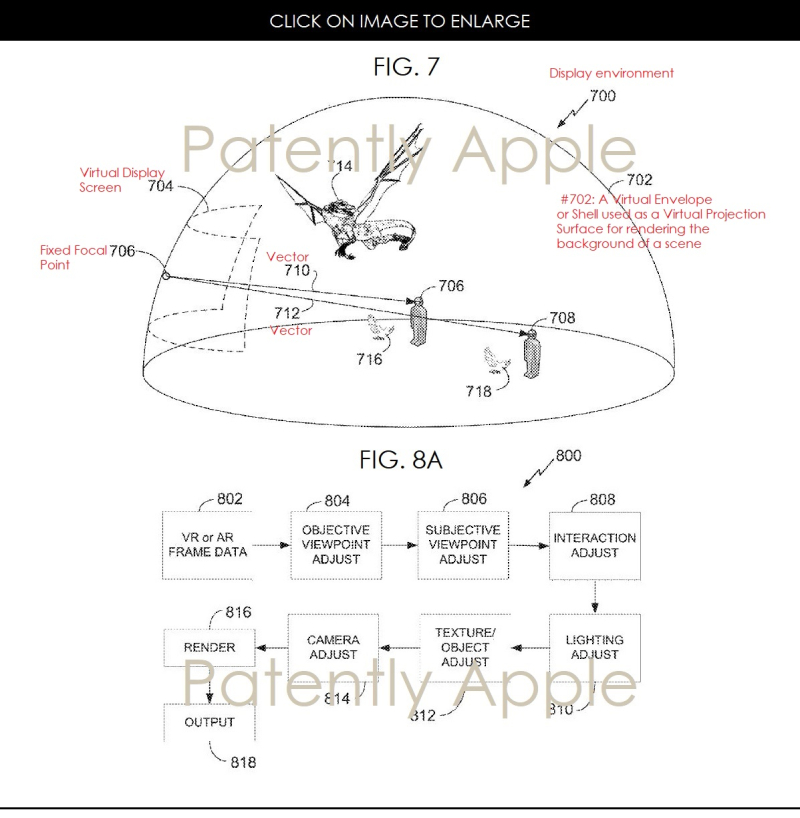
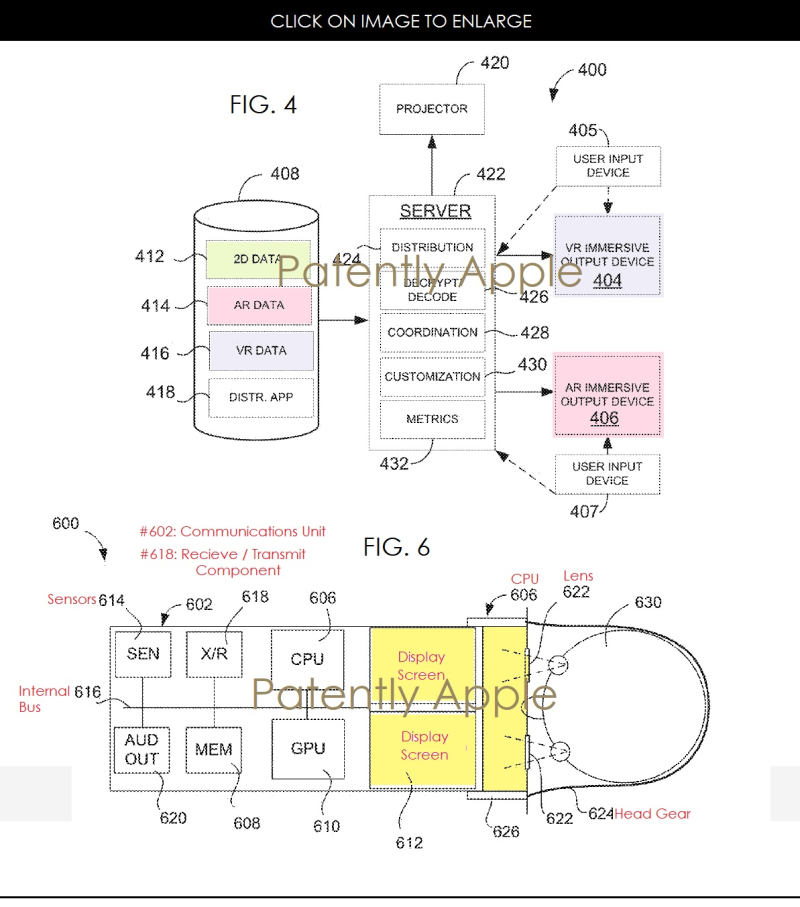 Years ago the big film studios began introducing 3D experiences for movies goers and handed out 3D glasses as you entered the theater. This week Patently Apple discovered a patent filing from Warner Bros. Entertainment describing new systems that are in development that will bring movie goers Augmented Reality, Virtual Reality and mixed reality films. And yes, users will be handed 3D/AR/VR headsets to watch these next-generation movies. The difference with these films will be that they're being designed to work in the theater and at home with iTunes or Netflix. So next-gen headsets are going to be needed to be able to watch this kind of content. Warner Bros. patent notes that these movies will work on headset powered either by Intel or ARM processors.
However, the technology for experiencing anything similar to cinematic content delivered using VR or AR equipment or methods is in a very early stage of development. Actual implementations of technology are quite limited, and users have thus far been largely or completely untouched by VR or AR in their experience of narrative content.
It would be desirable, therefore, to develop new methods and other new technologies for mastering cinematic content for VR and AR use, that overcome these and other limitations of the prior art and enhance the appeal and enjoyment of narrative content for new immersive technologies such as VR and AR.
See the full story here: http://www.patentlyapple.com/patently-apple/2017/04/a-major-warner-bros-patent-reveals-a-coming-arvr-movie-delivery-system-for-theaters-home-systems-headsets.html
VRLA – Microsoft HoloLens delivers first ever augmented reality Easter Egg hunt
 Philippe Lewicki, CEO of AfterNow.IO, developed this application for Microsoft. Brian Selzer is helping them with bus dev.
See the full story with multiple .gifs here: http://mashable.com/2017/04/15/hololens-easter-egg-hunt/#ddlSTo_ojPqt