Exploring Methods for Conveying Object Weight in Virtual Reality
 ...could we throttle the speed of a user’s actions when picking up objects to make things feel heavier or lighter?
As far as production software, we were torn between our familiarity with Unity and the rendering potential of Unreal. We stuck with Unity for now, and hope to explore Unreal more in future explorations.
Step 1: Becoming Pick Up Artists
You can’t explore weight without first nailing down the basic physics of how objects can be picked up and moved around, and we quickly found that these concepts were one in the same.
Step 2: Exploring Other Sensory Cues
In addition to the mechanics of lifting and grabbing, we felt it was important to explore other forms of feedback that could help convey an object’s weight. This manifested in two forms: visual and haptic feedback. In both cases, we tried to reinforce the amount of “strain” the user would feel as their controller approaches the thresholds of tension for a given object.
Step 3: Testing and Tweaking and Testing
With all of these factors, we had a seemingly endless list of permutations to explore. So to test and compare, we started working with multiple implementations in the same environment
Most of the primary differences weren’t even based on the physics — instead, they focused on the impact of secondary visual and haptic feedback on the physical interaction.
Testing
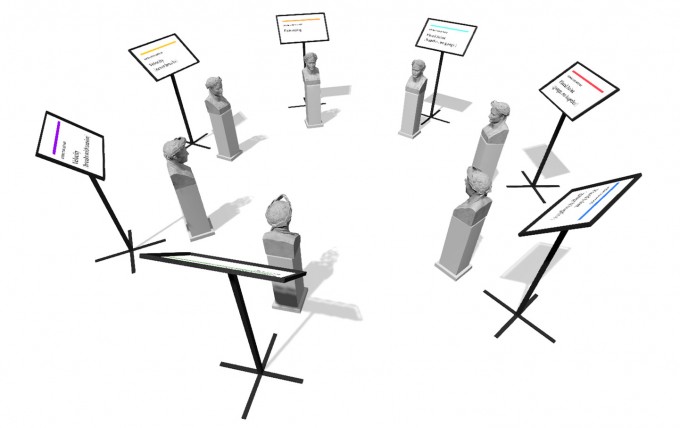
We created two scenes for user testing. In both, we arranged seven stations around the user. Our first scene had a single object per station, so testers could directly compare how it felt to pick something up using each method. As they worked through the stations, we asked a series of questions: Which object felt heaviest? Which method would you prefer if you had to pick up many objects? Which method felt the most natural?
Takeaways
While we saw a few high-level trends in our tests, no single implementation was a consensus top pick. This wasn’t unexpected; going into this exercise, we didn’t think there would ever be a ‘right’ answer. But we were able to draw plenty of conclusions from the input we received.
Loose Links Work Best When the Connection Can be Broken
But Unless It’s Vital to the Interaction, Weight Is an Annoyance
More Feedback is Welcome — and Don’t Forget Sound!
When we chose to add sound to this exercise, we didn’t think much of it. But it turned out to have a huge impact on how our testers perceived weight. The thuds of heavy objects hitting the ground or rubbing against each other reinforced the differences in mass.
‘Basic’ Interactions in VR Are More Complicated Than They Seem
See the full story here: http://www.roadtovr.com/b-reel-simulating-object-weight-mass-virtual-reality-motion-controllers
‘Zombie Survival’ Opens In Tokyo: The World’s Most Advanced Free-Roam VR Experience
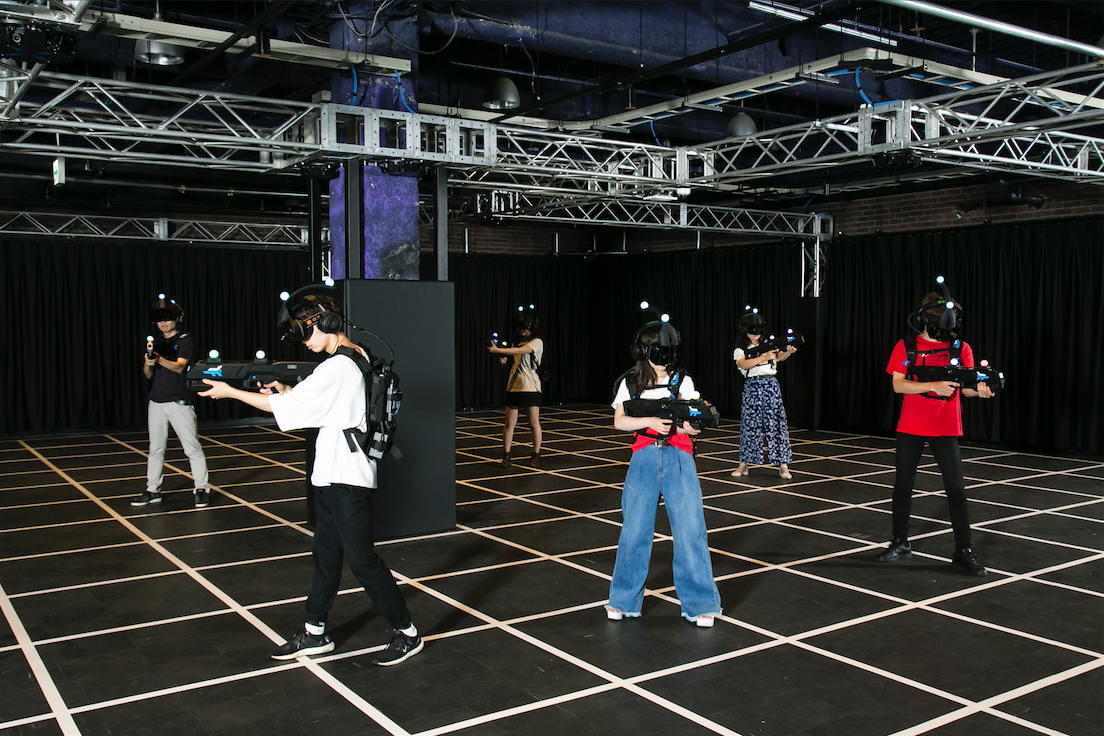
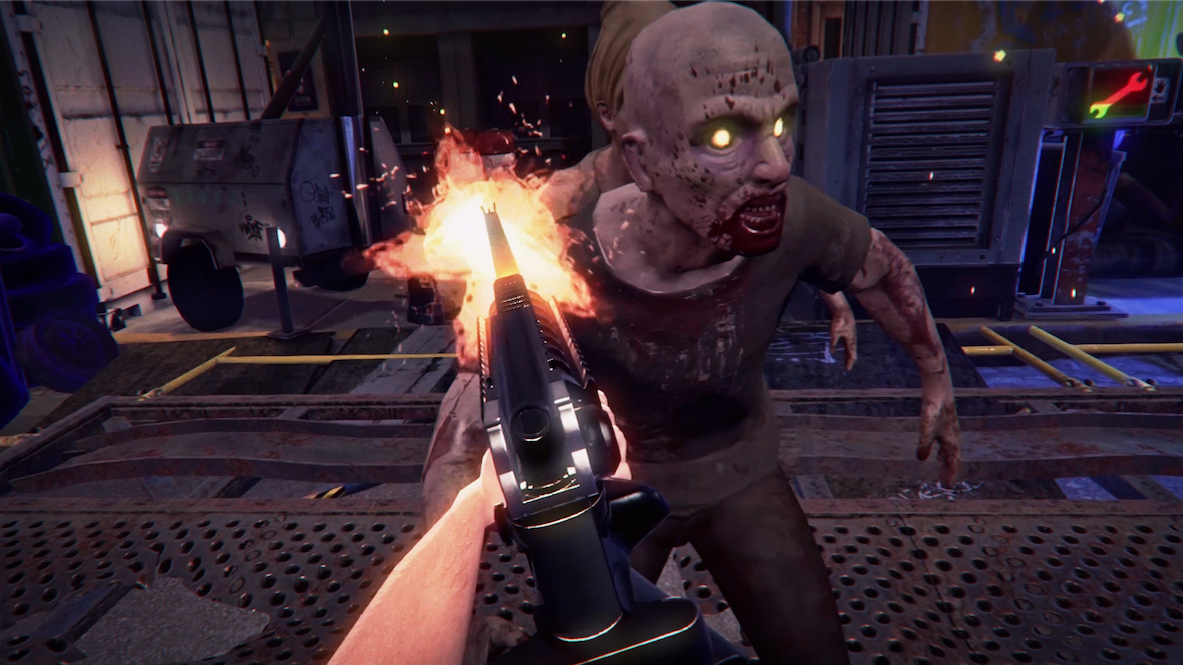 Developed by Australian start-up, Zero Latency, the game and platform have been updated for the Japanese market, and will be operated by game giant Sega. Playable by up to six gamers at once, Zombie Survivalis a specially tweaked version for the format in Joypolis, and is the first rollout to the public. It is also the first permanent installation for Zero Latency VR.
... spend 12-minutes as part of the six-man “Alpha Team” roaming a 280 square meter space blasting away at hordes of zombies as they tried to overrun our position. I felt like I was on the set of The Walking Dead TV series, but acting out the battle inside Star Trek’s holodeck. Zombie Survival is uncannily real, frightening, technically brilliant and above all epic fun.
See the full story here: http://www.forbes.com/sites/peterlyon/2016/07/22/zombie-survival-opens-in-tokyo-the-worlds-most-advanced-free-roam-vr/#b3f24433ff76
The Makings Of A Brilliant Virtual Reality RTS
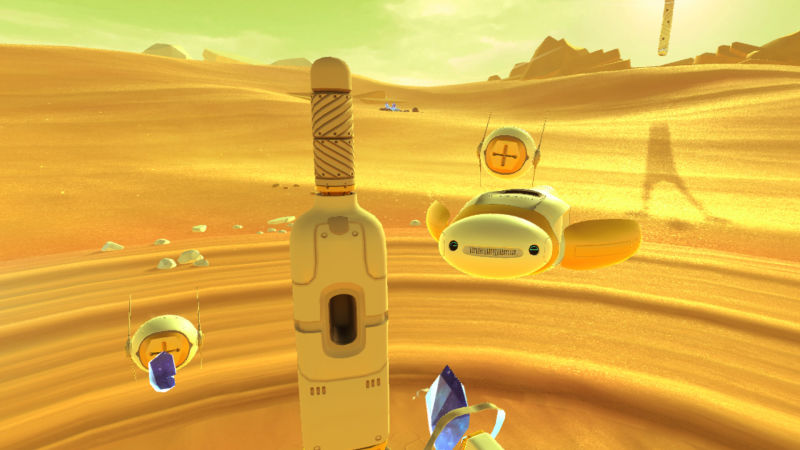 It’s funny how much more important defending your base is when you’re standing in the middle of it. Cosmic Trip for the HTC Vive uses virtual reality to deliver a intimate perspective on real-time strategy.
See the full story, with a game-play video, here: http://kotaku.com/the-beginning-of-a-brilliant-virtual-reality-rts-1784240890
MIT made a movie screen that brings 3D to all seats – without the glasses
 [Philip Lelyveld comment: I don't see anything here that goes beyond lenticular display tech.]
‘Cinema 3D’ that uses a complex arrangement of lenses and mirrors to create a set number of parallax barriers (think of Venetian blinds that show a slightly different set of pixels to each of the viewer’s eyes to simulate depth) that can address every viewing angle in the theater based on seat locations.
So far, the prototype isn’t nearly ready for market – it’s about the size of a letter-sized notepad, and it needs 50 sets of mirrors and lenses.
Researchers figured out you can do this in movie theaters because, unlike at home, you pretty much know where audience members are going to be: the seats are in fixed locations, and people tend not to move around, change seats or otherwise vary their angle of viewing too much during the screening of a movie.
See the full story here: https://techcrunch.com/2016/07/25/mit-made-a-movie-screen-that-brings-3d-to-all-seats-without-the-glasses/
THE MOST EXPENSIVE VR EXPERIMENT YOU’LL SEE ALL WEEK
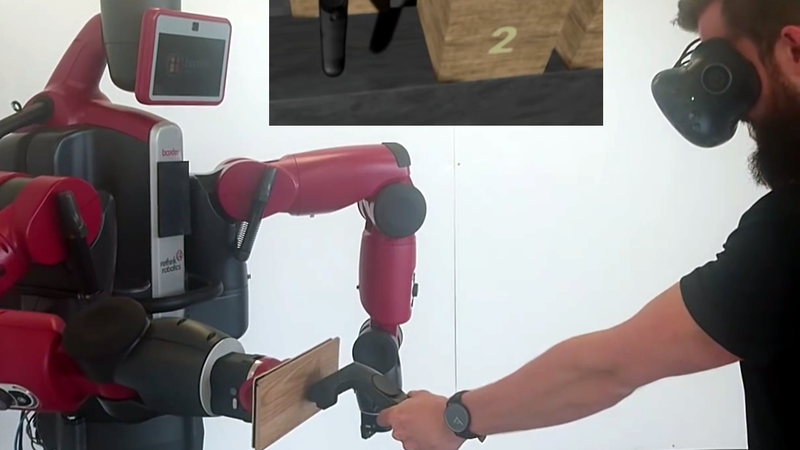 There isn’t a lot of detail to be found behind this short demo of robot-based physical feedback for VR, but the video (embedded below) demonstrates things well. It’s an experiment in generating force feedback for virtual objects using a Baxter robot and the HTC Vive. When the user presses against a wooden block in VR, the robot presses back which simulates the mass of the virtual object. Force feedback is one of these areas in which research is ongoing, and in a variety of different directions.
Like so many other things in life, nothing beats the real thing for actual physical feedback. Also, there’s something great about giving a $25,000 robot the job of impersonating a few simple wooden blocks in VR, just so you can strap on a VR rig and basically give a robot a realistic-feeling fist bump.
See the full story with video here: http://hackaday.com/2016/07/24/the-most-expensive-vr-experiment-youll-see-all-week/
Tech investors are betting big on alternate realities (graph)
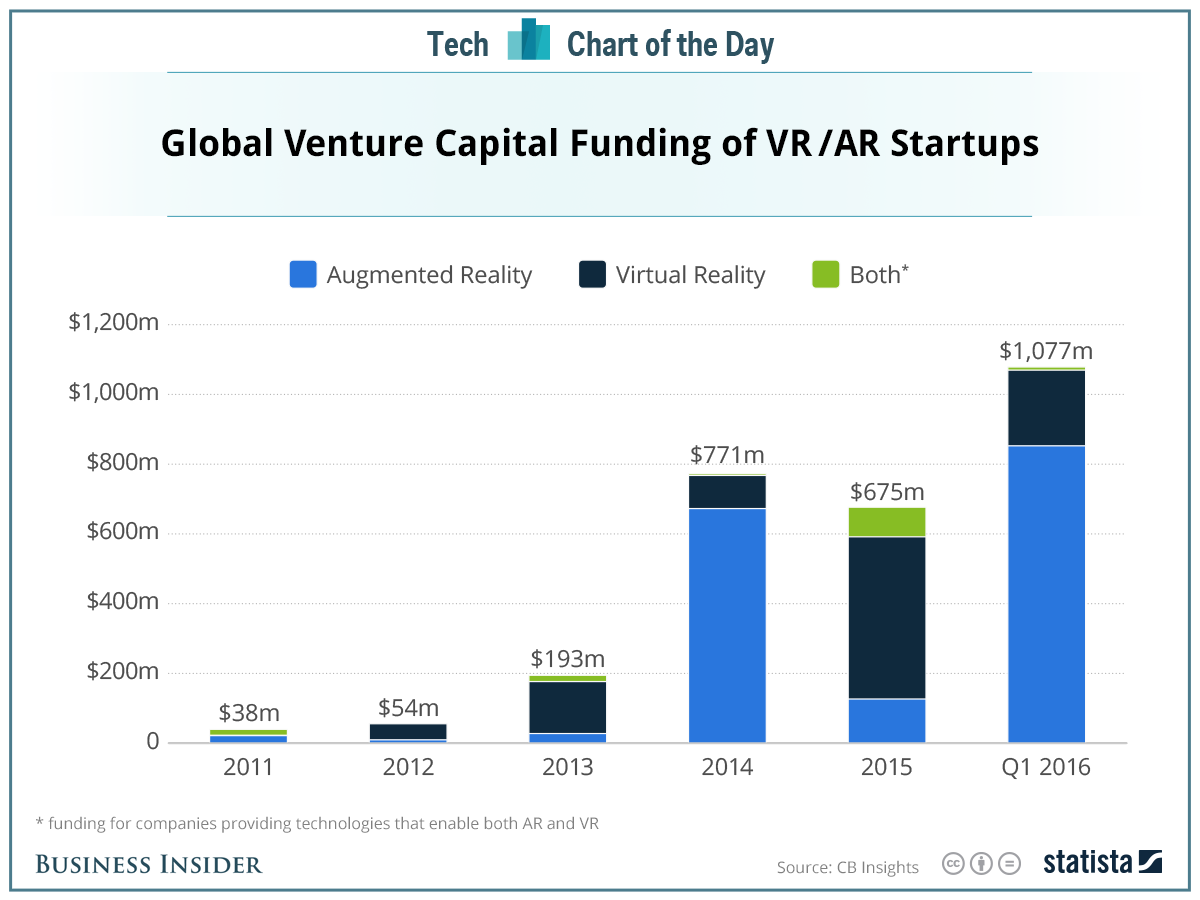 See the full story here: http://www.businessinsider.com/vc-investment-virtual-augmented-reality-2016-7?r=UK&IR=T
Legend VR creates virtual reality episodes for Stan Lee’s Cosmic Crusaders
 Virtual reality company Legend VR has partnered with Stan Lee’s Pow! Entertainment to create virtual reality episodes for the new adult animated series “Stan Lee’s Cosmic Crusaders” and is expanding its virtual reality division.
The company also said it has promoted the series’ VR producer Will Maurer to vice president of business development for its standalone VR and VFX divisions.
The series is the first show to debut on THR.com, the website of industry newspaper The Hollywood Reporter, and the first four episodes will air exclusively on THR.com leading up to Comic-Con International 2016 in San Diego this week. The VR episodes will premiere on the Hindsight VR app.
Legend VR said Maurer’s promotion “underscores the company’s commitment to expanding Legend VR," its freestanding virtual reality division that helps studios, documentary filmmakers and others create interactive content. Its clients have included Lionsgate, Warner Brothers, Apple Music, Annapurna Pictures, Hulu, and Tidal.
See the full story here: http://www.bizjournals.com/losangeles/news/2016/07/21/legend-vr-creates-virtual-reality-episodes-for.html
Augmented reality WW1 art exhibition opens in Greenwich
 Raven is the first oil painter to work in the exciting world of augmented reality, teaming up with industry leading application Blippar to unveil the process of creating her multi-layered oil paintings.
“My paintings have always had layers,” said Raven. “But no one has seen them until now.”
While creating her pieces, Raven set up cameras to capture the journey, with each picture having up to 10,000 photographs depicting its growth.
Within the exhibition, the individual layers, hidden from the final picture, are brought back to life using the Blippar app. Black crows swarm the scene before disappearing in a wave of darkness and sunny skies give way to grey clouds and transform into stunning sunsets. Beneath the ground, under the beauty of the sunflowers, poppies and bluebells lay many a lost life, and broken heart.
See the full story here: http://eandt.theiet.org/news/2016/jul/augmented-reality-exhibition.cfm
The Hubble Cantata (live AR concert)
 You'll be able to see the stars—light pollution be damned—at Prospect Park on Saturday, August 6th. That's when The Hubble Cantata, a virtual reality film paired with live music, debuts as part of BRIC Celebrate Brooklyn! Festival. For the music, a 30-piece ensemble and a 100-person choir (as well as Met soprano Jessica Rivera and baritone Nathan Gunn) perform composer Paola Prestini's music with words by librettist Royce Vavrek. For the visuals, directed by filmmaker Eliza McNitt, all 6,000 attendees will be given a cardboard VR headset, which they can use with their phones, to take an immersive look at the Hubble Telescope's images of the Orion Nebula. It'll be the first event to combine a VR space show and a live-music experience for free, organizers say.
Full story - http://www.timeout.com/newyork/blog/first-ever-virtual-reality-concert-coming-to-prospect-park-072016