‘Pokémon GO’ Is A Terrible Pokémon Game, But An Augmented Reality Home Run
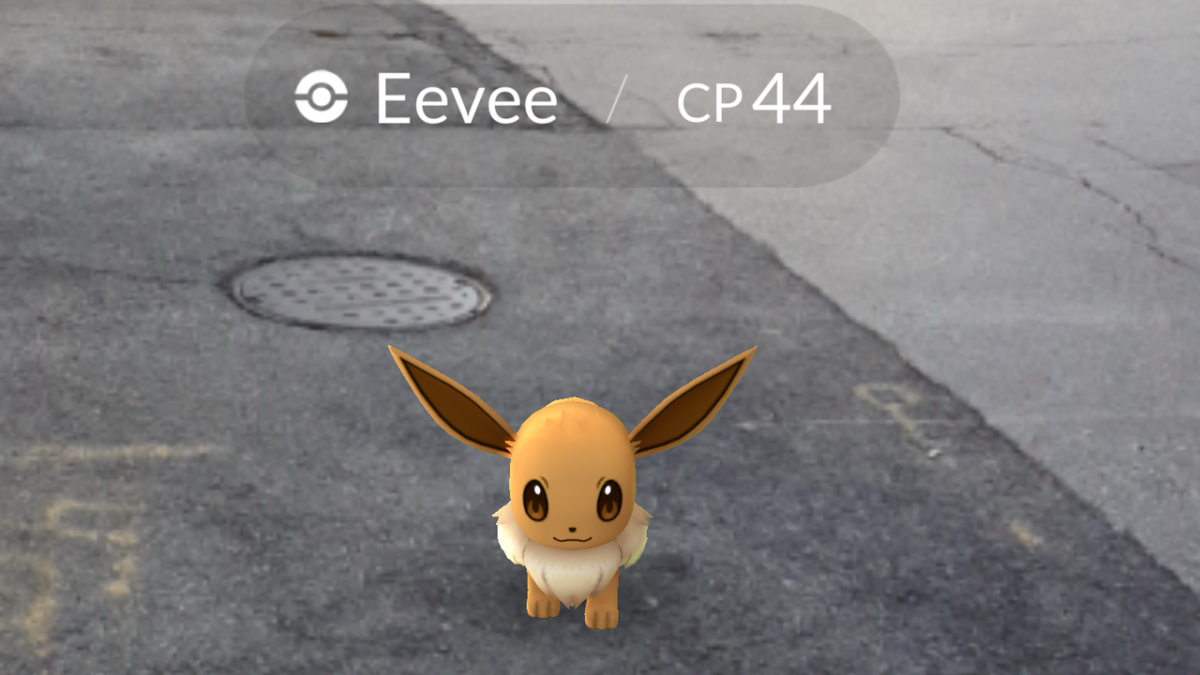 Am I having fun? Yes. Is this a very good Pokémon game? Absolutely not.
Pokémon GO is weird.
It’s simultaneously a huge disappointment and also something that has exceeded my expectations. Those two things sound mutually exclusive, but I’ll try to explain why that isn’t actually the case. I’ll start with the bad.
Pokémon GO is a pretty awful Pokémon game. It lacks everything everyone likes about Pokémon other than the existence of the Pokémon themselves. Everyone knew the game would be simplified to some degree for AR gameplay, but what we’re left with is just…such a bummer.
The only one of these points I’m willing to concede is the capture system. Given that the game is about walking around (hence the “GO”) if I had to stop and fight every single one of the 80 Pokémon I’ve caught in the last day with my Poke-team, that would have been a lot of standing around in the middle of sidewalks for an extremely long time. To keep things moving, I think the “headshot them with a Pokeball” system is actually not all that bad as a compromise.
Also unforgivable is what Pokémon GO has done with battling. Turning Pokémon battles into a button-mashing tap-fest is just embarrassingly bad.
And yet, the game is crazily addicting, a lot of fun, and possibly the most significant advancement in the battle against obesity in recent memory. I’m not kidding.
But for all the health benefits, I worry about a few of the health risks as well. For as much cardio as you may get from Pokémon GO, because the game essentially forces you to keep the app open and check it constantly, you are really not paying attention to where you are much of the time. Add in headphones, and the game can feel downright dangerous because of how much it engrosses you.
See the full story here: http://www.forbes.com/sites/insertcoin/2016/07/08/pokemon-go-is-a-terrible-pokemon-game-but-an-augmented-reality-home-run/#50aedce55b1c
Pokemon GO launches in Liverpool as augmented reality characters appear on city streets
 Users will be abkle to see the character projected on the street via their smart phone and can catch it by 'throwing' a Pokeball. The game also includes strategically placed 'training gyms' for the Pokemon and other power ups scattered around the city.
The game means Pokemon will appear in Liverpool city centre and surrounding areas, including famous landmarks and heritage buildings. Some Pokemon will be exclusive to this part of the country.
The creator of the game, Niantic Labs, says: "Some wild Pokémon appear in their native environments—for example, Water-type Pokémon may appear near lakes and oceans. Once players have encountered a Pokémon, they can catch it by using their smartphone’s touch screen to throw a Poké Ball. Poké Balls and other special items can be found at PokéStops located at interesting places, such as public art installations, historical markers and monuments."
The game, which includes in-app purchases, is currently ranked number in the App Store and has users across the world playing.
However, it has attracted criticism due to its high battery usage, with many users taking alternate power sources on their 'Pokemon hunts'.
See the full story here: http://www.liverpoolecho.co.uk/whats-on/shopping/pokemon-go-launches-liverpool-augmented-11585417
HOW VIRTUAL REALITY COULD SAVE PLANNED PARENTHOOD
 Regardless of what is and isn’t available at Planned Parenthood, this is just not how to act toward people, McDonald-Mosley says, and her organization made the film—and chose to make it in virtual reality—to help people see what it’s like to be treated that way. “Imagine how you would be if you were in a vulnerable situation just going to see your health care provider,” she says.
Jeremy Bailenson, founder of Stanford University’s Virtual Human Interaction Lab, sees virtual environments as psychological states in which individuals can perceive themselves in new ways. Along with perfecting the technology, he wants to get a greater handle on its psychological effects. His is the first lab to study the effects of VR over the long term, with approximately 1,000 people participating in a wide range of scenarios that deal with prejudice, bullying and other social ills. At his lab, researchers create and manipulate VR representations of users in an attempt to fool their brains into changing their behaviors.
In one experiment, researchers altered college students’ avatars to look like their 65-year-old future selves and found those students were willing to put away twice as much money in savings than those whose avatars were unchanged. Bailenson told PBS NewsHour the visceral experience of seeing yourself older as opposed to just thinking how one day that will be true creates a “deep connection to your future self.” If VR can build that kind of connection in other cases, it could be a powerful tool.
See the full story here: http://www.newsweek.com/2016/07/15/planned-parenthood-virtual-reality-across-lines-478230.html
Virtual reality: It’s what’s for dinner
 The way it works: You put on the headset and you're transported to an interesting location, which is probably the most normal element of this exercise.
Also on the table are several other devices. One is an "aromatic diffuser," which has a tube sticking out of it that blasts food aromas at you. Another is a "bone conduction transducer" that wraps around the back of your head to mimic the sounds and vibrations of chewing. There's a cup for drinking. Finally, there's a utensil shaped like tweezers. For eating.
Put all those items together, and you could be eating sushi in Japan, or be having a simulated food experience totally foreign to this world.
"There is no demand for an application like this, nobody will use it, and I'm shocked that it will attract any funding at all," said Michael Pachter, managing director of equity research at Wedbush Securities.
Or maybe it's so weird it just might work.
Eating too much chocolate? Try Project Nourished.
"Flavor is about 80 percent aroma and 20 percent taste," said Robert McGorrin, department head of Oregon State's Food Science and Technology department.
So, could Project Nourished help kick-start a new Willy Wonka-like magical food revolution? It will need to convince a lot of people.
Project Nourished is still working on its recipes, whose ingredients An said are "massaged" every day. The starter kit, available for preorder online for $59.84 and shipping this summer, is a "smell module." The devices that replicate the sensation of eating will follow in the latter part of 2016.
See the full story here: http://www.cnet.com/news/virtual-reality-its-whats-for-dinner/
5 Best Augmented Reality Games Like Pokemon GO
1. Ingress
2. SpecTrek
3. Life is Crime
4. Zombies, Run!
5. Parallel Kingdom MMO

See the full story here: http://www.mobipicker.com/games-like-pokemon-go/
Pokémon Go has already taught me so much
Hilarious review; sample - Catching Pokémon at a busy intersection definitely makes you look super weird
See the full article here: https://techcrunch.com/2016/07/06/pokemon-go-an-education/?ncid=tcdaily

Disney CTOs Talk Virtual Reality
 At a recent event hosted by The Walt Disney Studios’ Technology Innovation Group (TIG), employees from across the Company gathered at its headquarters in Burbank, California, to discuss the impact VR has had and will continue to have on Disney experiences.
Disney|ABC Television Group Senior Vice President (SVP) and Chief Technology Officer (CTO) Skarpi Hedinsson talked about innovations from his side of the business, as they are focused on making news and programming even more immersive.
“Our angle with VR is on cinematic storytelling,” The Walt Disney Studios SVP and CTO Jamie Voris said during the panel. The Jungle Book was the studio’s latest experiment with VR, and the team created four different experiences for a variety of platforms.
In the global marketplace, Walt Disney International SVP and CTO Emmanuel Frenehard expressed that VR will play an important role in bringing the magic of Disney in new ways to virtually ever corner of the world.
The panel agreed that close collaboration between Disney’s businesses would continue to be a catalyst in creating even more VR content to share stories in never-before-seen ways. Frenehard summarized the momentum on the technology at the Company best by saying: “We are all working as one company, in unison, toward looking at VR.”
See the full story here: https://thewaltdisneycompany.com/disney-ctos-talk-virtual-reality/