How Intel Is Exploring Virtual Reality
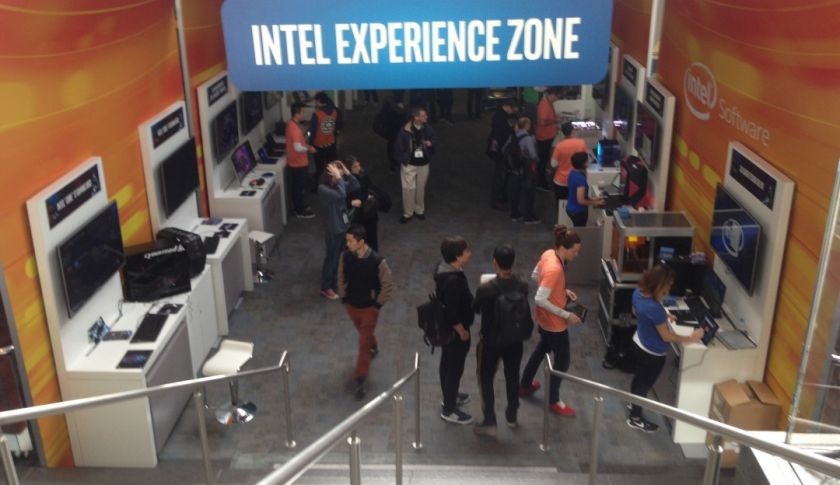 After initially funding eye-tracking startup Tobii in 2012, Intel has developed its own RealSense eye-tracking technology that also recognizes gestures and facial emotions.
In addition to funding Tobii, Intel also acquired Replay in March for an undisclosed sum. Pallister says that acquisition is aimed at scaling a new category for sports entertainment that Intel calls immersive sports.
According to Piper Jaffray senior research analyst Gene Munster, only 10% of current PCs in the world are capable of running an Oculus Rift or HTC Vive. He believes an additional 10% of PCs can be upgraded through an Nvidia or AMD graphics card for an additional $300. Most consumers will have to invest in PC hardware in addition to the headset purchase.
Intel INTC 2.19% has launched a “VR Ready” initiative for consumers to highlight which PCs can run virtual reality platforms such as Facebook’s Oculus Rift and the HTC Vive.
“2016 is when more VR-capable hardware and software will hit the market and potentially see the tipping point in its adoption,” Pallister says.
See the full story here: http://fortune.com/2016/03/17/gdc-intel-virtual-reality/
GDC 2016: Your Brain on VR, The Psychology of Doing VR Right
By Don Levy
March 16, 2016
Cognitive scientist, programmer, game developer, and senior technical designer for Riot Games and Radial Games Dr. Kimberly Voll took a packed house at the Game Developers Conference into the brain on VR, hailing the tremendous opportunities and flashing potential hazards this new medium presents. As someone who “engineers awesome experiences through understanding humans better, frequently in VR,” Voll’s latest project is “Fantastic Contraption,” a VR update to the popular 2008 building game, that will be shipping with the HTC Vive in April.
Voll points to what she calls the “fidelity contract” as a key design concept. “These are the rules, typically unspoken, that are set by the affordances and fidelity of the world as presented around you,” she wrote in a Tumblr post recently and amplified in her talk.
“Even games that mess with player expectations do subscribe to certain rules that are uncovered through experimentation. The brain anticipates consistency, which means as designers we need to understand our spaces well enough to not mess up what the brain gives us for free. When the fidelity contract is broken, the brain notices right away, and any immersive state is (sometimes irreparably) damaged.”
In VR, Voll explained, “the brain will work very hard to straighten things out, which is great news… because this means most importantly the brain is working for us, and we can take advantage of this if we don’t get in its way.”
“Our brains… present us their interpretation of reality,” she said. Perhaps the brain will rearrange a memory “or convinces you completely that you saw something you never did. We can actually trick the brain into seeing a lot of interesting things without those things actually being there, which turns out is also helpful in games, VR, and entertainment,” Voll said.
“Presence is the biggest buzzword since ‘The Cloud,’” Voll mused, quickly adding “You do not get presence for free in VR.”
“It might seem that way because the first time you put on that display, your visual system is screaming at you, ‘Holy shit, I’m in VR.’ But once you get over that, and those of you who have worked in VR for a while will know what I’m talking about, other things will start to bubble up.”
It bubbles up out of what she calls “a perceptual soup.” The recipe changes based on engagement. “We don’t need perfect perception to do cool stuff,” she said.
Instead, she suggests that simplicity and the aforementioned fidelity contract produce a better state of flow, where concentration is focused and the brain is given a reason to believe. Haptics, motion triggers, can be helpful to the brain in writing narrative. It is an extra level that rounds out the experience.
Voll sounded a cautionary note: “Our players are putting their trust in us when they place themselves in the rig. Part of creating believable spaces is that we want people to believe in these spaces, and we want people to feel safe so that they can give into these spaces. If someone’s uncomfortable, they won’t let themselves go. And if we’re contributing to that discomfort, well it becomes our fault.”
“While it might not be real, it’s sure as heck real enough,” Voll said. “And the potential for doing real psychological trauma is there. Physical trauma as well, people walking into walls, or scaring people to the point they have a heart attack. We don’t know yet how this is going to go, but we have to be careful. We have to be mindful of this. Our players place their trust in us when they place themselves in the rig. If you take nothing away from this talk, take that away.”
See the original post here; http://www.etcentric.org/gdc-2016-your-brain-on-vr-the-psychology-of-doing-vr-right/
HTC Vive Will Launch With 50 Virtual Reality Games
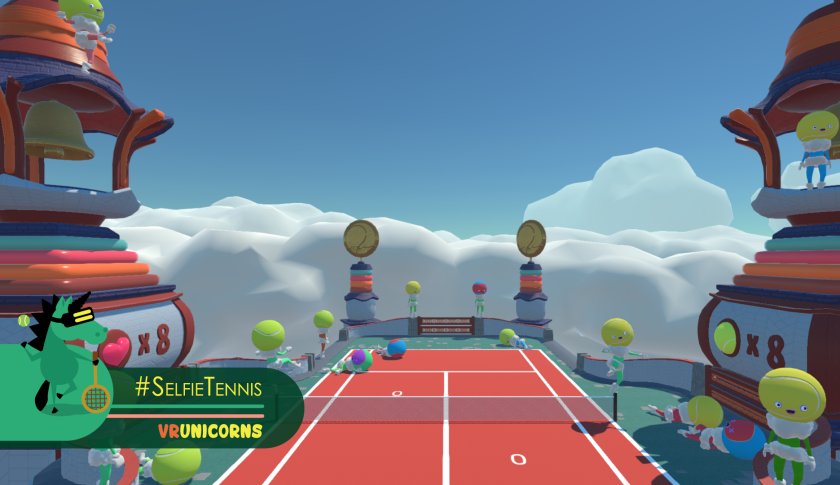 With the April 5 consumer launch just around the corner, the Game Developers Conference this week is all about the games for HTC Vive and developer Valve. The companies will be showcasing over 30 virtual reality games on the show floor, including the ILMxLab Star Wars: Trials on Tatooine demo and a playable John Wick: The Impossible Task.
According to Chet Faliszek, writer and virtual reality evangelist at Valve, 50 developers already have HTC Vive store pages on SteamVR that could begin selling content today.
In addition to offering gamers a trio of free virtual reality games—Job Simulator, Fantastic Contraption, and Google Tilt Brush—Valve is also giving away more content to early adopters. Among the free content is The Lab, a collection of eight mini-games set within Portal’s universe that includes activities such as fixing a robot, defending a castle, walking on Mars, and adopting a mechanical dog.
See the full story here: http://fortune.com/2016/03/16/htc-vive-will-launch-with-50-virtual-reality-games/
Bergen-Belsen recreated with augmented reality
 During World War Two, around 70,000 people died at the Bergen-Belsen concentration camp.
All traces of the camp were destroyed after the war, so today the area looks like an ordinary German forest.
A new tablet application, however, uses geo-localisation – as well as virtual and augmented reality – to recreate the camp at various points in history.
Stephanie Billib, a historian at the Bergen-Belsen Memorial, explains: “The memorial today is an empty space. There are no barracks or any other remnants of the camp. But when you see this reconstruction and when you walk around with this (a tablet connected to the app), it is a useful aid to get a feeling for the place.”
The Bergen-Belsen Memorial app was developed by scientists at the Synthetic Perceptive, Emotive and Cognitive Systems (SPECS) group at the Pompeu Fabra University in Barcelona.
SPECS is a core partner in the European research project, Collective Experience of Empathic Data Systems, which is aimed at developing integrated technologies to support human experience and understanding of large datasets.
See the full story with video here: http://www.euronews.com/2016/03/18/virtual-reality-app-recreates-horror-of-germany-concentration-camp/
Stanford Alumni Mag – VR Overview
 Virtual reality—VR, to the initiated—is so realistic, so immersive, that it feels something like an actual experience.
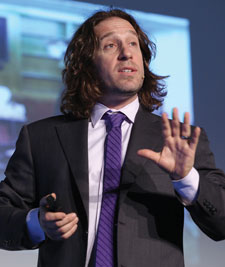
“We like to say the brain isn’t evolved yet to know that a virtual experience is not real,” says Bailenson, a professor in the communication department whose doctorate is in cognitive psychology and who has been studying VR’s effects for two decades.
And that, to hear Bailenson say it, means a whole lot more than you probably think. “We are going from essentially no VR to potentially pervasive use of the most powerful medium ever,” he says. “What are the consequences of a world where anything can happen at the touch of a button and feel like it’s actually happening?”
Jay Borenstein, ’94, MS ’94, a Silicon Valley veteran who teaches VR coding at Stanford.
As creators master VR’s potential, Borenstein expects the results to be just as far-reaching. “I am a real believer that the medium will be as transformative as television was, as the Internet was,” he says. “It is a profound leap ahead from the two-dimensional ways we experience things today.”
He also echoes a common refrain of VR creators—one borne out in Bailenson’s research—that VR allows the viewer to step into another’s shoes with unprecedented power. Indeed, VR has been embraced by documentary filmmakers who have used the medium to bring viewers inside uncomfortable environments, helping them relate to urban hunger, domestic violence and forced migration.
Belch, a former Cardinal kicker who developed STRIVR while working as a graduate assistant coach for the football team and earning his master’s in Bailenson’s lab, tells me to look for a receiver running an out pattern.
I take the mask off, clearer about the reasons for STRIVR’s growing reputation. Why, for example, Stanford head coach David Shaw, ’94, put his own money into starting the company. Why seven NFL and 13 college teams in addition to Stanford have signed on since STRIVR started. It’s like a flight simulator for athletes.
AltSpaceVR, for example, is a Redwood City company led by former rocket scientist Eric Romo, MS ’03, MBA ’06, who grew interested in the social potential of virtual reality after reading Infinite Reality, the 2011 book Bailenson co-wrote with Jim Blascovich, a professor at UC-Santa Barbara.
AltSpace enables a networked VR world where you can hang out, chat at a Super Bowl party, play Dungeons & Dragons, or stream Netflix onto a shared screen, all with people from around the world in the same room.
“Spatialized” sound conveys the changing distance between avatars, our virtual bodies. Voices are louder as you get closer, softer as you move away, in one ear or the other based on positions.
The AltSpace world is so complete you can check a web browser to read your real-life emails while in VR—something Romo does if he’s spending hours in a headset giving demonstrations. Once, early on, he spent six hours in a headset as others came and went. “I watched an awful lot of YouTube that day.”
In real life, for example, people often feel more favorable toward those who subtly—and often unconsciously—mimic their body language in conversation, the so-called “chameleon effect.” The same holds true in VR, according to research by Bailenson and Nick Yee, MA ’07, PhD ’07.
Likewise, Yee and Bailenson found that making your avatar taller can lead to assuming a strikingly more aggressive posture in negotiations, an effect that can continue even if the parties reconvene outside of VR. In one study, in which student volunteers negotiated on splitting $100, participants with short avatars were nearly twice as likely to accept a poor offer than were ones with tall avatars.
Bailenson’s lab is also early in studies on the effects of VR on young children, an area with scant research. In a previous study, they subjected elementary school children to a virtual experience where the children saw their own likenesses swimming with whales. A week later, a follow-up found half of them had false memories of themselves actually swimming with whales.
But if Bailenson is alert to concerns about VR, he’s also keyed into its potential for good. The lab has found that putting people in virtual reality can get them to change their behavior in positive ways. They save more for retirement if they see older versions of themselves, exercise more if they see their avatars lose weight as they work out, and show more empathy if they see the world through another’s eyes, quite literally in the case of a color-blindness simulation.
See the full story here: https://alumni.stanford.edu/get/page/magazine/article/?article_id=84558
Hands-in with the gloves that virtual reality needs
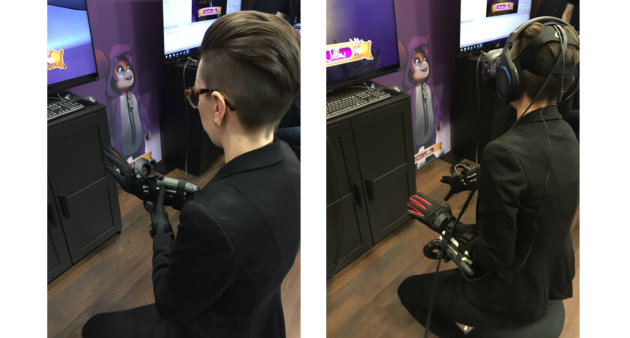 The gloves are still in development and they've only been in the works since 2014, but already they're satisfyingly responsive.
At the Game Developers Conference in San Francisco, I played an adorable platforming demo called Pillow's Willow with an engineering prototype of the Manus VR gloves, running on the HTC Vive headset. I slipped on a pair of black-and-red gloves, complete with a plastic charging bump and some wires dangling across the top. A developer strapped the Vive's motion controllers around my wrists for positional tracking and I settled the Vive headset over my glasses.
It sounds like a lot. But, once the game got going, the hardware attached to my arms and face melted away. I hardly noticed it -- the goal of any virtual experience.
I reached forward to pluck lighting bugs out of the air and place them in street lamps, illuminating her path. I swiveled in my chair -- the game existed around me in 360 degrees -- and pushed down the sides of a bridge for her to cross. I grabbed pieces of a broken staircase and rotated them until they fit back together again; I squashed a series of monsters popping out of the floor of a bedroom. I played a few notes on a piano in a quick game of Simon Says.
Each motion was intuitive -- I didn't have to memorize any buttons or input commands. I did what came naturally, grabbing, turning and prodding objects with my fingers.
The Manus VR developer kit goes on sale in Q2 for $250 and it's expected to ship in Q3.
See the full story here: http://www.engadget.com/2016/03/16/hands-in-with-the-gloves-that-virtual-reality-needs/
Sky sets up in-house studio for virtual reality content
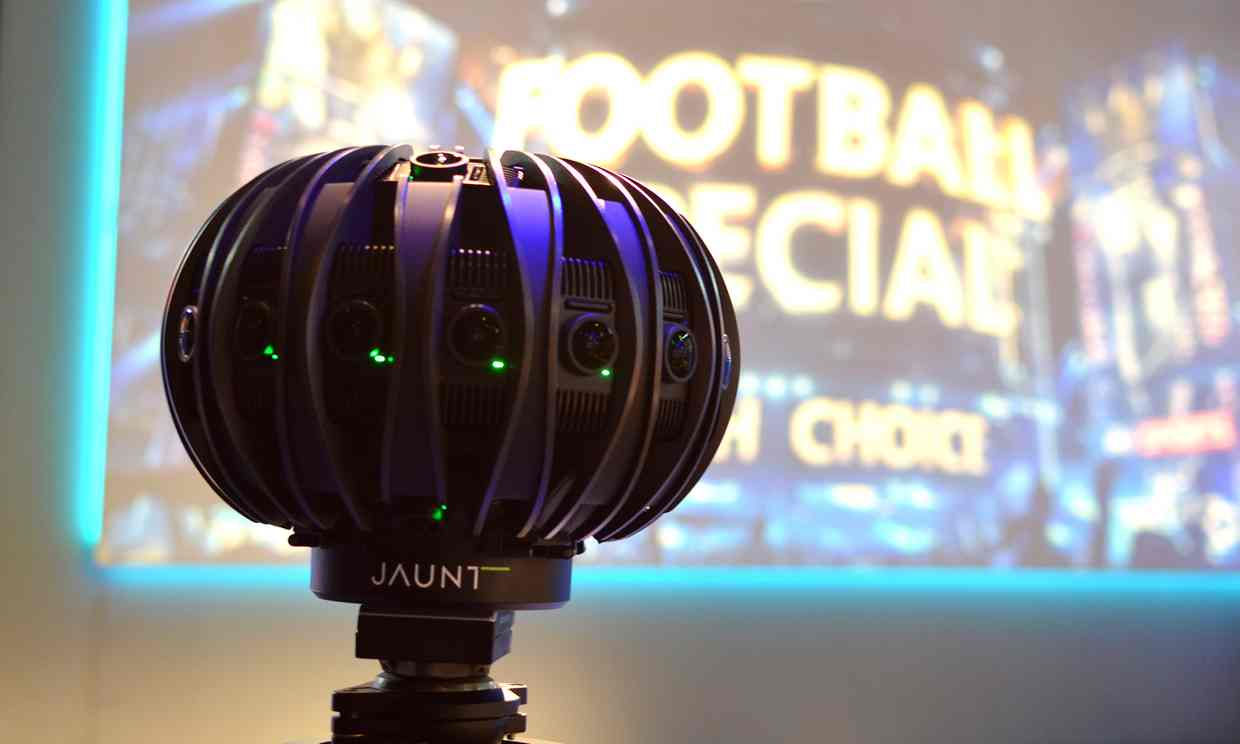 Sky’s move into VR content is a major step for a traditional broadcaster and could be crucial in pushing the adoption of the nascent technology beyond gamers.
The head of Sky VR Studio, Neil Graham, said: “Why now? The platforms are now ready to make this stuff happen and to test the boundaries of what is possible.”
 VR could provide that element of sport, if people are willing to don a headset and headphones, which is still a big if.
Nockles said: “Is 2016 the year of VR? Probably not. But it will gain greater recognition this year, meaning 2018 is likely to be the year of VR. When the gear is lighter and smaller and the experiments are over, allowing the story writers to come in.”
There is also the problem of delivering live sport VR broadcasts, which no one has tackled yet. It’s not simply a case of delivering twice as much data to two screens instead of one (one for each eye). VR requires a 360-degree view on two screens, which requires a significant amount of bandwidth.
See the full story here: http://www.theguardian.com/technology/2016/mar/17/sky-sets-up-in-house-studio-virtual-reality-content
Rob Bredow Upped To Chief Tech Officer Of Lucasfilm
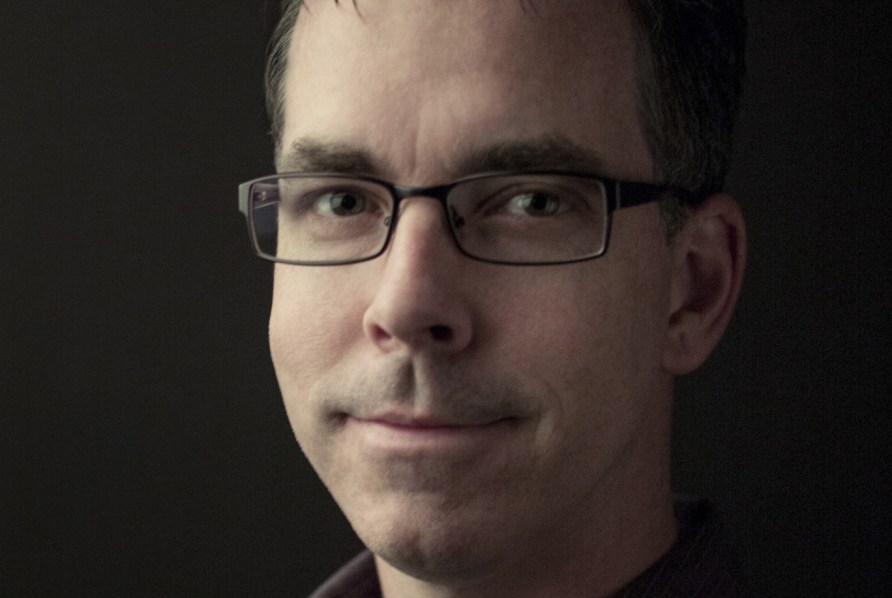 He initially joined the company as VP New Media and as the head of Lucasfilm’s Advanced Development Group, which develops tools and techniques for real-time, high-fidelity immersive entertainment. In that job, he was credited in helping to launch the new division ILMxLAB, which combines the talents of Lucasfilm, ILM and Skywalker Sound to create interactive storytelling and immersive cinema experiences.
Previously, Bredow was the CTO and visual effects supervisor at Sony Pictures Imageworks, where he worked on films such as Men in Black 3, The Amazing Spider-Man, Green Lantern, Cloudy With A Chance of Meatballs, Surf’s Up, Cast Away andGodzilla.
Bredow is a member of the Academy of Motion Pictures Arts and Sciences’ Scientific and Technical Council and a Visual Effects Society Technology committee chair.
See the original post here: http://deadline.com/2016/03/rob-bredow-chief-tech-officer-lucasfilm-1201722038/