WWE Steps Into Virtual-Reality Ring With Samsung
 WWE’s first VR video features 360-degree highlights from SummerSlam weekend, including the showdown between John Cena and Seth Rollins and the surprise appearance of Jon Stewart as host. The other video recaps the match between Finn Bálor and Kevin Owens at NXT TakeOver, a WWE Network special that took place the night before SummerSlam.
In producing the content, WWE ensured that the VR crew at SummerSlam didn’t interfere with the live crew for the pay-per-view broadcast. “We were able to put (the virtual-reality camera operators) in positions where they were a fly on the wall,” Wilson said. The VR camera rigs Reel FX used were relatively small, she added, and the bulk of the time and expense was in post-production editing.
WWE was an especially good fit for Samsung’s VR content push, Apfel said. Not only do the companies’ target audiences intersect, but WWE’s content provides both “proximity and polish” — it’s shot from ringside vantage points and has high production values.
“For (intellectual property) owners, the strategy is pretty clear: If you think virtual reality is going to take off, you have to have these experiments and experiences to learn and perfect, and then you start to build an audience,” Apfel said.
See the full story here: http://variety.com/2015/digital/news/wwe-virtual-reality-samsung-oculus-vr-1201633182/
“Circle With Disney” Is A New Device That Helps Families Manage Online Usage And Apps
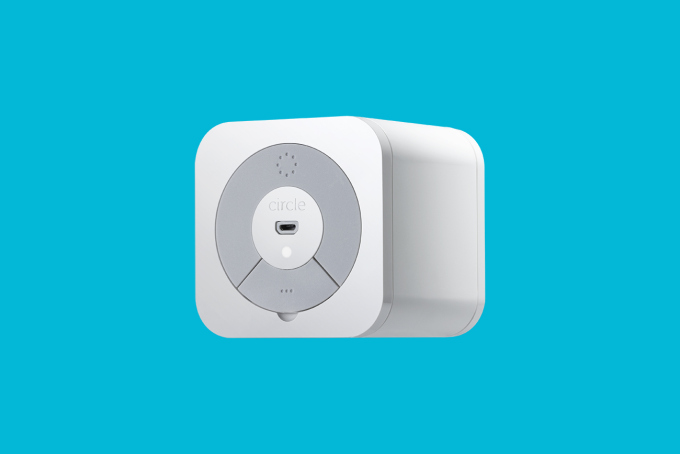 Parents looking to manage their children’s internet usage and screen time have a new option with today’s launch of Circle with Disney, a hardware device that works in conjunction with an iOS application that allows moms and dads to filter web content, set “bedtimes,” block ads, view insights and usage history, and even pause the internet entirely.
While there are numerous parental control solutions on the market, ..., the problem with many of these options is that they’re confusing for non-technical parents, poorly designed, or only work to manage and monitor usage on a single device or platform.
Unlike some other apps I’ve tested in recent days, including a hardware and app combo called KoalaSafe and a kid-safe browser from Mobicip, Circle comes with age-specific filters you can enable without having to monkey around much with its settings. These filters include: pre-K (ages 0-5), kid (6-12), teen (13-17), and adult (18 and up).
Another key feature to Circle’s software is its “insights,” which displays how each family member spends their time online by platform, category, and website and by day, week and month. The idea is to not only give parents an idea of what kids are doing, but also help spark conversations about that activity and the child’s interests.
And because the negative content is blocked, those discussions aren’t disciplinary in nature, but can actually be positive.
The Circle with Disney hardware device is $99 and is the first product in what Circle Media hopes will be a suite of hardware and software products for connected families in the future.
The company, based in Portland, is backed by $1.5 million in angel funding.
See the full story here: http://techcrunch.com/2015/11/04/circle-with-disney-is-a-new-device-that-helps-families-manage-online-usage-and-apps/
HTC Thinks Virtual Reality Needs 3-5 Years To Take Off
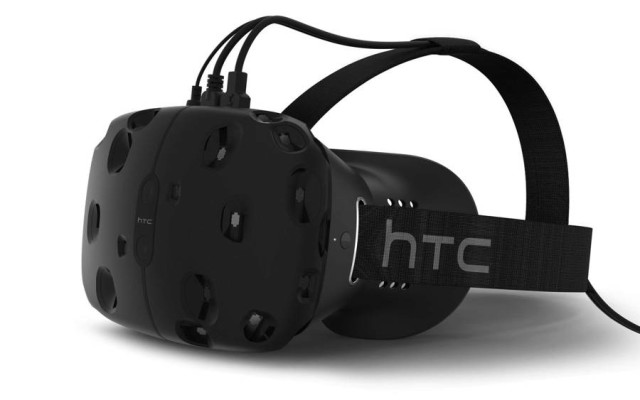 Speaking at the TechCrunch Beijing summit, HTC’s Chief Content Officer Phil Chen revealed that the company expects virtual reality to really take off in the next 3-5 years.
Why is this? According to Chen, he thinks that the technology behind virtual reality still needs to be refined further, and that there needs to be more content for virtual reality headsets which we suppose is a fair assumption. After all when the iPhone was first introduced, it took a couple of years before the smartphone scene became big and we were starting to see more apps and content designed for mobile devices.
See the full story here: http://www.ubergizmo.com/2015/11/htc-virtual-reality-3-5-years/
Google Aims to Make VR Hardware Irrelevant Before It Even Gets Going
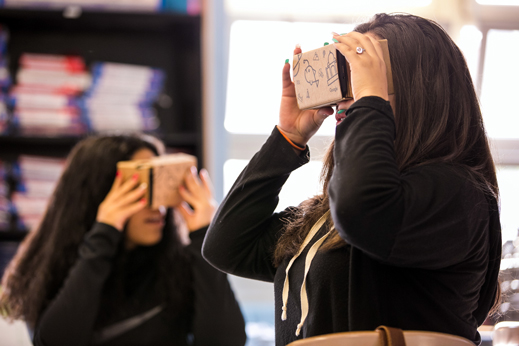 Google is taking on a chicken-and-egg problem common to any company trying to establish itself as the middleman in a new marketplace. Consumers won’t buy into virtual reality unless there’s something to experience; content companies won’t provide it without a ready audience. “The only way to get around it is to subsidize one side of the market,” says Michael Cusumano, a management professor at MIT who has studied how software and consumer electronics companies conjure up new businesses. “Give away 3-D viewers, or pay software developers to create applications or other content.” Facebook is trying to fill the content gap by hosting 360-degree video as YouTube does, partnering with content companies such as Netflix, and building an in-house production effort called Oculus Story Studio. Google is effectively subsidizing both sides of the market. By making handsets more or less for free out of devices we already own, it’s offering its content partners a potentially much larger audience.
Philip Rosedale, founder of the virtual world Second Life and now the CEO of High Fidelity, a company that has raised $16 million to develop ways for people to socialize in virtual-reality environments, predicts that both Google’s and Facebook’s projects will initially disappoint people who expect it to become popular. “Next year there’s going to be a big push to make VR a success, and it’s not going to succeed,” he says. Rosedale thinks it will take a few years for Oculus to reach beyond a niche gaming audience, or for smartphones to be capable of providing a widely acceptable experience. Referring to Bavor’s group, he says: “I have a lot of respect for that team. But I don’t think that doing VR in software on top of a mobile device can be compelling today.”
Bavor acknowledges that Google and other companies investing in virtual reality have much to learn, but he says the only way to do it is to get the technology to a significant audience. And the device for doing that is already—perhaps all too often—in our hands and in front of our eyes. “The technology’s here,” he says. “We’ve seen the proof that you can create wonderful VR experiences with today’s smartphone hardware; the sensors and the hardware and the content are only going to get better.”
Lionsgate Teams Up With Wevr for ‘John Wick’ Virtual Reality Experience
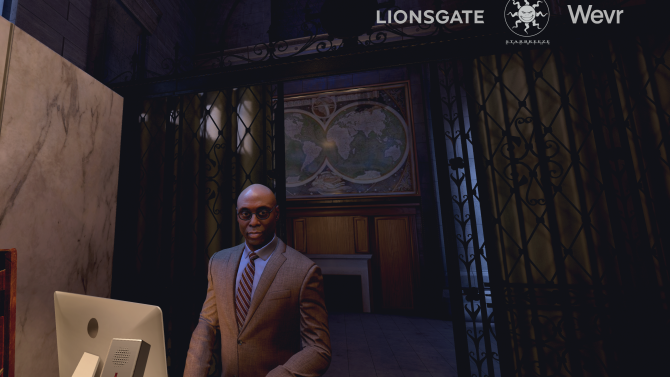 Lionsgate teamed up with Venice, Calif.-based VR startup Wevr to produce the “John Wick” VR experience, which lets users become Wick, and explore the Continental Hotel on his behalf. In the movie, the hotel is a safe haven for assassins, a kind of base camp that they can use to rest their bones and prepare for their next missions without the fear of work-related injuries. In the VR experience, it’s also a place of mystery, in which users have to figure out how to bribe the concierge, pick up dubious clues, and finally dodge bullets as someone breaks the Continental’s code of conduct and attacks their hotel room.
The fully animated VR experience makes use of the Vive’s motion tracking technology, allowing users to freely move around within a 10-by-10 feet space — which is enough to actually walk into that mysterious elevator or check out the hotel suite. Oh, and you’ll also have to get on your knees to escape the bullets once the attack starts. The experience also incorporates the Vive’s two handheld controllers, adding the ability to touch things, and for example move the lever in the hotel’s virtual elevator to get it to go up and down.
Lionsgate is getting ready to launch a full-blown VR video game based on the “John Wick” franchise next year, and it also recently started to film a sequel to the movie.
See the full story here: http://variety.com/2015/digital/news/john-wick-vr-virtual-reality-lionsgate-wevr-1201631538/
Digital Hollywood Panel Discusses Interfaces and Future of VR
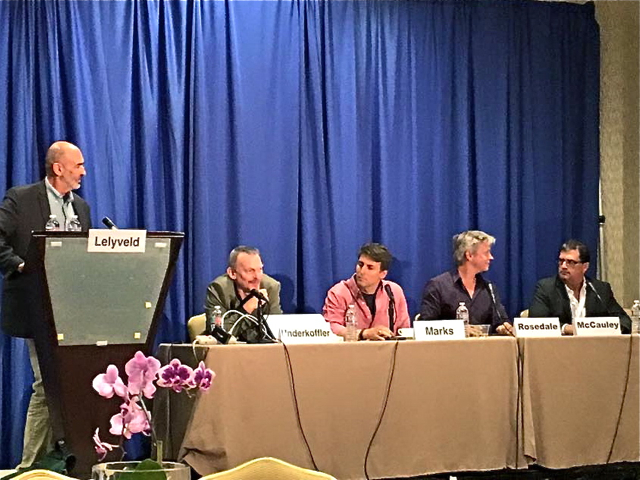 by Don Levy
An all-star panel of futurists and inventors featuring John Underkoffler, CEO & chief scientist, Oblong Industries; Philip Rosedale, CEO of High Fidelity and founder of virtual world “Second Life;” Berkeley academic Jack McCauley, founder & president of McCauley Labs and a co-founder and chief engineer of Oculus; and Richard Marks, director of PlayStation Magic Lab looked above and beyond the introduction of VR to articulate an array of visions and technical challenges yet to be mastered. The panel took place at Digital Hollywood and was moderated by ETC project manager Philip Lelyveld.
If there was a common theme to emerge among the participants, it was articulated by Richard Marks who summed it up in one word, “value.” If you are going to have the friction of wearing a headset, then the experience must be worth it, he elaborated.
The ease of something simple, such as Google Cardboard, permits lower level fidelity because the threshold is low. But the high value opportunity in VR he said, is with the highest possible fidelity, provided the cost and comfort are reasonable.
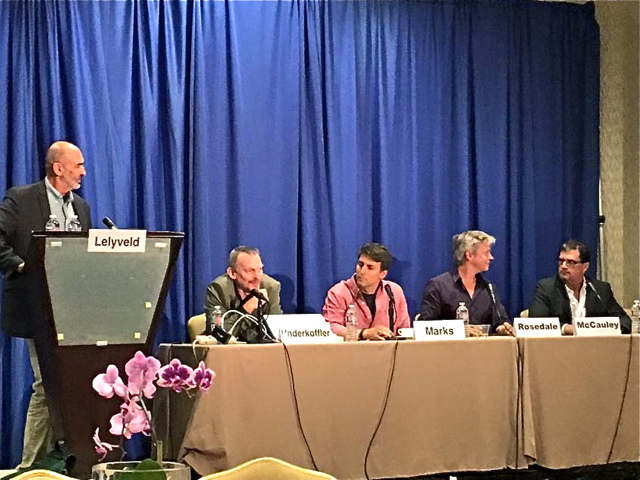
“I want to be able to do things in VR that I cannot do in any other way,” noted Marks. “I want to be able to reach into the world… and do things that I could never do in the real world.”
Rosedale, whose “Second Life” is widely regarded as a prototype for virtual worlds and social interaction, believes “the idea here is that we are going beyond the mouse.” He suggested that the revolution in VR will be “the absolute requirement of both the head and the hands.”
Where the mouse has just two dimensions of movement, the VR interface has the potential for 18 dimensions of free movement — six each for your head and hands.
“The real experiences that are genuinely going to be disruptive are going to be the ones where we have agency — where we can reach into the virtual world and do things,” said Rosedale.
McCauley wants to “take VR and put it into the hands of everyone by making it less expensive.” He envisions doing so by shifting the computational load off the host PC and potentially onto the headmount. He also cited eye-tracking as vital because eyes only resolve a small area of the field of view. By tracking the eyes, the system could render in high resolution only the pixels where the viewer is looking.
“Whether wearing the ‘bucket’ on your head or in a room surrounded by pixels, VR without an input, a UI, is just 360 Cinema,” Underkoffler observed.
Furthermore, the language of VR has yet to be defined. Unlike the pioneers of moviemaking, who transposed theater onto film, there is no single framework for VR. He suggested the evolution of a conformed UI — a lingua franca that would be relevant across VR, AR, cinema, the regular screens that we are used to, and mobile devices… we just need a little to get started.”
Nearly all of the panelists noted the importance of hands, both the tracking of their movement as well as their representation on screen. The projection of our hands on our brains is astonishingly strong, which makes the accuracy of their representation critical.
The panel concluded with a five-year projection on VR and AR.
McCauley recognized advances in mobile devices as a catalyst to the present state of VR. Resolution will improve to the point where you can no longer see pixels, likely with OLED technologies, Magic Leap’s development and the promise of untethered VR and AR.
Rosedale suggested that AR will not be viable in five years because registration — the accurate alignment of virtual objects in the real world — will still be a challenge. Overall, he compared this era to the early days of the Internet. Even people who completely embraced the Internet could not imagine its full potential.
Marks built on the theme of the not quite known. “In engineering we know the trajectory,” he said,” but not so much on the interaction.”
Underkoffler noted that, today, computation ends at the physical end of your device. Five years from now, there is no reason for that to be so. “Instead, the continuity of our world is a real possibility five years from now.”
Video of the panel discussion is now available online.
See the original post here: http://www.etcentric.org/digital-hollywood-panel-discusses-interfaces-and-future-of-vr/
Envelop raises $4 million for multi-tasking VR software
 Envelop VR easily enables a smart headset user to create a personal virtual environment or workspace in VR. Their software works across smart headsets like Valve/HTC Vive and Oculus Rift to extend the way you live, work and play in VR. It allows users to create a workspace that transforms your current work environment and adds layers of depth to it only available in VR. And, they are building a community of partners to help accelerate adoption of smart headsets and the virtual/augmented reality experiences they support.
See the full story here: http://uploadvr.com/envelop-raises-4-million-multi-tasking-vr-software/