Virtual Reality Pedals And Dances Its Way Into Fitness Classes
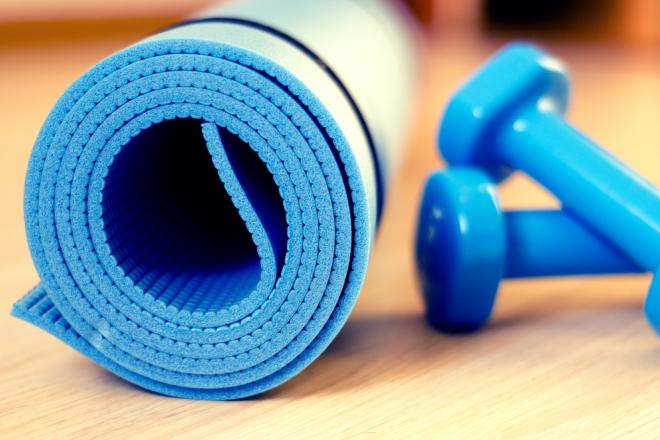 Anytime Fitness, a worldwide franchise, uses automated kiosks to screen immersive classes from indoor cycling to yoga.
“We have doubled down on our concentration of virtual fitness,” said Shannon Fable, corporate director of programing. “It’s an electronic way to deliver reliable, affordable group fitness for free.”
Fable, who is based in Boulder, Colorado, said virtual fitness is also popular in personal training and kiosks provide classes during off-peak afternoon hours.
Virtual exercise in the form of instructors and classes projected onto a screen has already penetrated some 3,000 clubs worldwide, according to IHRSA (International Health, Racquet & Sportsclub Association).
See the full story here: http://www.medicaldaily.com/virtual-reality-pedals-and-dances-its-way-fitness-classes-340338
Visitors DiVE into Virtual Reality at Duke
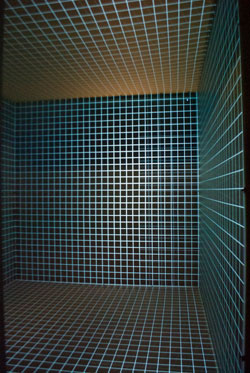 The DiVE is used by faculty and students from a large number of fields, including chemistry and biology to history and art. Recent uses have virtually reconstructed ancient Roman communities, as well as medieval towns.
Heather Liu, a rising senior double majoring in biomedical engineering and electrical and computing engineering described her experience as new and unusual.
“It’s an application of all the things you learn in class,” said Liu. “It’s good to see the application of engineering.”
DiVE is open to public use Tuesdays from 4 to 5 p.m. Space is limited. The DiVE welcomes students who are interested in getting involved in virtual reality development and research. Interested students should contact DiVE director Regis Kopper to learn more.
See the full story here: http://today.duke.edu/2015/06/divevisit
Jaunt unveils NEO, a high-end camera setup for virtual reality movies
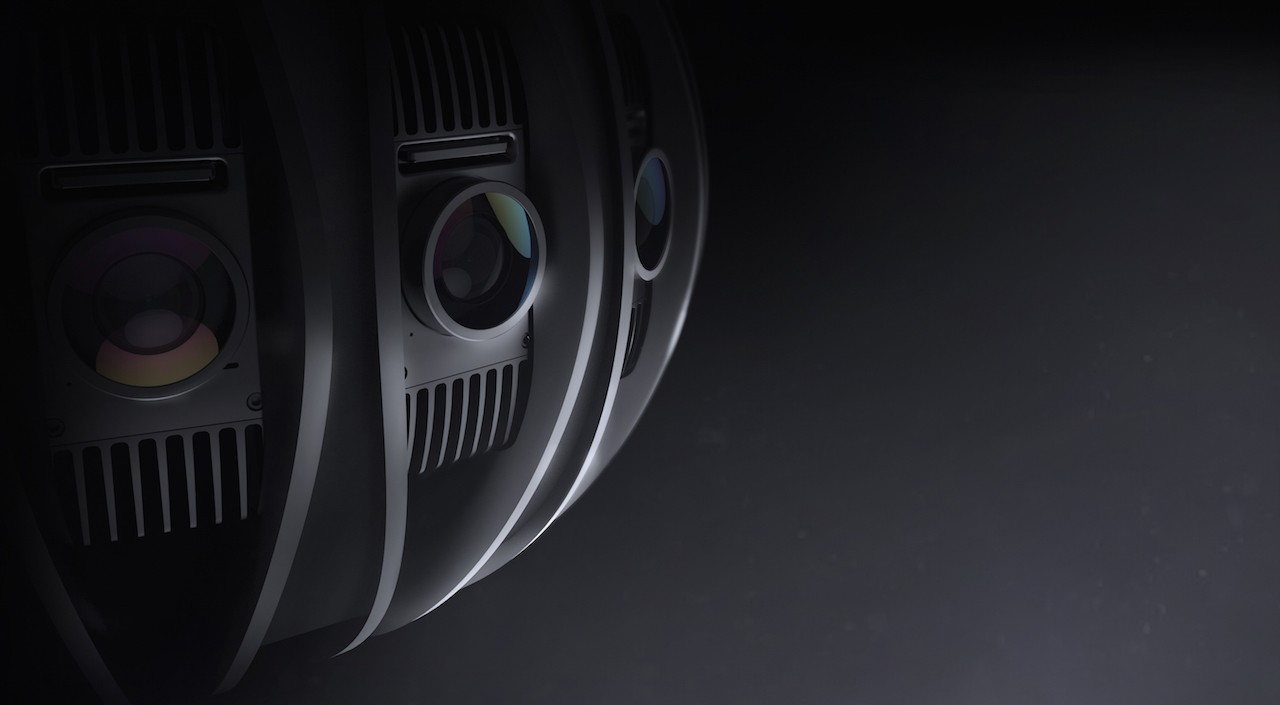 Jaunt has announced NEO; a professional-grade 360-degree VR camera system. Jaunt spent 2 ½ years on R&D to overcome the shortcomings of off-the-shelf VR camera solutions, including those built into previous Jaunt camera rigs. In their press release they say that “NEO is a flexible system that offers turn-on-and-shoot simplicity for capturing spontaneous events, while also providing full manual control for creatives to set up the perfect shot.” NEO system features include fully synchronized global shutter sensor array, HDR, large format sensors for superior low-light performance, and time-lapse and high frame-rate capture. “Every aspect of the NEO design… was engineered with cinematic VR capture in mind,” said Koji Gardiner, Director of Hardware Engineering at Jaunt. "The camera is a very bespoke camera, and it's going to be produced at low volume," says CTO Arthur van Hoff. In addition to the NEO camera series, Jaunt also engineered important improvements to their creative workflow. Jaunt Studios partners can edit VR content using tools such as Avid, Premiere, Final Cut Pro X, Nuke, RV, Shotgun, Maya, 3Ds Max, After Effects, DaVinci Resolve, Scratch, and Lustre. Jaunt will lease the NEO to Jaunt Studio partners starting in August.
The material for this story came from two urls;
http://www.jauntvr.com/neo-first-look/
http://www.theverge.com/2015/6/30/8867603/jaunt-neo-professional-virtual-reality-360-degree-video
“THE FUTURE UNIVERSE”: WHEN AUDIENCES ATTACK
A NEW GAME SHOW PITS IN-STUDIO CONTESTANTS AGAINST VIEWERS ARMED WITH MOBILE DEVICES AS WE INCH CLOSER TO THE RUNNING MAN.
The idea is that the game play will be a competition between handpicked, in-studio players geared up in motion-capture suits. They will be doing things like navigating an obstacle course, walking a balance beam, or chucking giant eggs into space in what the Future Group describes as an "Angry Birds-style" game—all while people around the world are playing the same game optimized for their stand-alone devices.
"Imagine people in the studio are driving Mario Karts through the streets [of a virtual] New York," Kasin says. "[The studio] audience would see them driving in Mario Karts. The at-home audience could be doing the same task [on their mobile devices], and if you do better or worse than them, you can see [the] people in the studio driving past you."
The Future Group’s idea is that each production company would be able to make choices about how the game is presented. Among them is whether mobile players would be going head-to-head with each other, or only against the studio contestants. Kasin says the TV networks will be able to choose, for example, if they want to create competitions between mobile players by geographical region or other criteria.
See the full story here: http://redef.com/item/5591f61adc4388066d32b46c?curator=MediaREDEF&source=http://www.fastcompany.com/3047887/the-future-universe-when-audiences-attack
Virtual Reality’s Real-World Obstacles (market research data)
See the full story here: http://www.wsj.com/articles/SB11363635366385803997104581072152536626720
Movie theaters branch out to host video game contests and other events
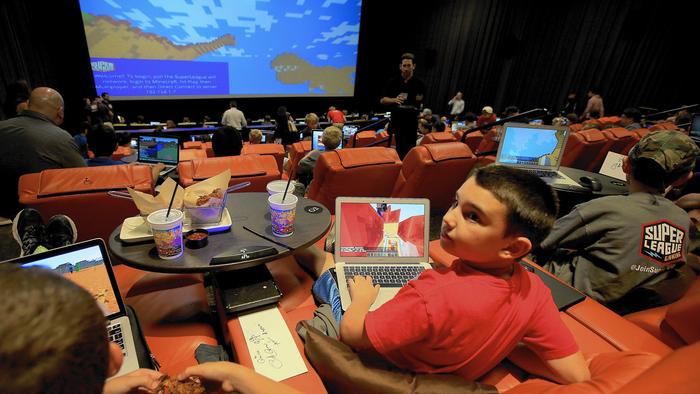 The 11-year-old wasn't at Westwood's iPic theater to catch a matinee screening of the summer blockbuster "Jurassic World." He and about 100 others filled the seats to play a video game called "Minecraft," where they built dinosaurs in a virtual world controlled from their laptops and simulcast on the big screen.
"I liked meeting people and playing 'Minecraft' with them," Solis said.
Start-ups including Super League Gaming, the Santa Monica company behind the "Minecraft" event, see in-theater gaming as similar to sports leagues.
The company was co-founded by John Miller, David Steigelfest and Brett Morris, who saw their children come home from school to play video games by themselves. They wanted to give their kids the same social experience that children who played outdoor sports like soccer or baseball had.
"We thought, if baseball has a Little League, why shouldn't kids who play video games have their own league?" Morris said. "Plus there's the competitive aspect to it, the thrill of playing to win."
Morris and his partners approached AMC, Regal and Cinemark about using their theaters to host a video game league that will run during six-week tournaments.
Participants at the iPic theater paid $20 each to participate in Wednesday's nearly two-hour video game session, with the ticket revenue split between the theater and Super League Gaming.
Theaters fill only about 16% of their seats during an average day, mainly because of very low turnout during weekday mornings and afternoons, according to Wunderlich Securities. So theaters see financial sense in essentially renting themselves out, especially since they don't have to bear much of the cost to host the events.
See the full story here: http://www.latimes.com/entertainment/envelope/cotown/la-et-ct-theaters-gaming-20150624-story.html
Virtual Reality Simulations Offer Potential for Breakthrough in Preventive Care
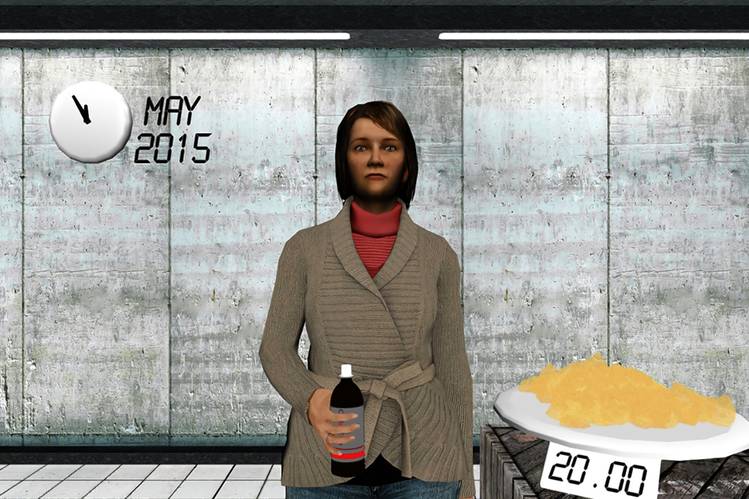 Everyone knows, in theory, that sugary soft drinks will make us fat.
But imagine watching a virtual-reality avatar of yourself sipping a soda. In the simulation, time flies by at super speed. With each sip, you see your hips and waist expanding. In the space of two minutes, you can see the effects of two years of accumulated globs of fat on your body.
This is just one example of how recent collaborations between health-care researchers and makers of virtual-reality simulations may promise a breakthrough in preventive care.
See the full story here: http://www.wsj.com/articles/virtual-reality-simulations-offer-potential-for-breakthrough-in-preventive-care-1435245358
State of VR (comprehensive update)
This is a lengthy article covering many aspects of VR.
 See the full story here: http://www.fxguide.com/featured/state-of-vr/