‘The Void’ is a VR Experience which Fuses Physical and Virtual Reality Environments
 See the full story here: http://www.roadtovr.com/the-void-is-a-vr-experience-which-fuses-physical-and-virtual-reality-environments/
VRCade and Survios are two leading names in the field of out-of-home, physical virtual reality entertainment experiences that promise to deliver both physical and mental immersion by allowing the player to roam (relatively) freely around a virtual environment using a physical space. In the case of those two systems, player position and movements are tracked in a room-scale arena (albeit a potentially large one) with the world around the player described predominantly through virtual reality.
The Void is a new startup based in Salt Lake City, Utah which claims to have gone some way in bridging the gap between physical and virtual worlds by building physical stages which match the virtual environment, then putting players inside.
The venture aims to provide Virtual Entertainment Centres (VECs) where people will go and immerse themselves in custom-built arenas (Gaming Pods), wearing untethered virtual reality headsets.
The system combines proprietary virtual reality headset technology, powered by a player-worn ‘backtop’ (a laptop in a backpack), room-scale tracking with input provided by virtual reality gloves with extra immersion added courtesy of a haptic vest.
The claimed initial specs for the Rapture HMD are:
- Dual High-Density Curved OLED Displays (1080p per-eye, initially)
- Quantum Dots (nearly doubling perceived resolution color range)
- Custom Optics (proprietary lens-in-lens design)
- High-Quality THX Headphones (featuring in-game binaural sound design)
- Super-Gain Inline Microphones (for in-game communications)
- Proprietary Global Head Tracking Sensors (running at 120Hz)
Players will also don a ‘Rapture Vest’, a haptic feedback device which the team claims to allow every virtual interaction to “…have its own hit point…” on the vest.
They also plan to incorporate data gloves...
With players entering ‘The Void’ being placed within specially constructed ‘stages’ (or Gaming Pods as the company calls them) and allowed to apparently move freely around the space, the question of tracking arises. The company claims to be able to offer “… the ability to track natural human body movement at an extremely accurate 1:1 ratio…,” although quite how this is achieved is as yet unclear.
The company is also working on smaller scale, Motion Simulators, which aim to provide a more traditional theme park style ‘sit in’ model, with up to two players wearing VR headsets and potentially “… swappable control devices providing for a variety of simulation experiences …” such as aircraft-dogfights, ground-transport, mech battles etc.
Virtual & Augmented Reality Summit Comes to Digital Hollywood
By Phil Lelyveld
Last week’s Digital Hollywood Spring event at the Ritz Carlton in Marina Del Rey featured a new track: a three-day Virtual & Augmented Reality Summit. Panels and sessions covered a wide range of topics — including cameras, software solutions, sound design, workflow, file management, and more — and demonstrated just how rapidly this new art form is evolving. GoPro’s acquisition of multi-GoPro spherical stitching software company Kolor was the big news. At the same time, VR producers say they are looking for better camera and stitching solutions.
The really low-end Ricoh 360 camera ($297 on Amazon) got mentioned often on the panels as an entry device for experimentation. Meanwhile, GoPro’s acquisition of Kolor, with its AutoPano stitching software, should result in stitching software improvements for low-end GoPro VR shoots.

Specular Theory, a VR production company, is using cameras with 180-degree lenses to minimize the stitching problem. Encouraging actors to stay away from the stitch lanes and to not come too close to the cameras is another way to minimize stitching workload and impact.
Christina Heller, co-founder and CEO of VR Playhouse, said that cameras and shooting are 25 percent of live VR production while post-production, including stitching the images from multiple cameras, is 75 percent of the time and work. Spend your money on computers and hard drives to process and store all the data, she said. You can rent the latest and most appropriate cameras and lenses from companies like Radiant Image. And file management is a huge production issue.
On the live-action capture side of VR, Aaron Thomen, who has shot NFL and NBA VR experiences with Two Bit Circus, said that fast camera motion is fine in VR as long as it is either smooth and serpentine without spin, or the viewer is sitting in a motion chair so their body moves with the camera.
Lucas Wilson of Supersphere Productions discussed how he shoots major sports events. He uses five 6K RED Dragons; one with a rectilinear lens capturing the primary area of interest for high resolution, and four with fisheye lenses capturing left, right, rear and up. Stitching them together into a continuous sphere, he said, is “interesting.” Everything in 3D VR now is a science project, he suggested. Getting the stereo and the parallax at the seams correct is very difficult.
I had the opportunity to discuss the difference between VR and AR, the concepts of emergent narrative and custom memories, and business model considerations, including niche markets and the minimum viable VR experience.
Andy Cochrane discussed how Mirada used its VR production pipeline to develop a virtual tour of a virtual Google store, integrating live actors with CGI environments. A video of that experience can be seen at the AWN site.
David Marlett (below), the VR filmmaker at Cinemersia, is working on “MansLaughter,” a VR film shot in four 90-degree quadrants. The four quadrants will playback simultaneously with coordinated overlapping dialog and choreographed action, similar to the “Sleep No More” and “Tamara” theatrical experiences.

Kara Fry, an actress in “MansLaughter,” said acting in VR is smoother than movie acting because you are playing to the moment in 14-minute scenes without cuts. It differs from theater acting in that you perform as if the cameras aren’t there, but you block the scene around the camera location points rather than a fourth wall.
Marlett added that the set designer has to get all of the details right because the audience can linger. He had to stock his gun shop set with real guns marked tagged with reasonable prices.
Chanel Summers, who teaches sound design at USC School of Cinematic Arts, pointed out that aesthetics can overpower technical errors. If the story is told well, sound design errors or shortcomings will be ignored. Nonny de la Pena’s sound design in her VR journalism pieces doesn’t vary as you walk around the environment, Summers noted, but the experience is still extremely powerful. Having said that, she enjoys developing sound designs that shift as the viewer moves through the space.
Chanel is currently working on a safe free-range (e.g. walking around) VR experience. She is also working with SCA’s Alex McDowell on the “Leviathan” project.
Regarding the expense of HMDs and VR peripherals, LOOT Entertainment’s Danilo Moura pointed out that serious gamers are not shy about paying $60 for a game. They will spend serious money for the promise of a quality experience.
Overall, the VR panels at Digital Hollywood covered a compelling range of topics. We plan to invite many of the panelists to future ETC VR/AR-related workshops and events.
See the original post here: http://www.etcentric.org/virtual-augmented-reality-summit-comes-to-digital-hollywood/
Immersive Storytelling Outside of Virtual Reality
 But one of the most immersive experiences at film festival’s “Storyscapes” event succeeded in transporting my mind to a different place by taking away my vision entirely. Instead of giving me a virtual reality headset, the “Door into the Dark” experience isolated me with a construction helmet, face-blocking visor and headphones.
But taking away my sight and taking control of my hearing was just one step toward focusing my brain on the storytelling that followed.
When I first blindly entered the main room, I followed a guide rope by running both hands over its fibrous surface as I listened to a story of how a blind man experienced his life through his other senses. At the end of the rope, a gentle audio narrator told me to let go of the rope and explore. I found it surprisingly difficult to obey at first, but eventually I abandoned the rope and stepped forward to encounter what felt like a fine mesh fabric strung up like a net. I pressed up against it and carefully felt my way along its length using my hands, ...
See the full story here: http://blogs.discovermagazine.com/lovesick-cyborg/2015/05/02/immersive-storytelling-outside-of-virtual-reality/#.VUbqXM5iBrg
Feelreal VR Mask
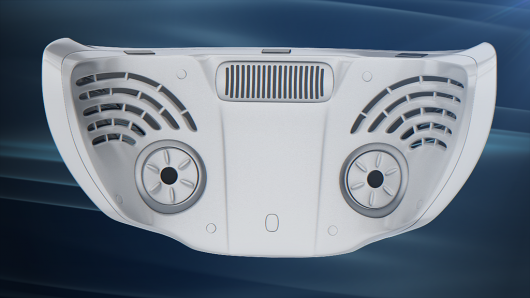 The Feelreal VR Mask fits somewhat awkwardly over the lower half of your face and optionally mounts to the bottom of a VR headset such as the Oculus Rift. The device includes an "odor generator" that takes seven removable "smell cartridges," which vaporize a mixture of perfumes to create an appropriate scent for the game you're playing or the movie you're watching.
The basic set of smells includes; jungle, flowers, ocean, burning rubber, fire, gunpowder, and aphrodisiacs. But Feelreal will be allowing orders of a number of other predesigned smells as well as custom-made smells for an additional $300 and can describe the smell in detail.
Wearily foldable phone-based VR on Kickstarter
Wearality, or at least a phone-based VR viewer with superior optics and wide field of view that folds down and fits in your pocket, is probably more likely to catch on than boxes like the Gear VR. See their kickstarter here: https://www.kickstarter.com/projects/wearality/wearality-sky-limitless-vr
See the story here: http://vrscout.com/projects/let-wearality-sky-open-your-eyes/

Ex-Lucasfilm Veterans Join with Jaunt VR to Form ‘Jaunt Studios’ to Create Cinematic VR Content
 Jaunt VR have today announced they’re launching ‘Jaunt Studios’, a venture dedicated to producing immersive cinematic experiences for virtual reality. The new studio will comprise veteran movie makers from the likes of Lucasfilm, ILM and Digital Domain and it will be dedicated entirely to the production of VR related content.
Heading up the new studio is Cliff Plumer, former CEO of effects house Digital Domain, CTO of Lucasfilm and the legendary Industrial Light & Magic. Joining Plumer as Chief Business Officer is former COO and General Counsel of Lucasfilm, David Anderman. Finally, Miles Perkins joins as VP of Marketing Communications – another Lucasfilm and ILM veteran with over 20 years service at the firm.
The first project out of the Jaunt Studios gates will be a collaboration with Condé Nast Entertainment (CNÉ), publishers of GQ, Vogue, Wired and Vanity Fair. The project comprises 2 virtual reality series focusing on CNE’s wide portfolio of travel, lifestyle, fashion, sports, and technology content. It’s not yet clear exactly what form these productions will take, be it infotainment, commercially focused or documentary.
Jaunt have thus far adopted a platform agnostic approach to delivering their content, with experiences available on Samsung’s Gear VR, Google Cardboard, Oculus Rift and more recently, IOS devices. Issues remain in the area surrounding IPD and stitching artifacts however, meaning some content was perhaps not received as positively as it might.
See the full story here: http://www.roadtovr.com/lucasfilm-veterans-join-with-jaunt-vr-to-form-jaunt-studios-to-work-on-cinematic-vr-content/