Virtual Reality Named Next Mega Tech Theme by Piper Jaffray
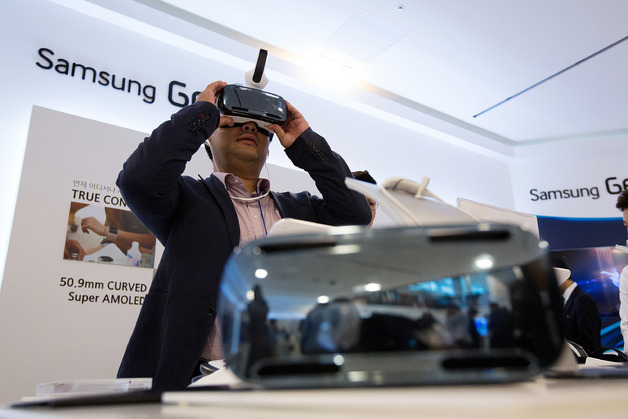 Virtual reality headsets and content will be “the next mega tech theme” and a market worth more than $60 billion in a decade, according to Piper Jaffray Cos.
“The diverse applications of VR in combination with accelerating technological improvements will lead to mainstream adoption over the next 10 years,” Piper Jaffray analysts including Gene Munster and Erinn Murphy wrote in a May report.
Because keyboard and mouse input isn’t optimal for use with VR goggles, there will be a new market for peripheral devices that bring users’ hands and feet into virtual reality, according to Piper Jaffray. Haptic devices that give physical feedback from interactions in virtual space will follow.
Gaming will be the first application, because of a user base that already owns PCs and consoles powerful enough to handle VR content, according to the report. Content will expand to include courtside seats at a basketball game, 360-degree movies and professional applications from hospitals to courtrooms.
Oculus buys Surreal Vision, letting company make virtual reality worlds out of the real one
[Philip Lelyveld note: put another way, Oculus buys an AR company.]
Oculus Rift has bought British company Surreal Vision, leading to hopes that the two companies might develop kit that allows for virtual reality versions of the real world.
Many other companies that are working on virtual reality, like Microsoft, have developed ways that their headsets can see the real world, map it, and then place it in the virtual reality one. That means that digital images can be laid on top of real ones, such as putting putting a Facebook wall onto a real one.
Such uses for the technology has been demonstrated by one of those involved in the company. Surreal Vision was founded by three researchers from Imperial College London.
Tackling Tech: Why Virtual Reality Will Become Reality for the NFL
 Determining if VR use by QBs definitely improves their play is a high priority. Calling VR a ‘game changer' before it's gotten into the pro football game is premature as were the original hype of being the next big mainstream tech thing decades ago.
Introducing a tech-driven means to improve some aspects of the NFL takes time and needs to be embraced by "old school" coaches, but it can be done. Who expected to see tablets computers used on the sidelines during games to review plays using video?
See the full story here: http://www.patriots.com/news/2015/05/28/tackling-tech-why-virtual-reality-will-become-reality-nfl
GoPro Working On A VR Camera Array And Quadcopter Drone
 Today, GoPro announced that it was working on an array that combines six GoPro Hero cameras for spherical shots all at once. CEO Nick Woodman says that when Facebook bought Oculus, the ‘gauntlet was dropped’ and GoPro started work on a spherical setup that could generate content for virtual reality and augmented reality systems.
Woodman also said that the company has software in ‘alpha’ right now inside the company that allows users to auto-sync their GoPro cameras to the cloud so they can access their footage. This is still in the ‘early stages,’ Woodman said, but this would theoretically allow people to view and edit without ever “having to touch an SD card or touch a USB cord.
The company is also working on a quadcopter drone for aerial photography using GoPro cameras.
The array will be available in the second half of 2015. “This is really going to be most appealing for production companies and prosumers,” said Woodman. He added that ‘normal’ people would definitely end up buying it but the first version would be for pros. GoPro envisions this mount capturing video for VR and AR systems such as Oculus, HoloLens, Cardboard and YouTube 360 videos.
Oculus Story Studio Explores Ways to Make VR More Social
 “Essentially, this allows two viewers (or more), each wearing an Oculus headset, to be a part of the same world and explore it simultaneously. In the case of ‘Lost Director’s Cut,’ the person giving the demo and I were both fireflies in the movie; we could look at each other or fly closer toward one another, all while a scene was taking place next to us. It’s breathtaking and weird at the same time, and that’s a good thing.”
According to Edward Saatchi, a Story Studio producer, “We think the future of VR in cinema is social, that you’re with your friends. You’re not in the same room, maybe; maybe you’re all going in together at the same time, and that’s where the lines between cinema and an MMO [massive multiplayer online] start to blur.”
See the full story here: http://www.etcentric.org/oculus-story-studio-explores-ways-to-make-vr-more-social/
Original post here: http://www.engadget.com/2015/05/25/oculus-social-experience/
Retinad’s Promising VR Ad and Analytics System is Now Backed with a $500,000 Investment
 Retinad, a company working to bring immersive advertising and analytics to virtual reality, has just closed a $500,000 early-stage round to bring their solution to market. Avoiding the worst case banner-in-your-face approach, the company is jumping feet first into VR, bringing immersive (but not invasive) pre-roll ads and useful analytics tools that could be a hit with developers and advertisers alike.
The company is primarily pitching a ‘pre-roll’ approach which presents users with an immersive advertisement at the start of the VR game or experience. That ad can be a 360 video or photo, and it includes gaze-based action-points for user interaction like Skip, Like, and More Info.
Analytics
One of the features I found most compelling about Retinad’s system was their analytic heat maps which allow advertisers to see visually where users’ attention is drawn to throughout the course of the ad.
See the full story here: http://www.roadtovr.com/retinads-promising-vr-ad-and-analytics-system-is-now-backed-with-a-500000-investment/
PATENTS SHOWS WIDESPREAD AUGMENTED REALITY INNOVATION
 We recently took another look at the companies that are actively patenting in this space, and identified over 2,300 US patents with claims related to AR and HMD platforms and devices. These patents cover a broad array of technologies specific to the augmented reality space, from display hardware and semiconductors, to software that drives image processing, network connectivity, and personalized content delivery.
Microvision Inc. topped our list as the largest US patent holder in this space, owning 233 US patents primarily related to hardware components for augmented reality systems, with a focus on miniaturized MEMS and PICO level systems.
Semiconductor Energy Laboratory Co. follows with over 200 US patents. The majority of its patents are directed towards semiconductor-level technologies for displays and imaging substrates.
Google is the next largest patent holder that we identified, with 117 US patents covering various physical hardware devices and related components, and software related to image-based user interfaces, user input technologies, and other user-experience applications.
Canon, LG Electronics, Sony, Microsoft, IBM, Siemens, and Samsung are also significant patent owners in this space. Other large companies which have a smaller number of issued US patents (<20) related to AR and HMD technology are Intel, Nokia, Apple, Qualcomm, Sharp, Panasonic and GE, defense contractors Lockheed, Boeing, Rockwell Collins and Raytheon, automotive manufacturers Ford and Honda, and entertainment giant Disney.
See the full story here: http://patentvue.com/2015/05/26/patents-shows-widespread-augmented-reality-innovation/