Welcome to the new VR
Philip Lelyveld summary:
 The author of this article, Beau Cronin, recognizes that VR is in the process of transforming from a specialty technology where innovation is driven by small groups of experts, to a general-purpose technology that will tap into a huge, broader market of users and hackers. He postulates that VR today is where the internet was in 1993; just before Netscape. At that time there was a re-evaluation of all the rules; often done by outsiders. Some elements were set aside as better solutions emerged (table-based page layouts gave way to CSS), while others were left intact for good reasons but later suffer from unintended consequences (easily spooked “From: addresses” in email). Simple numbers dictate that most of the innovations will come from newcomers, and not the VR “lifers” who currently dominate the field. He sees the Oculus Rift as the transformative platform; the “Crossing the Chasm” device. He wonders how standards will evolve; will they be extensions of existing standards, will new standards efforts be initiated, or will major players open up their platforms enough so formal standards will not be necessary. Finally, he notes that Oculus recently pivoted from supporting VR game app development to funding narrative VR entertainment. What the killer app for VR will be is anyone’s guess. “VR is at that thrilling fleeting moment when its imminent arrival seems assured, and yet every important question about the shape and nature of its adoption and socioeconomic impact remains unanswered.”
Read the full article here: http://radar.oreilly.com/2015/03/welcome-to-the-new-vr.html#
Breakthrough for Augmented Reality? – Route-n-Fuel app
 This all sounds highly practical – except for the fact that German law forbids people from operating their cellphones while driving a car. Legally speaking, apps like Route-n-Fuel cannot be used by the driver. And stopping often to check the display is of course out of the question. Inventive minds from across the globe however have come up with a solution – augmented reality (AR), i.e. the use of digital technology to widen our perception of reality. In the automotive scenario this means using a "head-up display", one which projects the relevant information onto the windshield. Among other carmakers, BMW is offering this feature in its latest 3 series and Mercedes in its C series cars.
See the full story here; http://www.cebit.de/en/news-trends/trends/internet-of-things/article/breakthrough-for-augmented-reality.xhtml
Hollywood looks to bring virtual-reality cinema to life
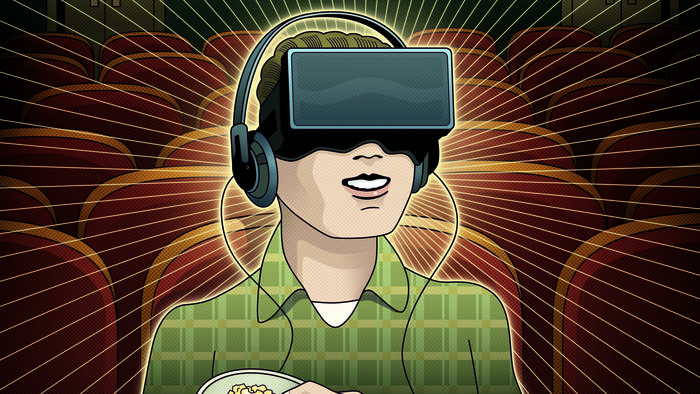 Buried deep inside the postproduction facilities on the 20th Century Fox lot, beyond where executives decide how best to sharpen Wolverine's claw and make Alvin sound like a chipmunk, sits a space with a more mysterious purpose.
Filled with multiple screens and piles of headsets, it is here that a select few executives, including the official Fox "futurist" Ted Schilowitz, are investigating all manner of digital possibilities. The area is called the Fox Innovation Lab, though it's informally known simply as "The Bunker."
Read the full story here: http://www.latimes.com/entertainment/la-et-mn-ca-vr-future-virtual-reality-cinema-20150308-story.html#page=2
With $45 Million In Funding, Augmented Reality Platform Blippar Is Rethinking Search
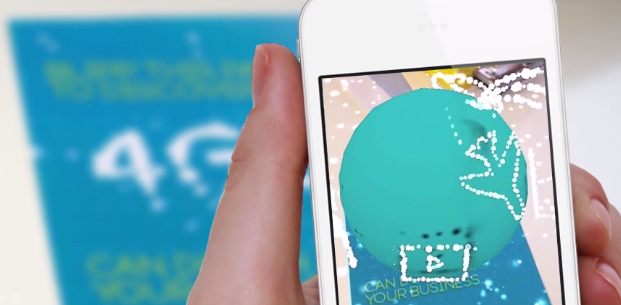 Blippar, an augmented reality ad platform that uses real-world tags to deliver extra AR content in offline situations, has raised $45 million in new funding from undisclosed investors. This comes on the heels of a big 2014 for UK-based Blippar, wherein the company made its first acquisition by purchasing Layar in June. Combined, the merged companies boast over 50 million global users.
With the new version of Blippar (which doesn’t require real-world markers), users would ideally be able to point their camera at any object (like an apple or a red dress) and instantly see all of the extra information around it, like a purchasing page or a conversation around that object on Twitter or Instagram or videos on YouTube.
Obviously, the system won’t simply change overnight. Blippar is unveiling its latest technology next week at SXSW and will start in a few verticals, including Movies, Music, Books (fiction) and US-based sports teams, and expand into new verticals on a “week-by-week basis.”
See the full story here: http://techcrunch.com/2015/03/06/with-45-million-in-funding-augmented-reality-platform-blippar-is-rethinking-search/#tmhmdj:nUJC
Suddenly, everyone’s making computers you strap to your face. Here’s a rundown of all the big players.
 Here is a good brief overview article of Vive VR, Oculus Rift, Gear VR, Hololens, Magic Leap, Project Morpheus, and Google Glass.
How Disney Thinks About Virtual Reality For Its Theme Parks
 Yang says that one major advantage to the cave approach is that it cuts down on the number of factors that can lead to motion sickness while you’re in the virtual reality experience. Instead of implementing stereoscopic 3D effects, Disney is able to use motion tracking to draw 2D images that look like they have depth — like the Amazon Fire Phone’s “dynamic perspective,” but at a much larger scale.
...Through years of testing these experiences, the team learned tricks for further reducing motion sickness, like not allowing the ride and screen to simulate the zero-point turns common in first-person shooters (and therefore, most early VR experiences) because most humans aren’t actually comfortable with constantly looking left and right without accommodating the change with a slight movement of the rest of their body.
...in the Q/A session after the main keynote, Yang said that the team is working on a more generalized version of this advanced cave system that could be used for multiple experiences and walk-through attractions.
See the full story here: http://techcrunch.com/2015/03/05/how-disney-thinks-about-virtual-reality-for-its-theme-parks/
Razer updates OSVR virtual reality headset
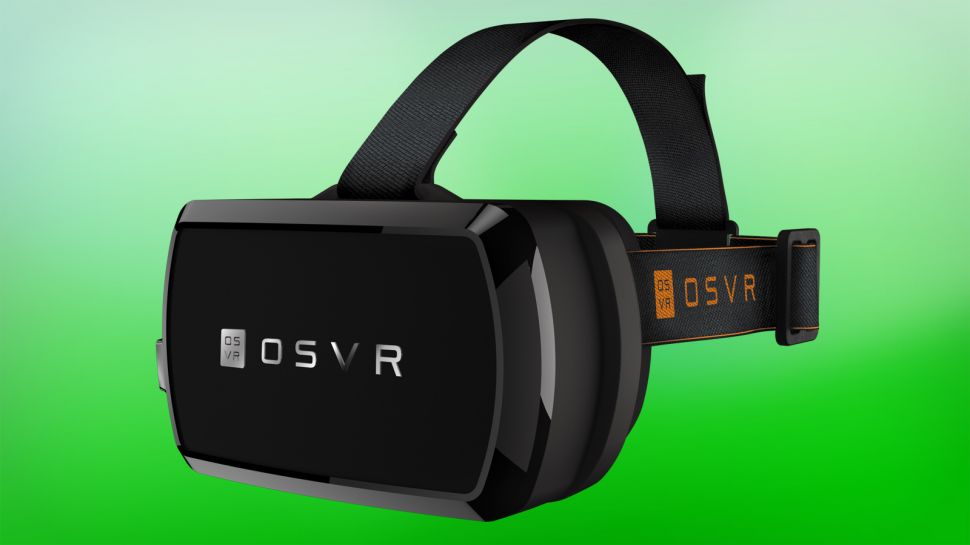 The OSVR Hacker Development Kit v1.1 will say goodbye to the IPS panel and now boast a full HD OLED display for lower latency and higher contrast.
The optical mechanics have also been improved for easier adjustments which is a relief since the first kit didn't work as well as the Samsung Gear VR's diopter.
New faceplates are now an option as well for the hacker dev kit. Whether it's for branding customization or for functional purposes - like utilizing modules for positional tracking - will be up to you, if you plan on using Razer's tech to develop your own VR headset.
Razer's Chris Mitchell also told us that the price for the OSVR HDK will remain the same at $199 (about £130,AU$246) and should start shipping in June 2015. The hardware might even be updated again before it ships out.
Though still in the alpha stage, the Open Source Virtual Reality platform has been upgraded as well.
There's now an Unreal Engine 4 plugin, imager interface to allow video streams such as those from color cameras, IR cameras and depth sensors to allow functions such as positional tracking, eye tracking, SLAM, face recognition and augmented reality. Also included in the update, a distortionizer tool that allows estimating the optical and chromatic distortion of HMDs and a shader that uses the measured parameters to correct such distortion.
Ubisoft has thrown its hat into the ring and joined the OSVR platform, as well as Vuzix, Stompz, Seven Hills Games, Seebright, Inc., Aesthetic Interactive, ARCortex, castAR, Godhead VR, Homido, Hydra Interactive Entertainment, Mindfield Games Ltd.
See the full story here: http://www.techradar.com/us/news/wearables/razer-updates-osvr-virtual-reality-headset-1286822