First Quantum Music Composition Unveiled
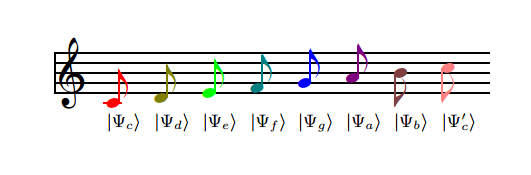 They begin by thinking of the seven notes in a quantum octave as independent events whose probabilities add up to one. In this scenario, quantum music can be represented by a mathematical structure known as a seven-dimensional Hilbert space.
A pure quantum musical state would then be made up of a linear combination of the seven notes with a specific probability associated with each. And a quantum melody would be the evolution of such a state over time.
An audience listening to such a melody would have a bizarre experience. In the classical world, every member of the audience hears the same sequence of notes. But when a quantum musical state is observed, it can collapse into any one of the notes that make it up.
And since this process is random for all observer, the resulting note will not be the same for each member of the audience.
The researchers go on to discuss the strange quantum phenomenon of entanglement in the context of music. Entanglement is the deep connection between quantum objects that share the same existence even though they may be in different parts of the universe. So a measurement on one immediately influences the other, regardless of the distance between them.
There is one obvious problem, however. Nobody knows how to create quantum music or how a human might be able to experience it. Svozil and Putz’s work is entirely theoretical.