Samsung announces Project Beyond, a 360-degree 3D camera that creates virtual reality worlds
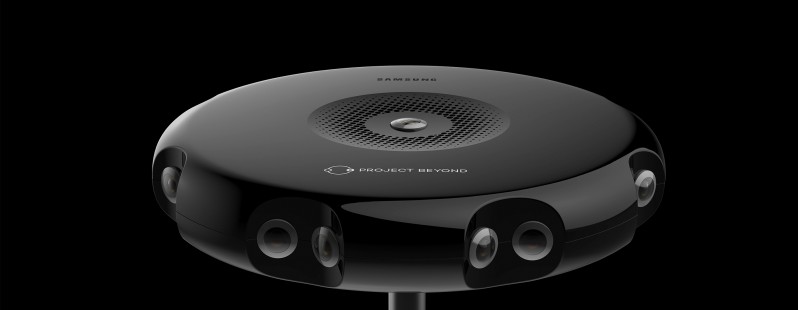 Samsung just announced Project Beyond at its 2014 Developer Conference — it's a 360-degree camera module that captures everything around it in 3D. It captures a gigapixel of 3D footage every second, and can stream that footage back to someone wearing Samsung's Gear VR headset, essentially transporting them into that world. Essentially, Project Beyond continuously creates a virtual 3D environment of wherever it is placed — Samsung said people would be able to tune in live or record footage to be viewed at any time. In a lot of ways it feels like the cameras seen on a Google Street View backpack, but much smaller and more portable. It's otherwise a pretty unique (and surely expensive) piece of hardware.
Naturally, your instinct is to step forward and explore the world, but Project Beyond is a stationary camera. You can see what the camera sees from the place it was set down, and no more.
The quality of the video itself wasn't quite as impressive as I was hoping for, either — it's noisier and grainer than I expected, given the relatively high resolution output of the Gear VR headset.
Virtual Reality Aims for the Mobile Phone
 [Philip Lelyveld comment: The point that 'this' technology must articulate why it is valuable, useful, and important soon, or it will die from the over-hype before it is established, was also said about 3D TV. Its deja vu all over again.]
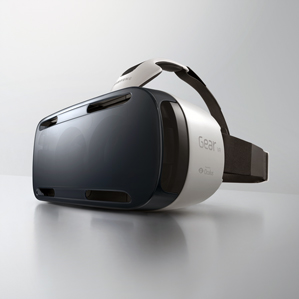
A smartphone-based virtual reality headset from Samsung and Oculus VR could make the technology more accessible, but it also demonstrates a new set of challenges.
Max Cohen, head of mobile at Oculus VR, the virtual reality startup bought by Facebook this year for $2 billion, is unequivocal: the dominant way most consumers will experience virtual reality will be on mobile devices.
“PCs and dedicated machines will always have more power, but at some point, graphics become ‘good enough’ on a mobile device and none of that matters anymore,” Cohen says. “Will it be in two years’ time? Five years? Ten? I don’t know. But it will happen. You can’t surpass the beauty of being untethered.”
The resurgence of the technology—more than two decades after the initial virtual reality rush of the late 1980s—is being driven in part by the giddy excitement of enthusiasts. The shift to mobile VR may be happening before the true value of the technology has been established. There are many interesting games and applications in development, but nothing that demonstrates VR’s necessity, or why it should propagate to new platforms with such urgency. Gear VR’s challenge is to not only clear the technological hurdles but also demonstrate the broader usefulness of immersive virtual worlds.
Proto Award Winning ‘Synthesis Universe’ Teases Breathtaking Visuals – Hands-On
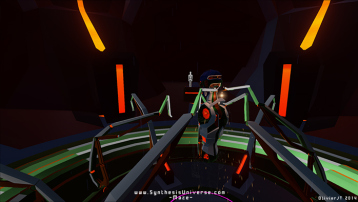 Synthesis Universe is a rare thing, a virtual reality game which has been in development for over 3 years. Paul James goes hands-on with the neon infused, futuristic teaser experience for the Oculus Rift DK2 and comes away wanting more. Much more.
Tron Lives
To compare the look and feel of Synthesis Universe directly to Tron is perhaps to do it a disservice. But as a child of the 80′s and a movie geek, this was the overriding visual impression the first few moments in SU’s world left me with. Like the 80′s Disney classic, the world of SU is comprised of grayscale, punctuated with dazzling streaks of colour. It’s an arresting aesthetic and one that works very well in virtual reality and in particular on the Oculus Rift DK2. Vibrant colours and bottomless blacks are OLED’s forte.
The teaser experience itself, subtitled ‘- Maze -’, is just that, there is no gameplay in the demo at all, merely suggestions and hints as to what’s in store. Whilst ‘playing’, Olivier recommends players stand to enhance immersion, so I did. The demo starts start in an antechamber, you’re viewpoint is surrounded by very busy looking mechanical arms.
As you whirl your head around looking for some context as to where or what you are, you quickly come to the realisation you’re not actually ‘there’ at all just yet. That is, your body and head are being constructed around your virtual viewpoint as you watch. As you look down, you acquire arms, legs torso and (somewhat disconcertingly), eyes and a head. All the while, pulsating electronic music beats in time with the rhythmic glow of the lights in front of you. I have to draw more parallels with regards to the music too. It has the dark, brooding and expansive sound that recalls the soundtrack to Tron: Legacy, one of the finest movie scores in recent years. From the off, it’s clear both colour and music will play key roles in the game proper.
Award Winning Even Before Release
There’s no doubt that, despite its obvious influences, Synthesis Universe has a visual flavour all its own. Styling is like a crazy mash-up of Tron and Jet Set Radio. It’s easy to see why the judges of the recent inaugural Proto Awards, bestowed Oliver JT with the honour of ‘Best Art Direction’ – beating our such leading lights as Darknet, Xing and Technolust. In many ways it’s a game which belong in VR, and yet currently the game (largely complete according to Olivier) awaits two crucial pieces of hardware: A commercial VR Headset (i.e. Oculus Rift CV1) and a suitably accurate VR Input device (Sixence STEM, whatever Oculus are working on), neither of which we have even the vaguest of release dates as yet.
See the full story here: http://www.roadtovr.com/proto-award-winning-synthesis-universe-teases-breathtaking-visuals-hands/
Avegant Closes $9.37 Million Series A, Final HMD Design to Be Shown at CES 2015
 [Philip Lelyveld comment. This is one way to back-door consumer acceptance - headphones plus...]
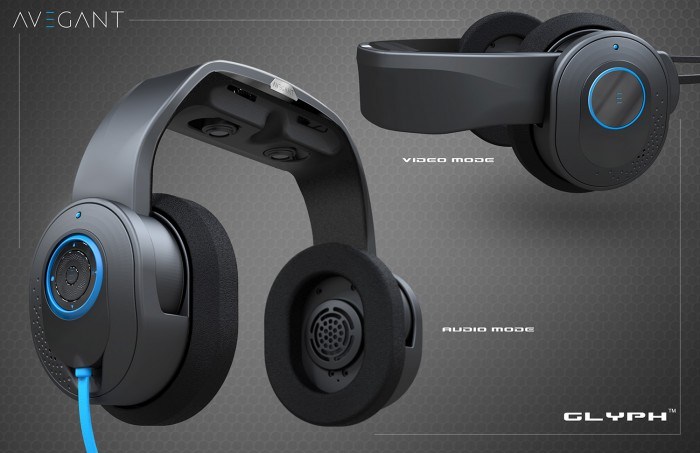
Avegant’s Glyph is a head mounted display which is embedded into a pair of over-ear headphones. The Glyph’s headphone band can be swiveled down to position what the company calls a “virtual retinal display” in front of the user’s eyes. With a field of view around 45 degrees, the Glyph doesn’t quite fall into the category of ‘VR headset’, but its unique display technology and portable form-factor make the Glyph worth tracking. The company has said previously that their display technology, which utilizes a micro-mirror array, could be adapted to a wider field of view for use with VR.
See the full story here: http://www.roadtovr.com/avegant-glyph-hmd-investment-series-a-intel-capital-nhn-snoop-dogg/
Samsung Gear VR Gets Positional Tracking Via Sixense STEM, Announced at SFVR
 Sixense’s Rubin went on to detail the company’s success with not only getting STEM tracking modules working with Gear VR, but claimed that they’ve managed to achieve around 7.5ms latency between STEM and the Note 4 via Bluetooth. This figure is impressively close to the company’s ‘full fat’ PC targeted system, which touts 4.2ms of latency. To bolster these claims and to cement the company’s dedication to Gear VR, the STEM systems due to ship next month to Kickstarter backers around the world will be delivered with Android support, allowing Gear VR developers to get right on creating STEM based Gear VR applications.
 Although Rubin claims the STEM pairing is restricted currently to just one STEM pack, it means that right now applications can be built that leverage’s the freedom this advancement enables. Gear VR is already a tantalising prospect as a wireless VR headset, anyone who’s used the Oculus Rift will know that cables are an impediment to immersion. So now you can move around VR spaces unfettered and with positional tracking.
See the full story here: http://www.roadtovr.com/samsung-gear-vr-gets-positional-tracking-via-stem-demod-sfvr-video/
Hands-on with Fove’s First Eye-tracking HMD Prototype
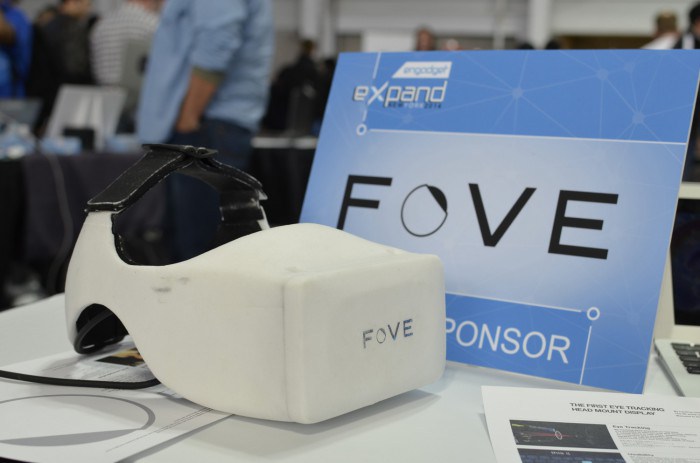 [Philip Lelyveld note: at the recent ETC Digital Town Square on Virtual Reality, I asked if there were any tools on the market to track eye motion in VR so artists could learn how to guide attention. This is a prototype of a potential solution.]
At Engadget Expand I met with Fove’s CEO, Yuka Kojima, who showed me the company’s first prototype head mounted display. Right now it consists of a lightweight foam housing, two lenses, and two small cameras, on the left and right of the lenses, pointed at each eye. I wasn’t allowed to snap a photo of the inside of the headset, but it appears they’re using all off-the-shelf components in this prototype. The lens and micro display assembly appeared to be torn out of a Sony HMZ headset. The infrared cameras on the left and right had fairly wide angle lenses and are probably taken out of a consumer gesture camera.
The next demo was closer to the applications that eye-tracking would be most useful for—gaze-based focus and character interaction. In the next scene I was standing in front of a virtual character in an open field. When I glanced at the background, the foreground blurred. When I glanced at the character, she smiled and came into focus while the background blurred.
The same mechanics could be used for foveated rendering, where the image is only rendered in high fidelity at the very center of the eye, while areas further away from that point are rendered with lower quality to reduce the computing power needed to render the scene (as we only see sharply in a very small area). This may be necessary to push framerates in virtual reality to 90 FPS or more, which is what Oculus believes is necessary.
All in all, Fove’s tech works well as a proof of concept.
See the full story here: http://www.roadtovr.com/hands-fove-eye-tracking-hmd-kickstarter-coming-march/
Technicolor’s Rennes Research & Innovation Lab Summons High-Tech Future
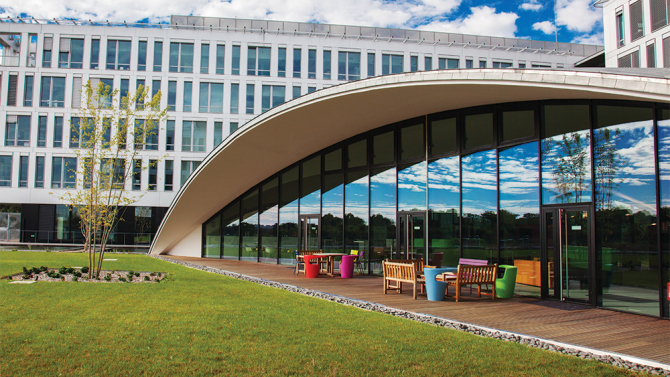 The virtual reality room, where work around visual effects is done, has that crazy-scientists-at-work feel. Among the advanced tech tools developed there is Interactive on-set PreviZ, a prototype augmented-reality plug-in for Maya delivering real-time image compositing and rendering during shooting, haptic feedback for actors, depth-maps for 3D and more, all in a single software package.
The Rennes lab is working on tech for consumers, too. One eye-opening experiment: The Immersive Experience, used to enhance movies, combines 360-degree stereoscopic video, 3D audio (sounds that seem to emanate from specific points in space, no matter how they’re played back), haptic feedback (which engages the sense of touch) and augmented reality.
“End users today have a real appetite to get effects and augmented reality into the content they consume, so we are going to see more and more professional and consumer technology blending together,” says Cristina Gomila, head of the Rennes hub.
The Rennes lab is also been focusing on “the Internet of things” — specifically, connected home services. Among its innovations: Ultra HD 4K set-top boxes which deliver more pixels, a high-dynamic range (HDR) and 3D audio technology simulating a 5.1 sound ambiance with a simple pair of speakers Although basic HDR is already available on iPhones, Rahier said the HDR technology which will soon be standardized will better handle contrast and will be combined with 4K.
See the full story here: http://variety.com/2014/film/news/technicolors-rennes-research-innovation-lab-summons-high-tech-future-1201346615/