Sony’s Google Glass rival will go on sale by the end of March
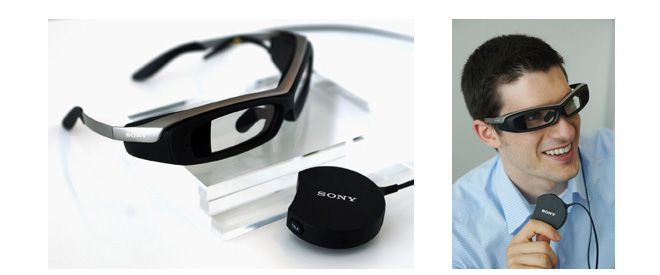 The rather awkward-looking SmartEyeglass is peppered with sensors — there's an accelerometer, gyroscope, electronic compass, ambient light sensor, and a 3-megapixel camera — and comes with a wire connecting it to an external battery pack equipped with an extra touch sensor and microphone.
Sony is releasing the software development kit for SmartEyeglass today and promises to have hardware kits available for developers to buy by the end of March. Other than the battery setup, the key difference between this heads-up display and Glass is that Sony uses a green monochrome display to overlay information atop the user's general view. SmartEyeglass will work in sync with compatible Android handsets to provide the wearer with notifications and other useful information like navigation directions. The Japanese company is now keen to recruit augmented reality devs who can start to provide SmartEyeglass with more and better functionality as it looks to progress beyond the concept stage.
See the full story here: http://www.theverge.com/2014/9/19/6483343/sony-smarteyeglass-sdk-and-dev-release-date
Failed Video Game Underlines the Perils of Using Kickstarter
 “The prototype was technically innovative, but it wasn’t very fun to play,” he said. “I probably focused too much on historical accuracy and not enough on making it sufficiently fun to attract additional investment.”
“Clang” received mixed reviews from its backers. Some demanded a refund, while others understood that they invested their money with knowledge of the risk. Crowdfunding sites rely on backers interested in putting money into project development, not necessarily investing in the traditional sense. And Kickstarter does not guarantee compensation.
See the full story here: http://qz.com/268852/neal-stephensons-failed-500000-video-game-and-the-perils-of-using-kickstarter/
Temp Post – Des Moines Register Adds a Bit of Virtual Reality to News Report
Newspaper Incorporates Technology of Oculus VR, Computerized Game Platforms to Tell Story

The Des Moines Register is using Oculus technology to enhance a story about a farming family adjusting to the globalization of agribusiness. Above, members of the Total Cinema 360 team shoot video for the Des Moines Register's virtual-reality news report. The Des Moines Register
If you've ever wanted to really get inside a news story, the Des Moines Register thinks it has the answer.
On Monday, the Gannett Co. GCI -1.70% -owned newspaper will publish its first virtual-reality news report, incorporating the technology of Oculus VR, computerized game platforms and 360-degree cameras. The report tells the story of how a sixth-generation Iowa farming family is struggling to maintain its traditions in an increasingly globalized world of agribusiness.
"We have tried to create a fully immersive news experience," said Anthony DeBarros, the director of interactive applications at Gannett's digital unit.
Last week, Gannett gave a preview of the virtual-reality news report. It includes familiar elements, such as a written article, photos and straightforward video. But it also takes a viewer into a computerized world of cows, soybeans and grain silos that gives the feeling you're roaming around a farm in Page County, Iowa.
After strapping on Oculus's virtual-reality headset, viewers can explore the farm grounds and interact with 3-D data graphics to learn more about the Dammann family and how demographic and economic changes have affected their lives. For example, viewers can walk up to the family's machine shop and click an icon that places them inside a 3-D video feature about maintaining high-tech farming equipment.

The virtual reality world you can explore through Oculus technology in one of the stories the Des Moines Register has produced. Gannett Digital
The report's nonlinear approach—users can view the information in any order—will feel familiar to videogame enthusiasts. For those who don't own an Oculus helmet, the feature will be available in a 2-D format that can be run on any computer. There are currently only 125,000 Oculus Rift headsets in circulation.
The effort comes amid a relentless push by traditional news organizations to add new multimedia dimensions to their storytelling as they try to woo online readers. The New York Times won a Pulitzer Prize last year for its 2012 "Snow Fall" feature about an avalanche in Washington's Cascades, which blended video, rich graphics, photos and text. Other organizations including the Guardian and The Wall Street Journal have created similarly ambitious works.
Previous Coverage
Mr. DeBarros says Oculus can be the next big innovation for newsrooms. "It is equal parts a journalistic endeavor and R&D effort," he says.
Beyond using the Oculus technology to advance storytelling, he says, Gannett also could sell ads to run within the virtual environment. The company may apply the various technologies used to produce the farm report in other articles at the 81 newspapers it owns, he said.
There are some reasons to be skeptical of the effort. For one thing, the technology is still in prototype phase. Facebook Inc. FB -1.42% recently paid $2 billion to buy the virtual-reality headset maker, but it isn't clear whether the technology will find an audience beyond the hard-core game community.
Roy Peter Clark, a senior scholar at the Poynter Institute, says new digital elements can enhance reporting, but they can't replace the value of strong narrative storytelling.
"Although we call it multimedia, most of these stories are hybrids that use the visual elements to amplify the underlying narrative," he says. "You can take a virtual tour of a building where an event occurred but that is a different thing than having characters who are fully explained."
Gannett includes a warning at the beginning of the report that virtual-reality technology can cause dizziness, as it did for this reporter. Oculus says it has been addressing the problem with better screens and software and promises that the next generation of the technology will have other improvements.
Mitch Gelman, Gannett's vice president for product development, says he sees plenty of applications for the new technologies the company is experimenting with. If a 360-degree camera were used at the protests in Ferguson, Mo., last month, for example, it could have given viewers the feeling they were in the middle of it all. Putting readers on the battlefield in Syria could have a much more visceral effect than a 2,500-word feature article, he says.
Messrs. DeBarros and Gelman said the costs of developing the reporting methods were fairly low, since the game technology at its core is inexpensive and is well established, so there is no shortage of programmers familiar with it.
"For journalists to make the leap to building in this environment is not such a big step anymore," Mr. Gelman said.
Write to Lukas I. Alpert at lukas.alpert@wsj.com
Des Moines Register Adds a Bit of Virtual Reality to News Report


Newspaper Incorporates Technology of Oculus VR, Computerized Game Platforms to Tell Story
Last week, Gannett gave a preview of the virtual-reality news report. It includes familiar elements, such as a written article, photos and straightforward video. But it also takes a viewer into a computerized world of cows, soybeans and grain silos that gives the feeling you're roaming around a farm in Page County, Iowa.
After strapping on Oculus's virtual-reality headset, viewers can explore the farm grounds and interact with 3-D data graphics to learn more about the Dammann family and how demographic and economic changes have affected their lives. For example, viewers can walk up to the family's machine shop and click an icon that places them inside a 3-D video feature about maintaining high-tech farming equipment.
...
Mr. DeBarros says Oculus can be the next big innovation for newsrooms. "It is equal parts a journalistic endeavor and R&D effort," he says.
Beyond using the Oculus technology to advance storytelling, he says, Gannett also could sell ads to run within the virtual environment. The company may apply the various technologies used to produce the farm report in other articles at the 81 newspapers it owns, he said.
...
Roy Peter Clark, a senior scholar at the Poynter Institute, says new digital elements can enhance reporting, but they can't replace the value of strong narrative storytelling.
"Although we call it multimedia, most of these stories are hybrids that use the visual elements to amplify the underlying narrative," he says. "You can take a virtual tour of a building where an event occurred but that is a different thing than having characters who are fully explained."
See the full story here: http://online.wsj.com/articles/des-moines-register-adds-a-bit-of-virtual-reality-to-news-report-1411358642
Oculus Reveals Its New “Crescent Bay” Prototype With 360-Degree Head Tracking And Headphones

 During the 10 minute demo, I hung out with a tyrannosaurus rex, perched on top of a skyscraper, stood by a fire with some woodland creatures in a polygonal field, floated over a SimCity, shrunk down to microscopic size to look at giant dust mite, and watched a SWAT team fight a giant battle mech.
The headset is remarkably light, causing no neck strain. The goggle portion feels like mid-quality hollow plastic, though overall it feels pretty durable for its weight. The field of vision is significantly wider than the Samsung Gear VR, which is a bit like looking through binoculars because you can see the frame around the screen. ...
The best part was how quick and accurate the motion tracking was. At one point in the demo, I was in a dressing room in front of a mirror with a floating mask mimicing my movements. No matter how fast I turned or spun around, I couldn’t detect any real latency in the mask. The motion tracking always kept up.
...The way it does the motion tracking is with an array of tiny LEDs layered over the outside of the Crescent Bay headset. Unlike the DK2 which just used LEDs on the front, there’s a back panel to the strap that goes around you head which holds LEDs that can also be tracked with a camera so Oculus knows when you turn all the way around.
Oculus CEO Brendan Iribe announced that over 100,000 Rift developer kits have shipped to over 130 countries. He said “If you love sci-fi, this is your holy grail....
To do that, Oculus needed to nail “Presence” or feeling like you’re actually in the virtual world. That means nailing every component of a VR rig so that no step causes motion sickness. These components are tracking the motion of your head, CPU, GPU, display, photons, optics.
Iribe went on to explain that Oculus sees VR as dividing into two categories, and that it needs to win at both:
- PC-based: Where computers can drive the most immersive experiences.
“With positional tracking, high frame rates, low persistence, and strong GPUs, you can create unbelievable worlds, you can create believable worlds.”
- Mobile-based: Where affordability, accessibility, and mobility will bring VR to a mass audience.
See the full story here: http://techcrunch.com/2014/09/20/oculus-connect-announcements/?ncid=tcdaily
The “Oculus Platform” Marketplace For Virtual Reality App Launches This Fall
 The Oculus Platform sits you in a blue holodeck-style space with floating tiles of different games you can play. You can look around and use your gaze to select an app or experience, then tap on the Gear VR’s touchpad to enter it. By turning your head around, you can see different sets of tiles for games, art apps, social, and other types of VR experiences.
Oculus will release some of its own apps in the Platform, including the Oculus Cinema and Oculus 360 Photos and Videos where users can watch films, and check out images and video clips shot for VR. Oculus will also open source these apps to help developers learn how to build for the marketplace. Platform will act as sort of a launcher for Oculus headsets, allowing people to quickly jump around and try different experiences.
...when Oculus Platform debuts as the Oculus homescreen of the Samsung Gear VR this fall, it will not allow for payments. Instead, developers will only be allowed to "give things away for free", says Mitchell. "We want to offer developers a way to get feedback on their content as soon as possible." This way, by the time Oculus is ready to have them sell their games for money, they'll be worthy of the consumer's dollar.
See the full story here: http://techcrunch.com/2014/09/20/oculus-platform/?ncid=tcdaily
Nielsen is Finally Going Electronic, Diaries on Their Way Out
 The ratings service is beginning to replace paper diaries with new electronic devices it’s developed that will track viewing by “listening” to the audio portion of TV shows watched and a Nielsen “audio watermark” embedded in the signals transmitted by stations. It is starting with 14 of the 154 markets that still use diaries.
“The devices — or ‘code readers,’ as Nielsen is calling them — are about the size of a Roku or Apple TV set-top box. The new system will enable the diary-based markets to obtain Nielsen viewership data 12 months a year, instead of just the current four sweeps months (February, May, July and November).”
Nielsen also plans on expanding the audience sample size in each converted market. The company hopes that eliminating the paper-based system will help make future measurements easier, especially as multichannel factors have become a concern.
See the full story here: http://www.tvnewscheck.com/article/79400/nielsen-diaries-finally-on-the-way-out
Vrvana tosses its Totem headset into the VR ring
 [Philip Lelyveld comment; since Oculus has said they want to develop the Rift with AR capabilities including cameras, the issue is can a start-up build a community that can overpower the Facebook marketing machine. See Vrvana's home page for tech specs]
The Totem separates itself from the pack by having onboard cameras and acceleration tracking to replace the need for an external tracking camera. The front-facing cameras also open up interesting possibilities like integrating augmented reality and tracking the users actual hands. It also sidesteps the tedious problem of needing to remove the snugly-adjusted headset whenever you need to deal with the analog world.
The headset features powerful onboard processing and control emulation to offload a lot of the work that is often left to another device, increasing the range of compatible systems, which includes tablets, PCs, mobile phones, and gaming consoles. Oversized, individually focused lenses allow for crisp, legible text and negate the need for wearing glasses, though the foam-cushioned headset still leaves enough room for most specs if the user prefers.
The company was formed by French Canadian engineers in 2005 as True Player Gear and have been gradually developing the technologies necessary to achieve their VR dream ever since. Boutique PC maker VoodooPC’s founder and CEO Rahul Sood makes an appearance in the video and on their advisory board for a bit of high profile endorsement.
See the full story here: http://www.digitaltrends.com/gaming/vrvana-tosses-totem-headset-vr-ring/