Half of New York’s Tech Workers Lack College Degrees, Report Says
 Tech companies in the city employ about 140,000 people and as many as 150,000 others have tech jobs in other companies, the report estimates. About 44 percent of those jobs do not require a college degree, but on average, they pay about 45 percent more than the typical hourly wage in the city, according to the report.
Mr. Rasiej said that premium was partly because tech jobs paid better and partly because technology companies tended to pay more than companies in some other big industries in the city, such as health care and retailing.
Many of the tech jobs are with large banks and media companies that have relatively high pay scales.
Many of the most lucrative opportunities are in programming, a field where demand for talent outstrips the current supply, said Avi Flombaum, the dean of the Flatiron School, which trains people in software coding.
Mr. Flombaum, who dropped out of college several years ago to create programming for a hedge fund, said all but two of the 126 graduates of his 12-week course have found work. Their average starting pay, he said, was $82,000.
Some of the students at the Flatiron School did not attend or finish college and others are older adults looking to switch careers, Mr. Flombaum said. “There are more programming jobs than there are programmers right now,” he said.
‘Airbnb For Retail’ Startup Storefront Raises $7.3M From Spark Capital, Expands To LA
[Philip Lelyveld note: could this be the new retail model - maintain commodity stock for your core business, and pop-up everything else to the highest vendor/bidder?]
 Storefront launched as a platform to connect those who have shops or empty real estate in highly trafficked areas with merchants who wish to make their goods available without making major investments in opening up a store right away.
Just as Airbnb offers a marketplace for people to make their homes available for others to stay in, Storefront allows those who have retail space to rent it out to merchants on a temporary basis.
The platform offers everything from full retail stores that can be used as pop-up shops to shelf space in boutiques available on a temporary basis. Merchants can rent space on a daily, weekly, or monthly basis, based on how much time or space they want.
According to co-Founder and CEO Erik Eliason, those locations range from neighborhood shops to MTA subway stops in New York to W hotels and other unique spaces.
Koyfman pointed out that Storefront could also be used to enable artists to launch their own show without booking space in a gallery, or for an online or mobile company to launch new products and showcase them to consumers by finding spaces with lots of guaranteed foot traffic.
See the full story here: http://techcrunch.com/2014/04/14/storefront-7-3m-spark-capital/?ncid=tcdaily
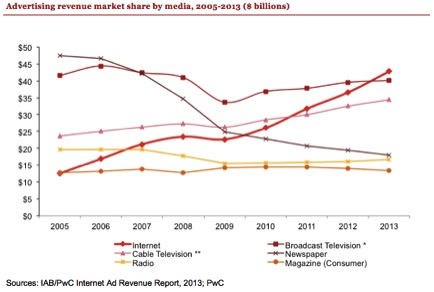
2013 Internet Ad Revenues Soar To $42.8 Billion, Hitting Landmark High & Surpassing Broadcast Television For The First Time
[Philip Lelyveld comment: 10% of internet revenue comes from ads directly related to video content (video ads 7%, rich media interactive ads 3%). This study shows that content creators and distributors are adapting, and not being cut out, of the new reality.]
U.S. interactive advertising revenues for 2013 hit an all-time high of $42.8 billion, according to the IAB Internet Advertising Revenue Report for the full-year, exceeding broadcast television advertising* revenues ($40.1 billion), for the first time ever. This momentous figure marks an increase of 17 percent from 2012’s landmark revenues of $36.6 billion. The report, unveiled today by the Interactive Advertising Bureau (IAB) and prepared by PwC U.S., also reveals that fourth quarter revenues for 2013 came in at $12.1 billion, an increase of 17 percent from the $10.3 billion brought in during the same quarter in 2012. In addition, this total represents an uptick of 14 percent from 2013’s third quarter revenues at $10.6 billion.
 Other highlights include:
- For the third year in a row, mobile achieved triple-digit growth year-over-year, rising to $7.1 billion during full year 2013, a 110 percent boost from the prior year total of $3.4 billion. Mobile accounted for 17 percent of 2013 revenues, whereas it was 9 percent of revenues in 2012.
- Digital video, a component of display-related advertising, brought in $2.8 billion in full year 2013, up 19 percent over revenues of $2.3 billion in 2012. As a result, it also increased its share to become the fourth largest format, directly behind mobile.
- Search revenues totaled $18.4 billion in 2013, up 9 percent from 2012, when search totaled $16.9 billion.
- Display-related advertising revenues in 2013 totaled $12.8 billion or 30 percent of the year’s revenues, a rise of 7 percent over $12 billion in 2012.
- Retail advertisers continue to represent the largest category of internet ad spending, responsible for 21 percent in 2013, followed by financial services and closely trailed by automotive which account for 13 and 12 percent of the year’s revenues respectively.
See the full story here: http://www.iab.net/about_the_iab/recent_press_releases/press_release_archive/press_release/pr-041014
Bitcoin Falls Below The $400 Mark, Down More Than 60% From Its All-Time High
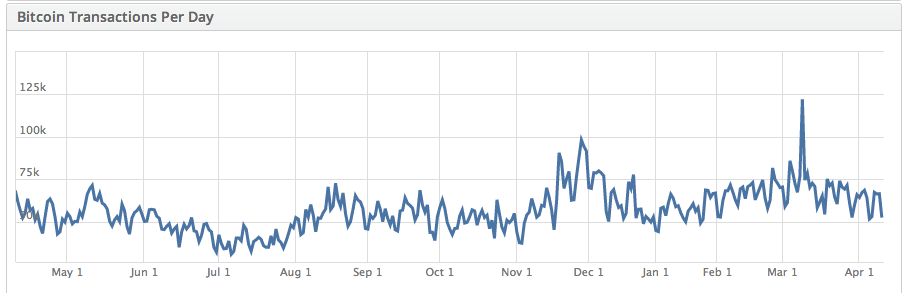

Bitcoin reached another milestone today, with the cryptocurrency falling below the $400 per-coin mark. Bitcoin sold for over $1,100 inside of the last 52 weeks.
The price correction was driven by news from China, as it often has been. Fresh rumors of a government crackdown on the currency in the country, which could blunt demand and adoption, and therefore impair its value, sent the price of bitcoin down a quick 10 percent. It has since continued to slip.
According to Bitcoin Average, the average price of bitcoin is currently around $388, down from a 52-week high of roughly $1,132. Coinbase has the current price of bitcoin at around $394, down from a peak of $1,126.
As we’ve discussed ad nausem, bitcoin’s network is the key to its value. However, it could be that the network’s activity has not grown quickly enough to support declining speculative interest in bitcoin. That’s my best guess, at least.
See the full story here: http://techcrunch.com/2014/04/10/bitcoin-falls-below-the-400-mark-down-more-than-60-from-its-all-time-high/?ncid=tcdaily
NAB: USC’S ELIZABETH DALEY SPEAKS AT TECH SUMMIT ON CINEMA
April 8, 2014
 The ongoing effort to utilize new technologies in the service of storytelling was the theme of USC School of Cinematic Arts (SCA) Dean Elizabeth Daley’s keynote address Sunday at the SMPTE Technology Summit on Cinema at NAB. Digital technology is deeply engrained throughout the SCA curriculum. In fact, the Interactive Media & Games Division and the John C. Hench Division of Animation and Digital Arts wouldn’t exist without it. Yet “everything has changed, and nothing has changed. Great storytelling is still key,” Daley said.
Read the full story here: http://www.etcentric.org/nab-uscs-elizabeth-daley-speaks-at-tech-summit-on-cinema/
CINEMIZER HMD IDEAL FOR ON-SET SHOOTING AND VR EXPERIENCES
April 9, 2014
 In one corner of the Zeiss NAB booth filled with video cameras and lenses, the latest model of the Zeiss Cinemizer head mounted display is plugged into a video camera. The Cinemizer features dual 870×500 pixel OLED displays. An optional soft-rubber Eye Shield blocks out all external light. Once plugged into the camera via a standard HDMI connector, the camera operator sees exactly what the camera sees. The camera controls can be overlain on the image, just as they can appear in the eye piece or screen on the camera itself.
Read the full story here: http://www.etcentric.org/cinemizer-hmd-ideal-for-on-set-shooting-and-vr-experiences/
SPROCKIT STARTUP ENABLES COMPANIES TO LEVERAGE FAN CONTENT
April 9, 2014
 Chute helps clients take the best content created by a brand’s most loyal customers, people who create content that features their brand, and use it in marketing and ad campaigns with the customers’ permission. Chute scours the Web for user generated content of all types — text, photo, music, video — that celebrates a client’s brand. Using both online metrics and human screening, they select the best examples of content: selfies holding a favorite drink, a post about a store experience, a fake commercial for a favorite car, etc.
See the full story here: http://www.etcentric.org/sprockit-startup-enables-companies-to-leverage-fan-content/
FROM THE NAB SPROCKIT STAGE: CREATING WATCH ABC PRODUCT
April 8, 2014
 Ken Williams, executive director and CEO of ETC@USC, moderated a Disney/ABC Television Group panel at NAB called “Creating the Watch ABC Product.” From the SPROCKIT stage Monday in Las Vegas, the panel included Albert Cheng and Skarpi Hedinsson of the Disney/ABC Television Group, Ralf Jacob of upLynk and Doug Knopper of FreeWheel. The discussion focused on content creation, advertising, distribution workflow, technology integration and vendor relationships.
In 2005, Albert Cheng understood that Disney’s primary competitor for content delivered over the Internet was piracy. He, along with Skarpi Hedinsson and the Disney team envisioned a world with multiple platforms, formats, and devices, and worked to develop the content creation and distribution workflow to realize that vision. Early on they decided to integrate the best vendor solutions for the various components of that vision, rather than build them internally. Skarpi understood that technology integration was a complex problem, so he worked to standardize their content file format in order to smooth the workflow process.
See the full story here: http://www.etcentric.org/from-the-nab-sprockit-stage-creating-watch-abc-product/#more-77596