Face electrodes let you taste and chew in virtual reality
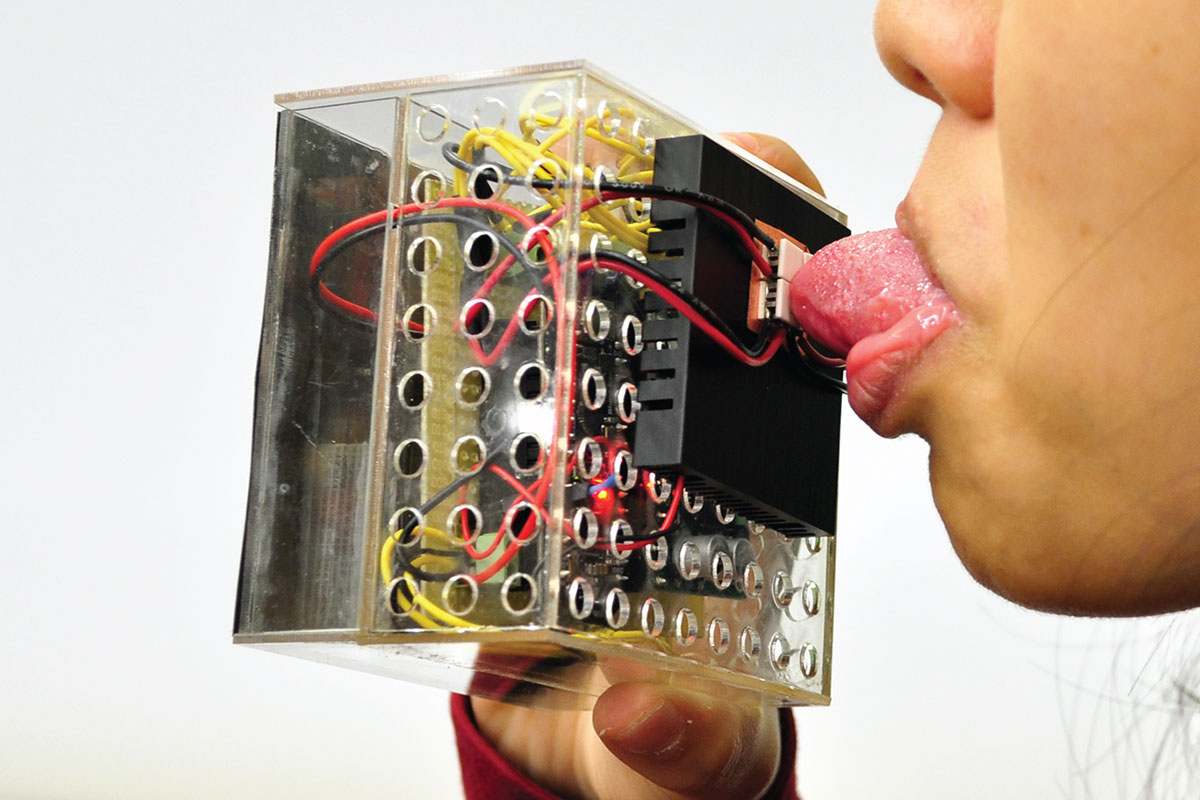 Experiments with “virtual food” use electronics to emulate the taste and feel of the real thing, even when there’s nothing in your mouth. This tech could add new sensory inputs to virtual reality or augment real-world dining experiences, especially for people with restricted diets or health issues that affect their ability to eat.
Several projects have succeeded in tricking us into tasting things that aren’t there. Nimesha Ranasingheat the National University of Singapore has already experimented with a “digital lollipop” to emulate different tastes, and a spoon embedded with electrodes that amplify the salty, sour, or bitter flavour of the real food eaten off it. However, his experiments with electrical stimulation had less success simulating sweetness compared to the other tastes. But digitising this taste could be particularly useful in, for example, helping people cut back on sugary food or drinks.
So Ranasinghe and his colleague Ellen Yi-Luen Do started experimenting with thermal stimulation instead. Their new project, presented at the 2016 ACM User Interface Software and Technology Symposium (UIST) in Tokyo, uses changes in temperature to mimic the sensation of sweetness on the tongue. The user places the tip of their tongue on a square of thermoelectric elements that are rapidly heated or cooled, hijacking thermally sensitive neurons that normally contribute to the sensory code for taste.
In an initial trial, it worked for about half of participants. Some also reported a sensation of spiciness when the device was warmer (around 35 °C) and a minty taste when it was cooler (18 °C). Ranasinghe and Do envisage such a system embedded in a glass or mug to make low-sugar drinks taste sweeter.
This week, a team from the University of Tokyo presented a device that uses electricity to simulate the experience of chewing foods of different textures. Arinobu Niijima and Takefumi Ogawa‘s Electric Food Texture System also uses electrodes, but not on the tongue, instead they place them on the masseter muscle – a muscle in the jaw used for chewing – to give sensations of hardness or chewiness as a user bites down. “There is no food in the mouth, but users feel as if they are chewing some food due to haptic feedback by electrical muscle stimulation,” says Niijima.
Ranasinghe says that a Singapore hospital is planning a long-term study with the electrode-enhanced spoons to try to reduce sodium intake in its elderly patients. Many older people lose their sense of taste and prefer stronger flavours, but adding too much salt can contribute to health problems such as high blood pressure. The spoon acts like electronic seasoning instead.
See the full story here: https://www.newscientist.com/article/2111371-face-electrodes-let-you-taste-and-chew-in-virtual-reality/