This startup’s AR headset can hold its own against the HoloLens
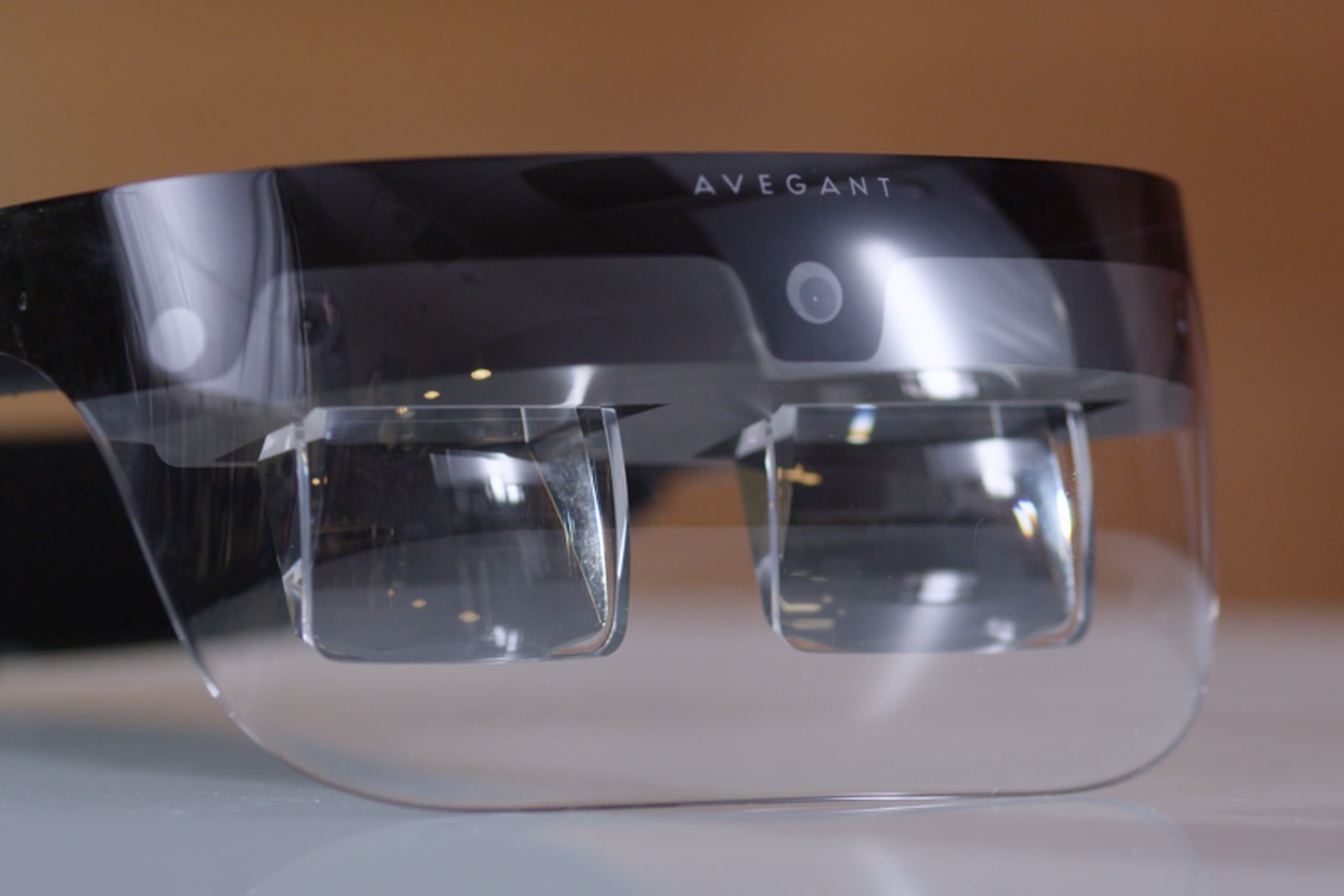 Avegant, a Silicon Valley startup that sells a pair of headphones equipped with a VR-like portable screen, is breaking into augmented reality. The company today announced that it’s developed a new type of headset technology powered by a so-called light field display.
In a demo shown exclusively to The Verge last month, the company’s wired prototype proved to be superior in key ways to the developer version of the HoloLens. Avegant attributes this not to the power of its tethered PC, but to the device’s light field display — a technology Magic Leap also claims to have developed, yet has never been shown off to the public.
Yet with that said, Avegant’s prototype managed to expand the field of view, so you’re looking through a window more the size of a Moleskine notebook instead of a pack of playing cards. The images it produced also felt sharper, richer, and more realistic.
Avegant constructed its demo to show off how these objects could exist at different focal lengths in a fixed environment — in this case a converted conference room at the company's Belmont, California office. So I was able to stand behind the Sun and squint until the star went out of focus in one corner of my vision and a virtual Saturn and its rings became crystal clear in the distance.
The demo also used off-the-shelf cameras to let the headset do positional tracking and understand where objects like tables and chairs were in the room. But Avegant says it ultimately wants to build a headset similar to Microsoft’s that can do inside-out tracking with cameras and sensors built into the device.
What it’s more excited about is its light field display. Light field technology, with regards to AR headsets, works by replicating how the human eye perceives light and then structuring virtual images that can be placed at different, fixed distances in an environment. The human eye can also look at them in the same way as physical objects.
Because these objects are not made of traditional pixels, and instead constructed out of light and essentially blasted onto your retinas, they can behave more organically than 2D VR images being warped to fit a 3D screen, as is the case with the Oculus Rift.
By investing in retinal imaging and mirror-based projection, the company discovered a more ideal way to work with human sight.
But what Avegant and its light field tech prove is that the market for mixed reality is no longer just for the world’s biggest corporations or its most well-funded (and secretive) startups.
Avegant has neither the wealth of expertise and massive head count of Microsoft Research, nor the more than $1.3 billion in funding of Magic Leap. Yet it has nonetheless produced a remarkably capable AR prototype all the same.
See the full story here: http://www.theverge.com/2017/3/9/14869310/avegant-ar-headset-microsoft-hololens-magic-leap-mixed-reality