Magic Leap One Creator’s Edition
 See the full lengthy review here: https://www.cnbc.com/2018/08/08/magic-leap-one-creators-edition-first-look.html
It costs $2,295. That's a lot, but it's not being sold to consumers just yet. Instead, Magic Leap will sell it to people who the company hopes will build more apps and games for the device.
The first edition is targeted at developers who want to make apps for the platform, as well as "creators" like cinematographers who want to learn how to shoot video or create other content for Magic Leap.
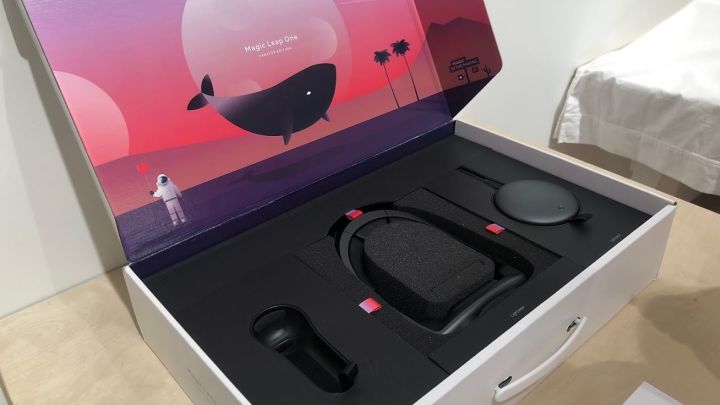
The whole product consists of three main components. There's the Lightwear headset, a pair of computerized goggles that drop over your eyes. The Lightwear is connected to the Lightpack, a puck-shaped computer about the size of a portable CD player, which clips to your pocket. The Lightpack houses a chip from Nvidia and provides power to the headset. Then there's a remote that you hold in one hand that allows you to control the experience with a digital pointer that you can see through the glasses. (The author forgot #4, the battery pack!)
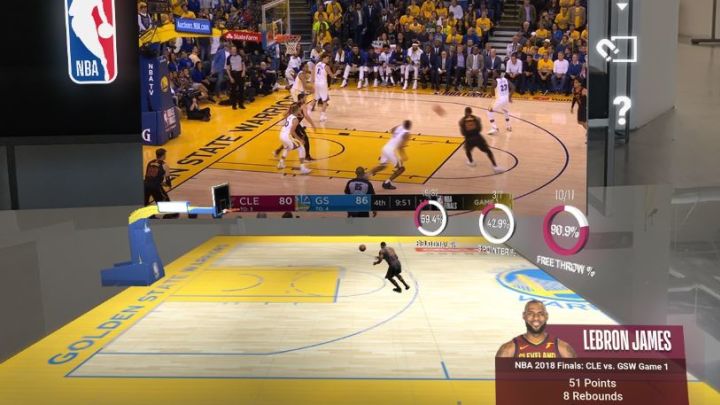
In a beta version of an NBA app, I was able to put a video clip of LeBron James on a wall in the room and then see a 3-D rendering on the floor of LeBron's scoring play in slow motion.
The video of the basketball game was good enough that, if it were live, I'd have no issue watching the full game wearing the headset. The 3-D rendering on the floor didn't look real, but more like renderings you'd see in a modern game console.
The text on it was sharp enough to understand and read. The experience didn't hurt my eyes or give me a headache in the brief time I spent with it, either.
The Magic Leap One doesn't work if there's too much or too little light in the surrounding environment, but it should be fine in most indoor settings. There's also a field-of-vision issue. The Magic Leap One is sort of like looking through a window within your field of view.
I knew the experiences weren't real, but it was unlike anything I've experienced before. None of the demos fooled me into thinking these images were really in front of me, but there was something calming about sharp, clearly rendered jellyfish swimming around me. And I loved the idea of being able to place a digital TV screen anywhere I wanted.
The "magic" component of the Magic Leap One is the "photonics chip," which is manufactured in a factory that I toured below Magic Leap's offices. In an interview, Abovitz told me the company can already build millions of the components that are required for the Magic Leap to work.
He said that the technology is different from other augmented reality devices because it projects light directly into the user's eye.
When I took the goggles off, I could see a small rectangular area superimposed on each lens. It seems that Magic Leap is displaying the images within these rectangular areas, and the light from those images was traveling into my eyes when I put the headset on. It's not clear how this is technically different from looking at a computer monitor or phone screen, both of which generate light that travels into the viewer's eyes.
But whatever Magic Leap has done, the experience with the goggles on was like a computer-generated 3-D world with real depth. For instance, a fish can appear to swim from behind you, up past you, and into the distance. That wouldn't be nearly as realistic on a regular screen.
The processing for rendering the graphics is done by an Nvdia Tegra X1 chip included in the Lightpack that clips to your pocket. The Lightwear headset includes cameras that can scan the room around you, which tells the computer how big the room is and where virtual objects can be placed. Lightwear also includes eye-tracking technology, so it knows where you're looking.
Abovitz said people around the world might be worried about artificial intelligence replacing their jobs, but that Magic Leap can help keep those jobs intact.
"That's the most important theme we are bringing in," he said. "When you have a human working with AI, they always beat the AI. That's super powerful."
He cited his previous start-up, Mako, which made robotic arms to help doctors perform surgery. "That was my combo at Mako — robotics and a surgeon. We can make people into superheroes. They have heightened sensing, intelligence and can see and do things better. Whether that's an athlete or a business person."
Abovitz also said that intelligent assistants will play a big role in Magic Leap's future. I didn't get to test one, but Abovitz says he's working with a team in Los Angeles that's developing high-definition people that will appear to Magic Leap users and assist with tasks.
Finally, there's a whole world of entertainment that Abovitz imagines can take advantage of spatial computing....Abovitz calls this "volumetric cinematography." He has an entire team at Magic Leap dedicated to building these experiences while working with potential partners in TV and movies.
The technology still needs to change on the other end, however. Instead of filming for the TV, producers and movie studios will need to think about how to film for Magic Leap. That will be a tough sell for a company that still doesn't have a customer base.
Yet, after using it, I'm pretty convinced this is where computing is going.