‘Knitting Is Coding’ and Yarn Is Programmable in This Physics Lab
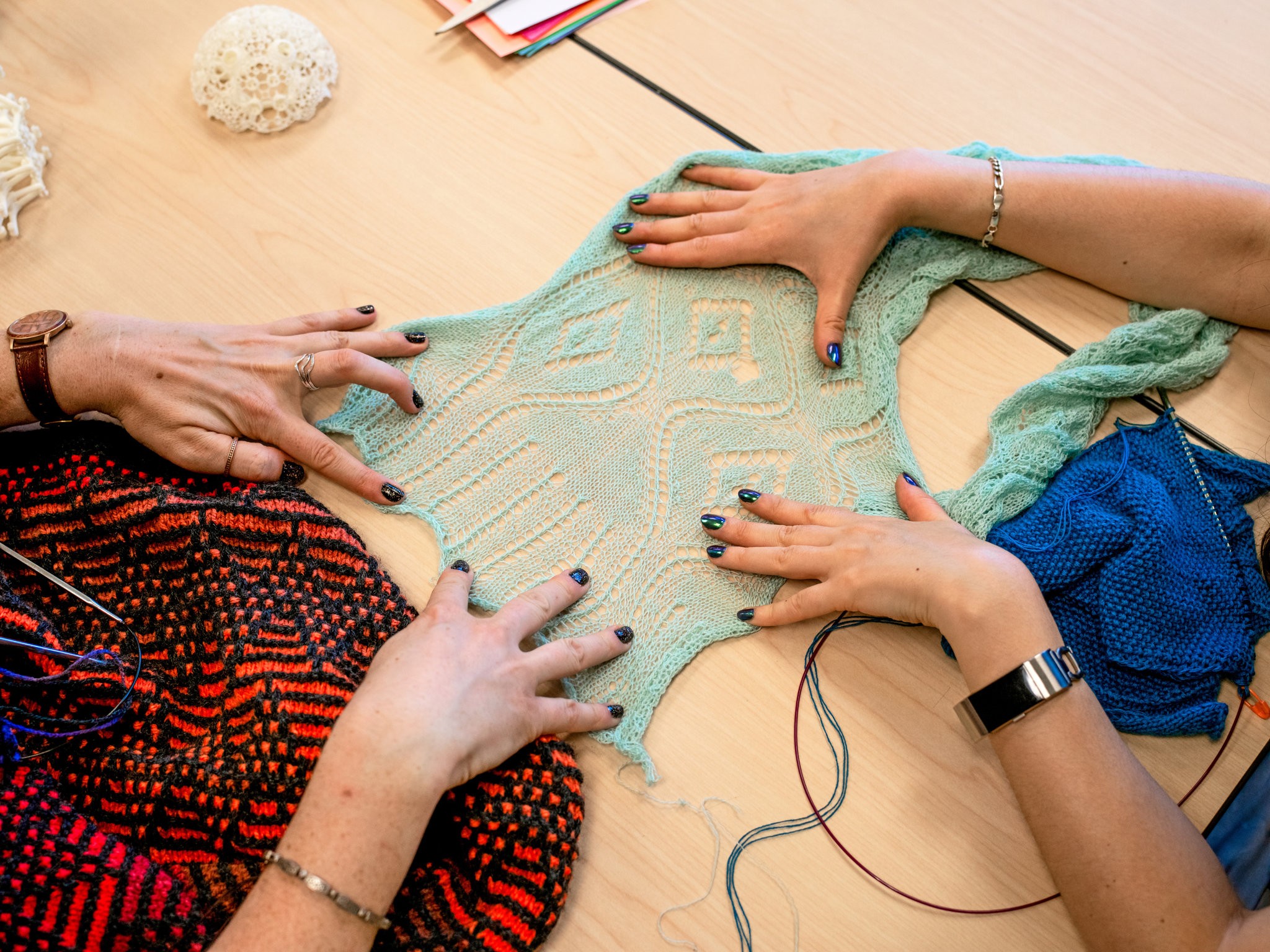 For Dr. Matsumoto, knitting is more than a handicraft hobby with health benefits. She is embarking on a five-year project, “What a Tangled Web We Weave,” funded by the National Science Foundation, to investigate the mathematics and mechanics of “the ancient technology known as knitting.”
Some of the oldest examples date to the 11th century B.C.E. in Egypt. But despite generations of practical and experiential knowledge, the physical and mathematical properties of knitted fabric rarely are studied in a way that produces predictive models about how such fabrics behave.
Dr. Matsumoto argues that “knitting is coding” and that yarn is a programmable material. The potential dividends of her research range from wearable electronics to tissue scaffolding.
During the happy-hour meetup, she knitted a swatch illustrating a plastic surgery technique called Z-plasty. The swatch was for a talk she would deliver at 8 a.m. on Wednesday morning called “Twisted Topological Tangles.” Scores of physicists turned up, despite a competing parallel session on “The Extreme Mechanics of Balloons.”
Knitted fabric is also a metamaterial. A length of yarn is all but inelastic, but when configured in slipknots — in patterns of knits and purls — varying degrees of elasticity emerge.
“Just based on these two stitches, these two fundamental units, we can make a whole series of fabrics, and each of these fabrics has remarkably different elastic properties,” Dr. Matsumoto told the audience.
See the full story here: https://www.nytimes.com/2019/05/17/science/math-physics-knitting-matsumoto.html