Better than reality: NASA scientists tap virtual reality to make a scientific discovery
Using a customized, 3D virtual reality (VR) simulation that animated the speed and direction of 4 million stars in the local Milky Way neighborhood, astronomer Marc Kuchner and researcher Susan Higashio obtained a new perspective on the stars’ motions, improving our understanding of star groupings.
Astronomers have come to different conclusions about the same groups of stars from studying them in six dimensions using paper graphs, Higashio said. Groups of stars moving together indicate to astronomers that they originated at the same time and place, from the same cosmic event, which can help us understand how our galaxy evolved.
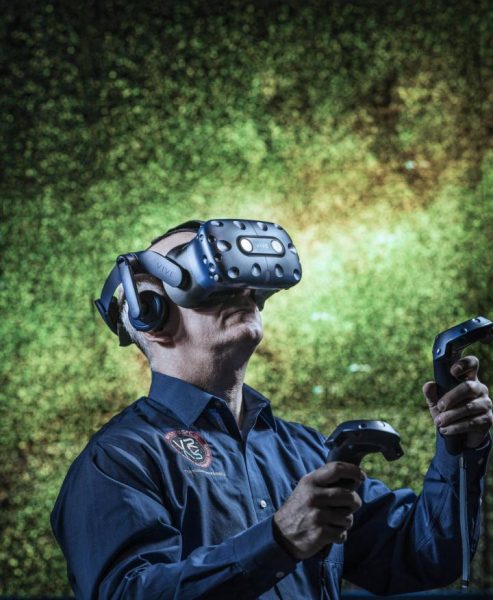
Goddard’s virtual reality team, managed by Thomas Grubb, animated those same stars, revolutionizing the classification process and making the groupings easier to see, Higashio said. They found stars that may have been classified into the wrong groups as well as star groups that could belong to larger groupings.
REALIZING A VISION
The discovery realized a vision for Goddard Chief Technologist Peter Hughes, who saw the potential of VR to aid in scientific discovery when he began funding engineer Thomas Grubb’s VR project more than three years ago under the center’s Internal Research and Development (IRAD) program and NASA’s Center Innovation Fund [CuttingEdge, Summer 2017]. “All of our technologies enable the scientific exploration of our universe in some way,” Hughes said. “For us, scientific discovery is one of the most compelling reason to develop an AR/VR capability.”
See the full story here: https://www.advancedsciencenews.com/better-than-reality-nasa-scientists-tap-virtual-reality-to-make-a-scientific-discovery/