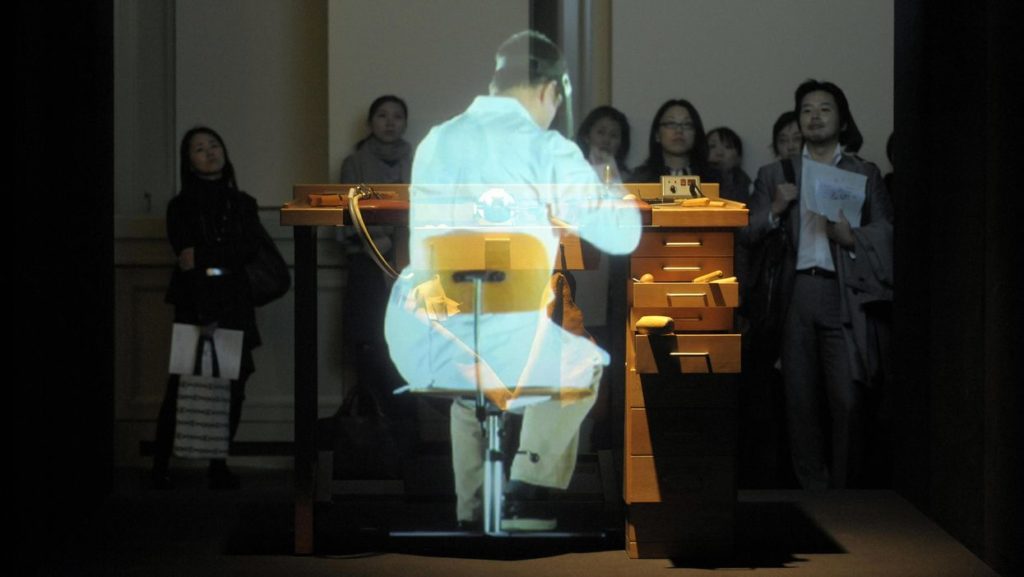
MIT artificial intelligence tech can generate 3D holograms in real-time
Now, MIT researchers have developed a new way to produce holograms almost instantly — and the deep learning-based method is so efficient that it can run on a laptop in the blink of an eye, the researchers say.
Shi believes the new approach, which the team calls "tensor holography," will finally bring that elusive 10-year goal within reach.
...a hologram encodes both the brightness and phase of each light wave. That combination delivers a truer depiction of a scene's parallax and depth.
...
Shi's team took a different approach: letting the computer teach physics to itself.
They used deep learning to accelerate computer-generated holography, allowing for real-time hologram generation. The team designed a convolutional neural network — a processing technique that uses a chain of trainable tensors to roughly mimic how humans process visual information.
In mere milliseconds, tensor holography can craft holograms from images with depth information — which is provided by typical computer-generated images and can be calculated from a multicamera setup or LiDAR sensor (both are standard on some new smartphones).
This advance paves the way for real-time 3D holography. What's more, the compact tensor network requires less than 1 MB of memory. "It's negligible, considering the tens and hundreds of gigabytes available on the latest cell phone," he says.
The research "shows that true 3D holographic displays are practical with only moderate computational requirements," says Joel Kollin, a principal optical architect at Microsoft who was not involved with the research.
Currently, most affordable consumer-grade displays modulate only brightness, though the cost of phase-modulating displays would fall if widely adopted.
The work was supported, in part, by Sony.
See the full story here: https://bigthink.com/technology-innovation/3d-holograms