Step into the Cube: Virginia Tech’s giant virtual reality room
An interdisciplinary research project is keeping VR weird
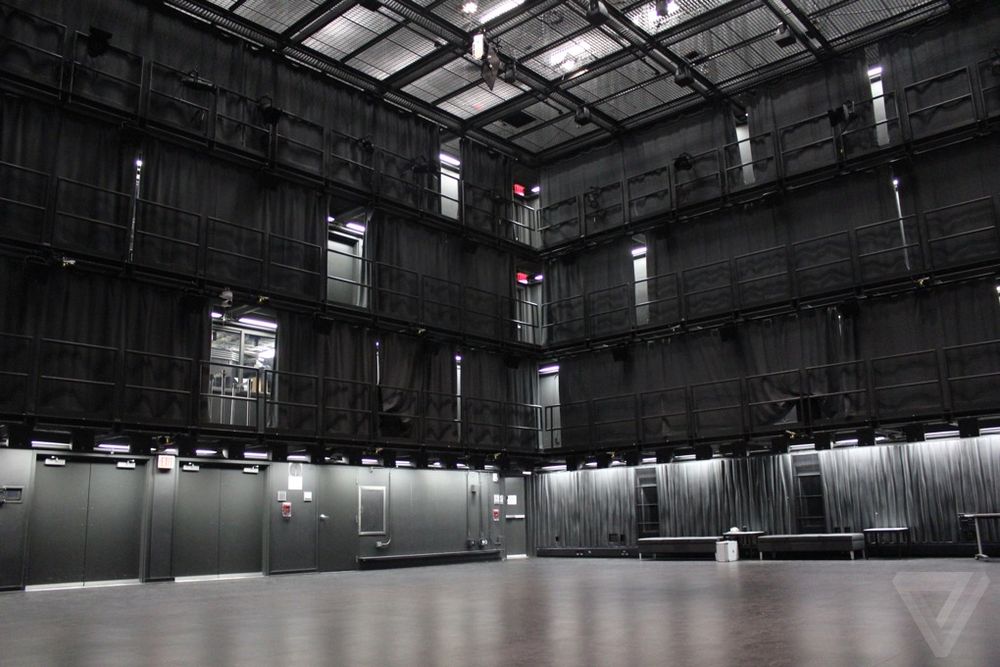 A 50 x 40-foot box isn’t even big enough to fit the scoreboard in Virginia Tech’s Lane Stadium. But for me, the room looks like the giant venue, full of 60,000 spectators in the midst of evacuating. The audience is represented by tiny boxes, torrents of them streaming through a simple replica of one wing, mixing and jostling each other as they pass. If I walk slowly, I can match their pace. A little faster, and my speed multiplies, until walking briskly in the Cube shoots me through the stadium and straight into empty blue space.
Originally built as a black-box theater, the Cube is shared between ICAT and Virginia Tech’s Center for the Arts, used for both art projects and scientific research. This doesn’t necessarily have to involve VR; in 2013, the Cube theater hosted a live performance called Operacraft, where K-12 students used Minecraftavatars — projected onto a wall — to perform an opera sung by Virginia Tech musicians.
One of the Cube’s biggest selling points is its sound system, which creates deafening 360-degree audio with 124 standard speakers, four subwoofers, and nine additional speakers that project hyper-targeted sound, like the aural equivalent of a spotlight. It’s possible to create things that could never be replicated with an ordinary sound system, like an experimental composition by ICAT media engineer Tanner Upthegrove that sends metal and chainsaws whirling around the room and wouldn’t feel out of place in Hellraiser. Close your eyes in another demo — a recording from inside a tornado — and you can almost feel the tremors as wind rips away nails and wood.
See the full story, and a 5 minute movie, here: http://www.theverge.com/2015/3/13/8204193/virginia-tech-icat-vr-research-oculus-rift